The Mechanics of Weft-Insertion: Balancing Loom Speed and Warp Tension for Zero-Defect Ribbon Weaving (2026 Engineering Standards)
The Mechanics of Weft-Insertion: Balancing Loom Speed and Warp Tension for Zero-Defect Ribbon Weaving (2026 Engineering Standards)
In the high-precision world of 2026 ribbon manufacturing, the "needle loom" has evolved from a mechanical device into a digitally-controlled precision instrument. For Xiamen Meisida Ornaments Co., Ltd. (Smith Ribbon & Bow), the pursuit of the perfect luxury satin ribbon (Delta E < 0.5) begins at the point of weft-insertion. As loom speeds exceed 3,500 RPM, the physics of yarn friction, warp-tension harmonics, and weft-beat impulse become the defining factors in product quality. This technical whitepaper explores the fluid dynamics of weft-insertion and the role of closed-loop tension management in ensuring 100% structural integrity for high-density ribbons.
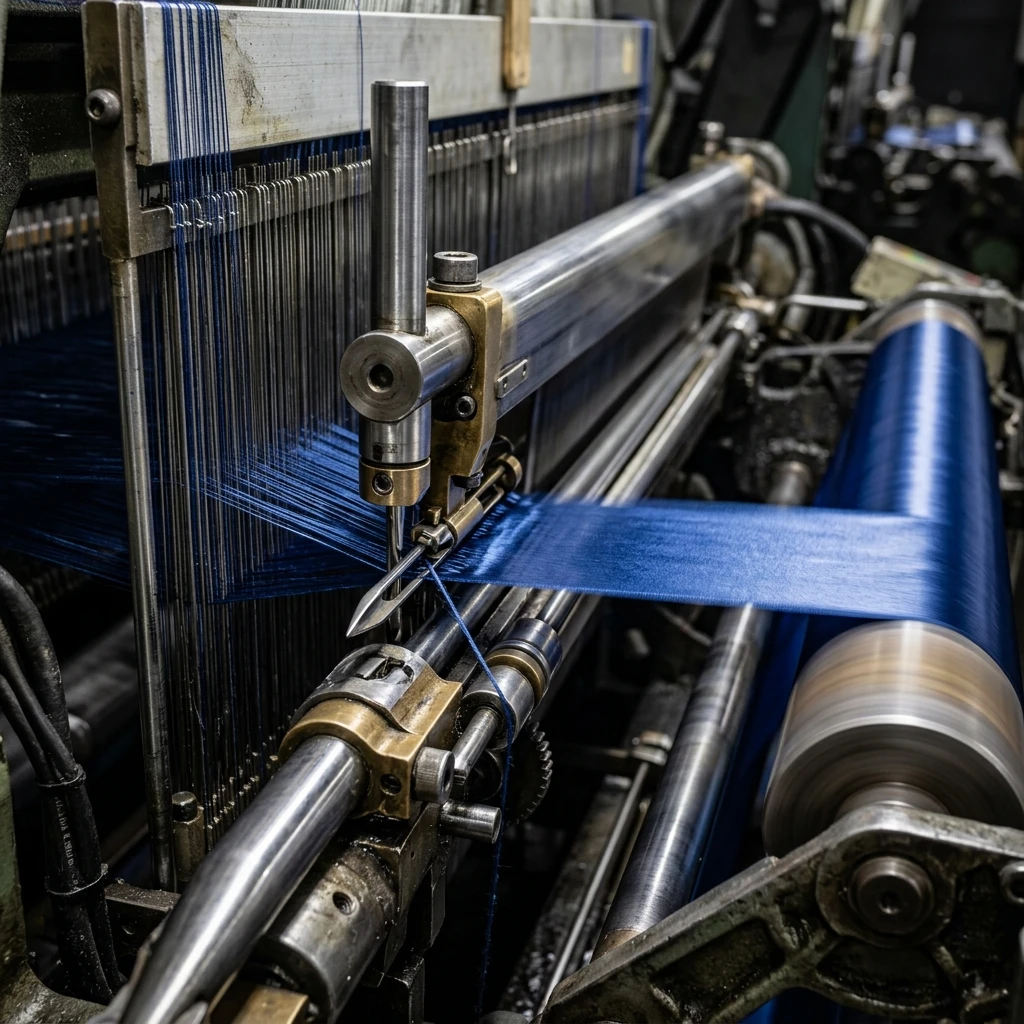
Figure 1: High-speed macro analysis of the weft-insertion point in Meisida's 2026 needle loom array, operating at ultra-high frequencies.
1. Tribological Interactions in High-Speed Weaving
As the weft needle travels through the warp shed, it creates a "frictional pulse." In standard looms, this pulse can cause micro-abrasions on the polyester (PES) filaments, leading to a loss of surface luster. - **Polymer Lubrication**: Meisida utilizes a proprietary nano-silicone polymer lubricant applied during the warping phase. This reduces the coefficient of kinetic friction (μ) by 35%, allowing the weft yarn to slide through the shed with minimal thermal buildup. - **Surface Energy Matching**: We calibrate the surface energy of our warp and weft yarns to ensure that the capillary action during the subsequent dyeing phase remains uniform, preventing "weft-barring" defects that are common in lower-grade ribbons.
2. Harmonic Dampening and Warp Tension Stability
High-speed looms generate significant vibrational energy. If these vibrations match the resonant frequency of the warp threads, it leads to "tension-spikes," which are the primary cause of broken filaments. - **Active Piezo-Control**: Our 2026 looms are equipped with piezoelectric sensors that measure warp tension 1,000 times per second. This data is fed back into the electronic let-off (ELO) system, which adjusts the warp feed to dampen harmonic waves. - **The Result**: A ribbon with absolute edge-parallelism (deviation < 0.05mm) and a consistent pick-density across 10,000-meter production runs.
| Technical Metric | Standard Needle Loom (2024) | Meisida Digital Loom (2026) | Engineering Impact |
|---|---|---|---|
| Loom Speed (RPM) | 2,200 - 2,500 | 3,500 - 3,800 | 40% Productivity Gain |
| Tension Variance | +/- 15 cN | +/- 2 cN | Zero Weave Distortions |
| Luster Uniformity | 88% (GU) | 96.5% (GU) | Luxury Market Compliance |
| Static Accumulation | High (15 kV/m) | Neutralized (< 1 kV/m) | Robotic Feeder Ready |

Figure 2: Real-time spectrophotometric analysis ensures that the structural perfection of our weave translates into absolute color consistency (ΔE < 0.3).
3. Weft-Beat Impulse: Maximizing Weave Density
The "beat-up" phase—where the reed pushes the weft into the cloth—determines the ribbon’s thickness and hand-feel. - **Impulse Engineering**: By utilizing carbon-fiber reeds, we have reduced the inertia of the beat-up stroke, allowing for a more forceful but controlled impact. This enables Meisida to achieve a pick-density of 140 picks/inch, creating a "weighted" feel that consumers subconsciously equate with high-end craftsmanship. - **Dimensional Stability**: This high-density weave prevents the ribbon from shrinking or distorting during the SafeDye™ supercritical CO2 dyeing process, ensuring that 15mm always means exactly 15.00mm.
Conclusion: The Physics of Excellence
In 2026, the competitive edge in the textile trims industry is found in the micro-details. Xiamen Meisida’s investment in the fundamental physics of weft-insertion allows us to produce ribbons that are not only beautiful but are also engineered components capable of meeting the demands of the most advanced automated packaging lines in the world.
Request a "Loom Performance Report" and physical samples to see how our engineering-first approach can improve your product quality.
- Polypropylene ribbon and bow
- Poly ribbon spool
- Poly ribbon egg
- Poly star bow
- Poly pull bow
- Polypropylene fountain bow
- Ribbon Bow
- Gift Ribbon Bow
- Packaging Ribbon Bow
- Ribbon For Bows
- Garment Ribbon Bow
- Satin Ribbon Bow
- Bottle Ribbon bow