How Do I Know If a Ribbon Supplier Is a Factory or a Trading Company — 5 Ways to Check Before You Order
How Do I Know If a Ribbon Supplier Is a Factory or a Trading Company — 5 Ways to Check Before You Order
The distinction between a ribbon manufacturer and a ribbon trading company matters more than most first-time B2B buyers expect. On Alibaba or at a trade fair, both present as "ribbon suppliers," both have product photos, both quote prices, and both say they manufacture. The operational differences emerge later: in documentation capabilities, response to custom specifications, lead time reliability, and the ability to provide production-level quality records.
These five methods work reliably across different communication channels and do not require a factory visit to execute.
Method 1: Request the Business License and Read the Enterprise Type
Every registered Chinese company has a business license (营业执照). Ask for it directly — any legitimate supplier will provide it within 24 hours. The key field is enterprise type (企业类型) and business scope (经营范围).
A manufacturer's business scope includes production-related language: 生产 (production), 加工 (processing), 制造 (manufacturing). The address listed on the license corresponds to a production facility. A trading company's scope typically reads 销售 (sales), 贸易 (trade), 批发 (wholesale) — without production language.
Some companies register as both manufacturer and trader. In that case, ask to see the production facility's separate registration, or ask which facility produces the specific ribbon you are ordering.
Method 2: Ask for Process-Specific Production Photos
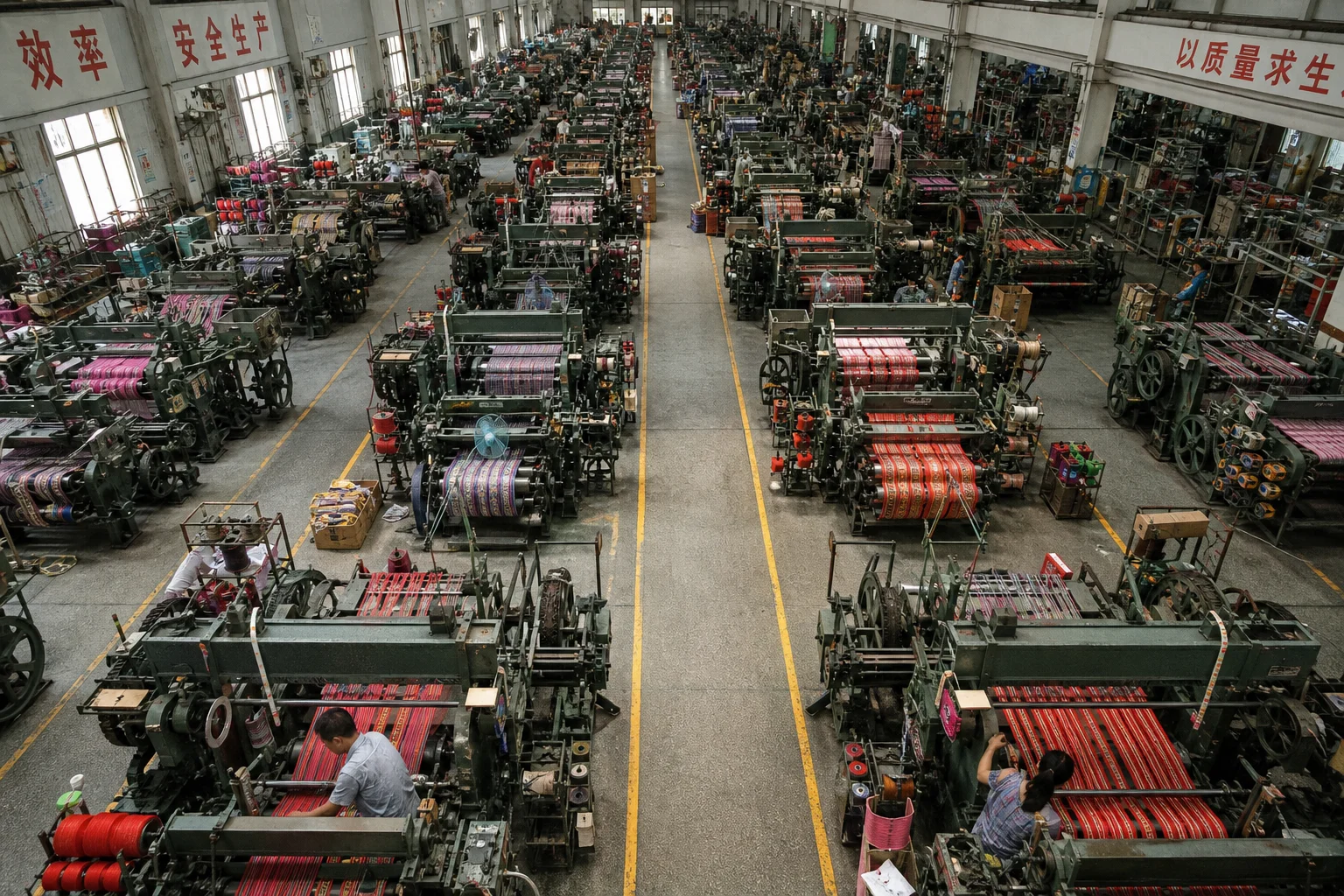
Request photos of the ribbon loom setup running your specific width. Not showroom photos — photos of active looms running ribbon at the width you are ordering, showing the reed, the warp beam, and rolls forming at the output end.
A factory provides these within a day because they exist on the production floor. Trading companies typically have generic stock photos or take longer because they have to request them from a third-party manufacturer. Follow up with: "Can you show me the loom running 38mm satin specifically?" Delayed or evasive responses are a clear signal.
Method 3: Probe the MOQ Structure
Ask about minimum order quantities per color and per specification. Factories have MOQs determined by production economics — minimum run lengths based on loom setup time, dye batch minimums, and heat-setting line capacity. A typical ribbon factory MOQ for a custom color is 300–1,000 meters per color, and the supplier can explain the production logic behind it.
Trading companies have more flexible MOQs because they aggregate orders across buyers to reach factory minimums, or pull from spot inventory. They may quote lower minimums but cannot explain the production logic because they do not control manufacturing.
Method 4: Test Lead Time Logic
Ask two questions: "What is the lead time for a standard color?" and "What is the lead time for a custom color we have not ordered before?"

For a factory, standard colors are typically 15–25 business days (production plus finishing). Custom colors requiring new dye formulation are 25–35 business days — longer because the dyeing batch must be developed and tested before production. The custom lead time is longer than standard, and the factory can explain the difference in terms of dye development time.
For trading companies, standard color lead time is often shorter — 7–15 days — because they are pulling from ready stock or spot inventory. But custom color lead time is much longer, often 30–45 days, because they are queuing through a manufacturer they do not directly schedule. If a supplier quotes similar lead times for standard and custom colors, or if the custom lead time is surprisingly short, ask how they manage dye development for new colors. A factory has a process for this; a trader without a clear answer is relying on someone else's process.
Method 5: Ask Production-Specific Technical Questions
The most efficient single method is a direct technical question that only a manufacturer can answer specifically. Choose one or two from this list:
"What heat-setting temperature and dwell time do you use for 100% polyester satin ribbon?"
"What loom reed count do you use for 38mm satin?"
"If I find a width deviation on incoming inspection — say, 37.2mm on a roll ordered as 38mm — can you provide the production run's width inspection log for that roll?"
"What is your dye lot numbering system, and can you guarantee color matching on a reorder placed 6 months after the original?"
A factory answers these specifically and immediately. A trading company either provides vague or generic answers ("our quality is very good"), says they need to "check with production," or gives an answer that doesn't match standard manufacturing practice. The pattern of the response — not just a single answer — is what you are evaluating.
Frequently Asked Questions
How can I tell if a ribbon supplier is a factory or a trading company?
Five reliable methods: check the business license enterprise type for production language, request loom photos specific to your width, probe MOQ structure for production logic, test lead time reasoning for standard vs custom colors, and ask technical questions about heat-setting and dye lot documentation. Factories answer specifically; traders hesitate or defer to "production team."
Is it always better to buy directly from a factory?
Not always. For small orders, trading companies can aggregate volumes and stock ready inventory. For large recurring orders with custom specs or certification requirements (GRS, OEKO-TEX), a direct factory relationship gives you documentation access and production control that traders cannot provide.
What documents can only a ribbon factory provide?
Loom calibration records, heat-setting temperature logs, batch-level width inspection reports, dye lot numbers with production dates, and factory-scope certificates for GRS or OEKO-TEX. Trading companies can issue transaction certificates but cannot provide production-level documentation.
How do I verify a Chinese supplier's factory status?
Request the business license, check the enterprise type and business scope for production language (生产, 加工, 制造). Cross-check the registered address against production photos. Request an SGS or Bureau Veritas factory audit report, or arrange a video walkthrough of the production floor during business hours.
What questions distinguish a ribbon factory from a trading company?
Ask about loom setup for your specific width, heat-setting temperature for polyester, MOQ per dye lot for custom colors, and whether they can provide width inspection records from a recent production run. Factories answer these specifically; traders hesitate or say they need to "check with their production team."