How Ribbon Manufacturers Control Width Consistency Across Large Orders — What Buyers Should Know About Production Tolerances
How Ribbon Manufacturers Control Width Consistency Across Large Orders — What Buyers Should Know About Production Tolerances
When a buyer orders 10,000 meters of 38mm satin ribbon and the first roll measures 37.2mm, the third measures 38.8mm, and the last measures 37.9mm — that is not a quality problem in the dramatic sense. Nothing is broken. But if the buyer runs those rolls through an automated bow-tying machine calibrated for 38mm feed guides, every deviation jams the machine, slows the line, and adds cost that was not in the original calculation.
Width consistency is one of the ribbon quality dimensions that most buyers do not check until they have a problem. This guide explains how it is controlled in production, what the practical thresholds mean for different packaging applications, and what to ask a supplier before placing a large order.
Where Width Variation Comes From
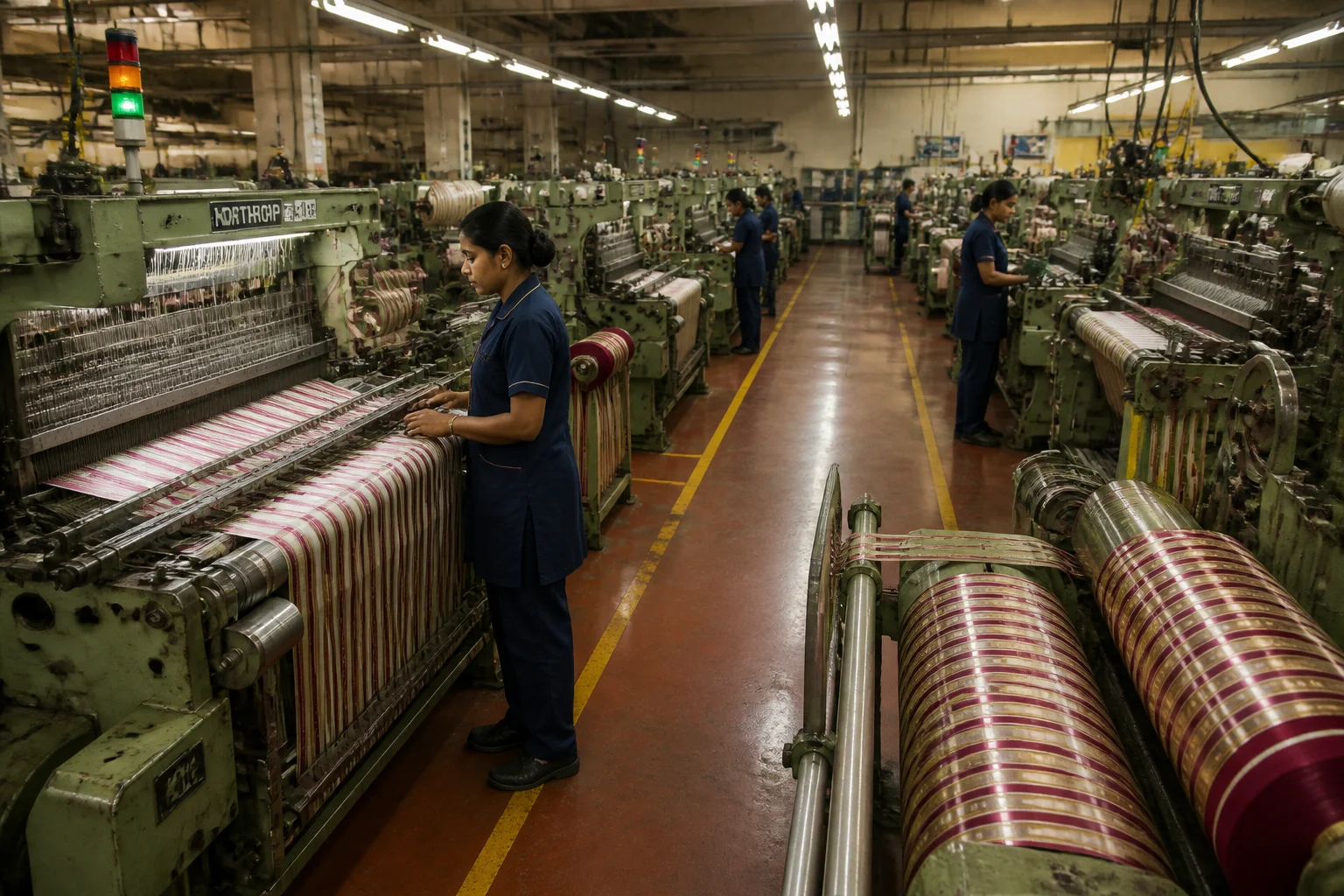
Ribbon width is set at the loom by the reed — the comb-like device that spaces the warp threads. Three variables cause delivered width to drift from the specified target.
Warp tension drift. As a run progresses, tension decreases as the supply beam pays out yarn. Lower tension means warp threads spread slightly, producing ribbon that runs wider toward the end of a beam. On looms without automatic tension compensation, this drift is controlled by operator adjustment — meaning it is controlled by attention, not a documented standard.
Heat-setting variation. After weaving, ribbon passes through a heat-setting zone. If the temperature is too low or varies between runs, width changes between factory measurement and the customer's incoming inspection.
Loom-to-loom calibration differences. In factories running multiple looms, each loom has its own reed and tension profile. Without regular cross-loom calibration, the same width specification produces different actual widths on different looms. Buyers receiving rolls from multiple looms in one shipment will see roll-to-roll variation even within a single order.
What "Standard Tolerance" Actually Means
The published industry tolerance for woven polyester ribbon is ±1mm for widths up to 50mm, and ±1.5mm for widths above 50mm. A 38mm ribbon at ±1mm tolerance should deliver between 37mm and 39mm across the full batch.
This sounds tight, but it depends entirely on whether the supplier is measuring and documenting. The ±1mm figure is achievable by any manufacturer with calibrated looms and consistent heat-setting. It is not achievable by manufacturers running uncalibrated equipment or skipping post-weave measurement.
For automated packaging operations, the practical threshold is tighter. Most ribbon feed guides have 2–3mm of clearance above the nominal ribbon width. A ribbon that runs at the top of ±1mm tolerance (38mm + 1mm = 39mm) in a guide set for 38mm + 2mm clearance has only 1mm of remaining clearance before it starts binding. On a high-speed line, that 1mm difference between a smooth feed and a jam is commercially significant.
Manufacturers who document ±0.5mm tolerance — achievable with automatic tension control and temperature-controlled heat-setting — provide meaningful headroom for automated operations.
How to Evaluate a Supplier's Consistency Before Ordering
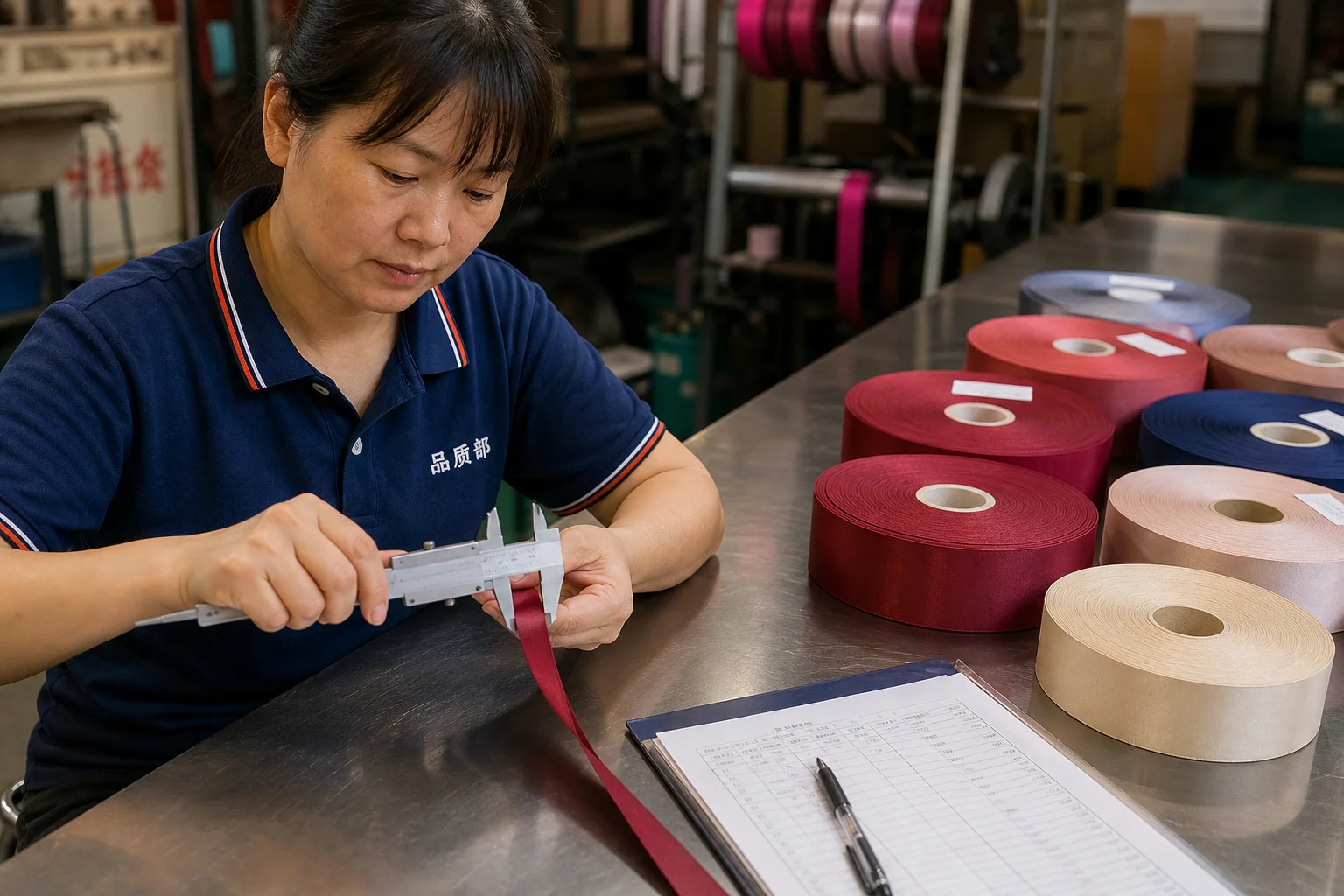
The most reliable method is to request production samples from multiple production runs — not a single sample roll. Ask for three 1-meter samples from three different production runs of the same specification. Measure each sample at three points along its length and three points across its width (9 measurements per sample, 27 total). A supplier with consistent production should show a range of 1mm or less. A range above 2mm indicates systematic width control issues.
Beyond samples, ask for:
Loom calibration records showing tension settings and calibration dates per loom per width specification
Heat-setting logs showing temperature and duration per run
Outgoing inspection records showing measured width per production run
Suppliers who can provide these documents have structured quality control. Suppliers who cannot are relying on worker experience without documented standards — which produces inconsistent results as operators change, machines age, and production pressure increases.
Incoming Inspection Protocol for Large Orders
When receiving a large ribbon order (500+ meters per color), sample at least 5% of rolls, or a minimum of 3 rolls per color. Select rolls from the beginning, middle, and end of each carton to detect batch drift. Measure width at the first 10 meters and last 10 meters of each sampled roll — these are the positions most likely to show deviation if warp tension drifted during the run.
Record measurements against the purchase order specification. Reject any roll that falls outside ±1mm of the specified width, document with caliper photographs, and share with the supplier for replacement or credit. This protocol adds roughly 20 minutes per color to incoming inspection — less than the cost of a single machine jam from out-of-spec ribbon on an automated packaging line.
Frequently Asked Questions
What is the standard width tolerance for polyester ribbon?
Industry standard is ±1mm for widths up to 50mm, ±1.5mm above 50mm. Manufacturers with calibrated tension control and heat-setting equipment achieve ±0.5mm — important for automated packaging lines with tight feed guides.
Why does ribbon width vary between orders from the same supplier?
The three main causes are warp tension drift during a production run, heat-setting temperature inconsistency, and loom-to-loom calibration differences. Suppliers with documented tension logs and calibration records per loom can identify and correct these issues systematically.
How do I check ribbon width consistency when receiving a large order?
Sample 3+ rolls from different batch positions. From each roll, cut samples at the start, middle, and end, and measure at three points across the width. If any roll's average deviates more than 1mm from specified width, reject and request replacement.
What causes ribbon to curl after cutting?
Post-cut curl is caused by residual tension locked in during winding, released when cut. The root cause is insufficient heat-setting. Specify "no-curl" or "fully heat-set" in your purchase order and confirm the supplier's heat-setting process before ordering.
What production documentation should I request from a ribbon supplier?
Request loom calibration records, heat-setting temperature logs, and outgoing width inspection records per production run. Suppliers who can provide these have structured quality control; suppliers who cannot are relying on unverifiable worker experience.