What Is the Difference Between Wired and Unwired Ribbon — and Which Should You Order?
What Is the Difference Between Wired and Unwired Ribbon — and Which Should You Order?
Wired ribbon and unwired ribbon look nearly identical on the roll. Same fabric, same colours, same widths. But they behave entirely differently when you use them — and ordering the wrong one for a specific application creates problems that cannot be fixed after the fact. This guide explains the structural difference, how it affects practical use, and how to match the right type to your packaging requirements.
What Makes a Ribbon Wired
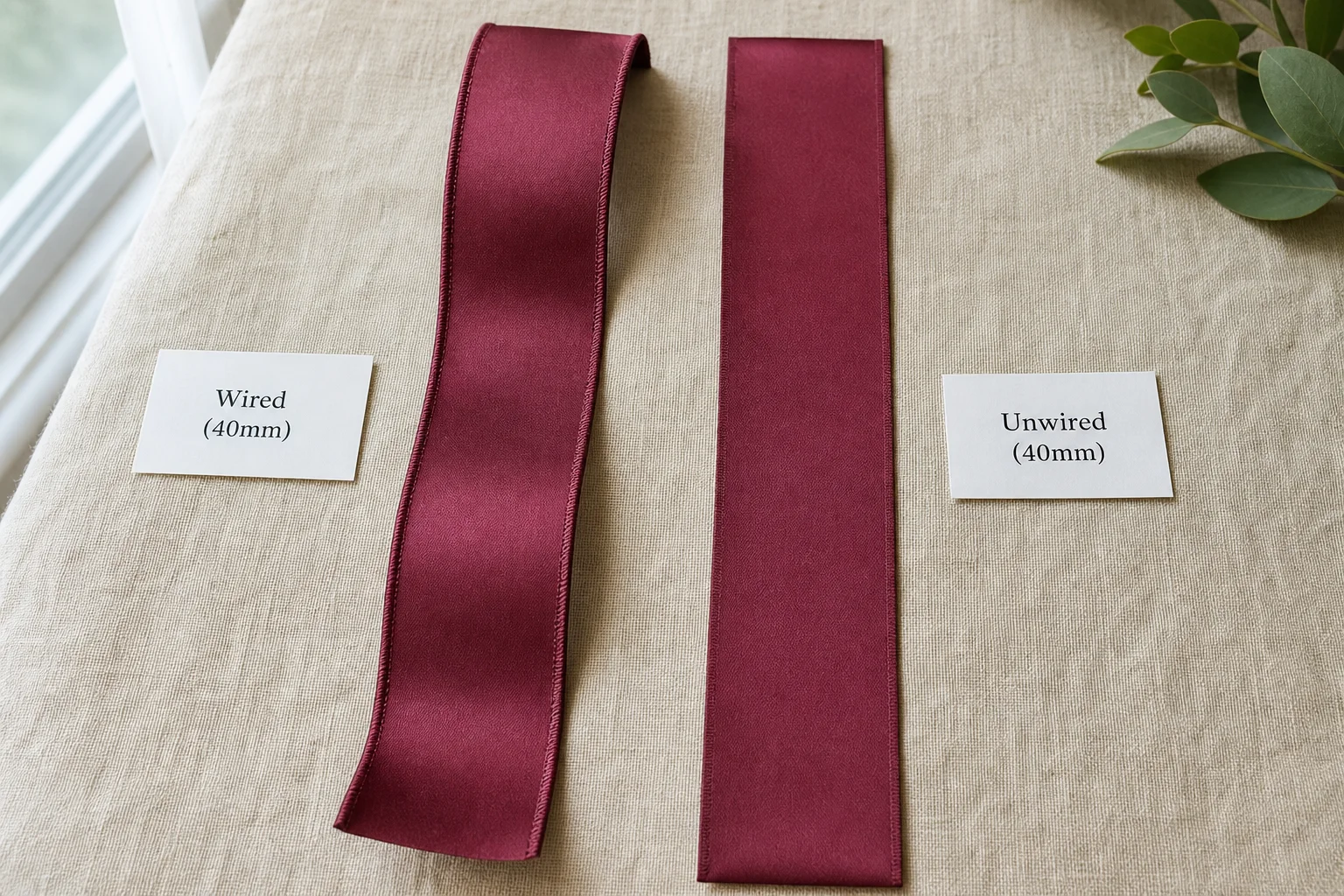
A wired ribbon has a fine, flexible metallic wire woven into both selvedge edges during production. The wire — typically 26–32 gauge copper or aluminium — runs along each edge, locked into the weave by the selvedge weft threads. It is not glued, stitched, or inserted after weaving: it is part of the fabric structure from the moment the ribbon is made.
The result is a ribbon that holds its shape when bent or folded. Pull the ribbon into a curve and it stays curved. Crimp the edge and it stays crimped. Form a loop and it holds the loop without internal support. This property — shape retention — is the entire point of the wired construction. Unwired ribbon has none of it: it drapes and falls according to its own weight and the surface it contacts.
When to Order Wired Ribbon
The applications where wired ribbon genuinely outperforms unwired are specific:
Multi-loop bows for display: A properly tied wired ribbon bow holds its loops open and maintains its three-dimensional shape under display conditions — retail shelving, trade show displays, point-of-sale decoration. The same bow in unwired ribbon collapses under its own weight within hours unless it is wired or structured internally with additional materials.
Floral and seasonal decoration: Wired ribbon is standard in wreath-making, floral arranging, and seasonal window display because it can be shaped around forms, bent into curves, and adjusted without losing its position. Florists and display designers who work with ribbon at scale almost universally use wired construction for anything structural.
Large bows and oversized applications: The wider and larger a bow, the more it benefits from wired construction. Bows above 50mm width that need to maintain their shape at width typically require wire to avoid the loops going limp.
Machine-tied bows for retail packaging lines: Many automated bow-tying machines require wired ribbon to achieve consistent bow geometry at speed. The wire allows the machine to shape the ribbon reliably and produce consistent results.
When to Order Unwired Ribbon
For most standard gift wrapping and retail packaging applications, unwired ribbon is the correct choice:
Tied bows on boxes: A standard gift-wrapping bow — pulled tight at the centre and trimmed — does not need wire to look good. The bow is secured by the knot and the tension of the wrap, and wire in the edges adds cost without adding value.
Ribbon as a wrapping element: When ribbon is used to wrap around a box or bag and tied flat, the drape quality of unwired ribbon is often preferable. Wire at the edges can dig into packaging materials or cause the edges to curl in ways that look unfinished.
Printing and customisation applications: Ribbon that will be printed, hot-stamped, or otherwise processed through equipment is almost always easier to handle in unwired construction, as the wire can interfere with the processing machinery.
Cost-sensitive programmes: Wired ribbon costs more than equivalent unwired ribbon — the wire is a material cost addition, and the production process is more involved. Where the application does not require shape retention, the premium is unwarranted.

Frequently Asked Questions
Can I remove the wire from wired ribbon if I decide I don't want it?
Yes — the wire can be pulled out of wired ribbon by grasping it at one end and drawing it along the edge. The ribbon retains its structure after the wire is removed, though the selvedge edge may show slight distortion at the wire channel. However, removing wire from a large quantity of ribbon is labour-intensive and not practical for production-scale use. If you are uncertain whether you need wire, order a sample of each type and test the application before committing to a volume order. Contact mystyleribbon.com to request both wired and unwired samples in your target specification.
Does wired ribbon come in all the same constructions as unwired?
Most woven ribbon constructions — satin, grosgrain, organza, sheer — are available in both wired and unwired versions. Velvet ribbon is less commonly produced with wire because the pile construction makes the selvedge wiring process more complex. Printed and jacquard ribbons are more commonly available unwired. For any specific construction and colour, the available wired option should be confirmed with the supplier before finalising a specification. Contact mystyleribbon.com for current availability of wired constructions in your required specification.
How do I specify wired ribbon in a purchase order?
Wired ribbon should be specified explicitly in the order: construction (e.g. double-face satin), width, colour, and "wired edges" or "wire edge" as a separate specification line. Wire gauge (26g, 28g, 32g) is typically a factory default for each construction — lighter gauges for narrower, lighter ribbon; heavier gauges for wider, heavier ribbon. If a specific wire gauge is required for a machine application, specify it. Contact mystyleribbon.com for the wire gauge standards applied to each construction in our production range.
Is wired ribbon suitable for automated bow-making machines?
Wired ribbon is specifically designed for machine bow-making applications. The wire allows the bow-tying mechanism to consistently shape the loops and hold them open without secondary support. Check your machine manufacturer's specification for required wire gauge and ribbon width range — not all wire gauges are compatible with all machine designs. Contact mystyleribbon.com for technical data sheets on wired ribbon constructions suitable for automated bow production.
What is the price difference between wired and unwired ribbon?
Wired ribbon is typically priced 15–30% higher than equivalent unwired ribbon, depending on the construction and wire specification. The premium reflects the cost of the wire itself, the additional weaving process complexity at the selvedge, and the slower production speed required to maintain wire placement accuracy. For applications where wire is genuinely required, the premium is justified. For applications where it is not, it adds cost with no functional benefit. Contact mystyleribbon.com for comparative pricing on wired and unwired options in your required specification.