How a UK Gift Retailer Cut Ribbon Lead Time by 40% — and What B2B Buyers Can Learn From It
How a UK Gift Retailer Cut Ribbon Lead Time by 40% — and What B2B Buyers Can Learn From It
Lead time is one of the most consequential numbers in ribbon procurement — and one of the least discussed when buyers first evaluate suppliers. A retailer buying ribbon for seasonal packaging programmes typically focuses on price, colour accuracy, and minimum order quantities. Lead time gets attention only when it causes a problem: a Christmas programme delayed because the ribbon arrived in the second week of December, or a promotional window missed because a custom colour took three weeks longer than expected.
This case study looks at what one UK gift retailer changed to reduce ribbon lead time by approximately 40%, and the structural reasons behind that improvement.
The Starting Point: What Was Causing the Delay
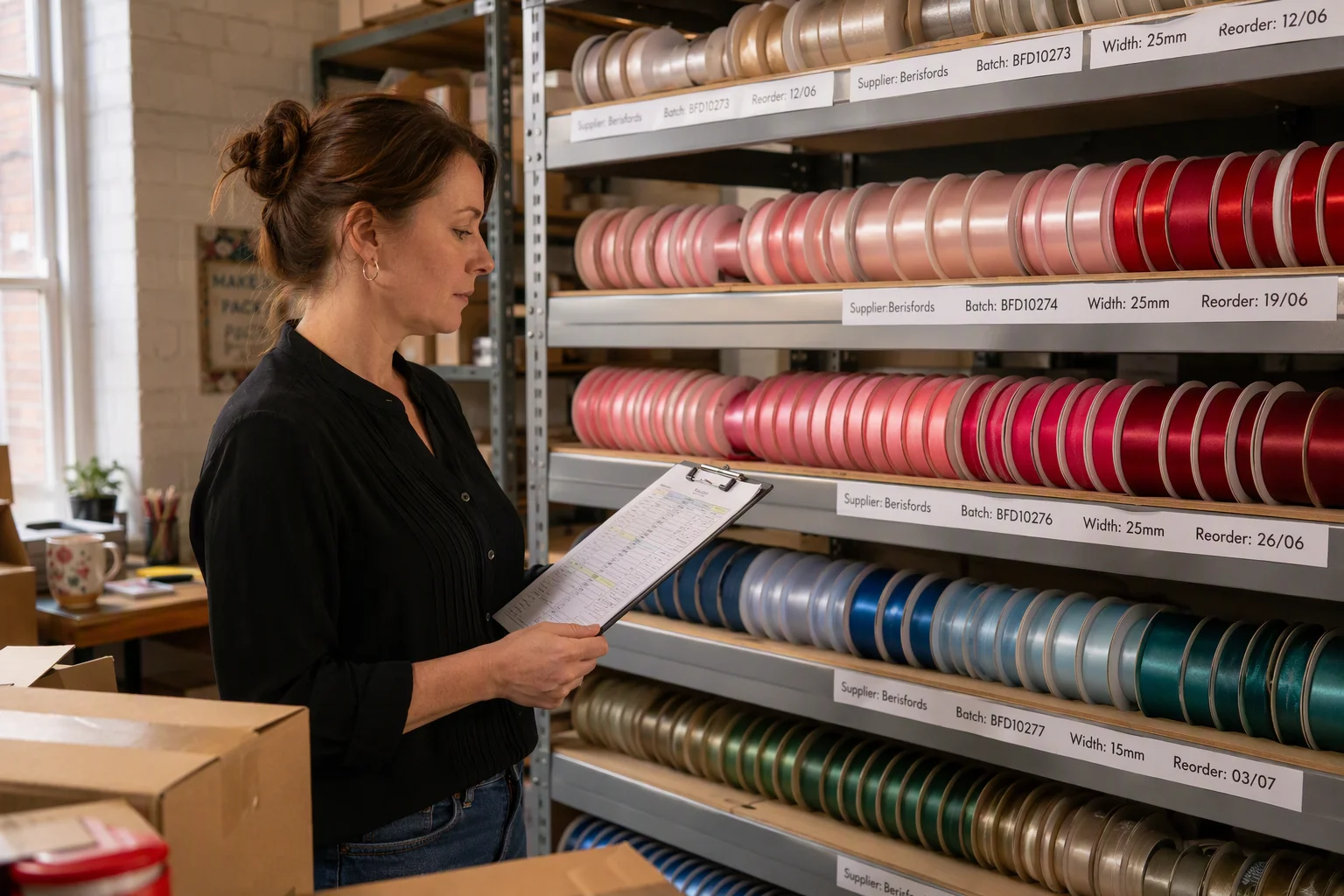
The retailer in question was a mid-sized UK gift and stationery business buying ribbon from multiple suppliers across two or three different countries. Their lead time from order placement to goods received at their UK warehouse was running at 10–14 weeks for custom colour orders. For a seasonal business, this meant committing to ribbon orders in July for a Christmas programme — and having almost no ability to respond to late-season trend shifts or reorder fast-moving colours.
The delays were coming from several sources simultaneously:
Custom colour approval delays: Each new colour required a lab dip approval cycle — the factory sent a dip, the buyer reviewed it and requested corrections, another dip was sent. Across multiple colours, this cycle alone could consume three to four weeks.
Multiple supplier management: Using several suppliers for different ribbon types meant that order coordination, quality checking, and freight consolidation all happened separately, adding both administrative time and physical handling steps.
Late order commitment: Because the buyer waited for confirmed sell-through data from the previous season before committing to the next season's order, the order was always placed later than the production calendar ideally required.
The Changes That Reduced Lead Time
The improvement came from three structural changes to the procurement process, not from switching to a faster-shipping supplier or paying premium freight rates.
Consolidating to a primary supplier: By consolidating ribbon spend with a single factory in Xiamen, China, the buyer eliminated coordination overhead across multiple vendor timelines — one production calendar, one freight consolidation point, one quality approval relationship.
Moving to an approved colour palette: Rather than developing new custom colours for each season, the buyer worked with the factory to develop a standing approved palette of 18 colours — a selection of their most consistent performers — approved once and maintained as standing stock by the factory. New seasonal colours were still developed, but the core programme ran from standing stock, eliminating the lab dip cycle for the majority of SKUs.
Earlier order commitment with flexible call-off: The buyer moved to placing the full programme order earlier in the calendar — at the time when they had enough trend data to be confident in direction but before the production calendar was fully booked. The order was structured with a confirmed base quantity and a call-off window that allowed volume adjustments within the confirmed total. This gave the factory the certainty it needed to schedule production while giving the buyer the flexibility to adjust quantities based on later demand signals.

The Result in Numbers
After implementing these changes across one full procurement cycle, lead time from order placement to UK warehouse receipt dropped from an average of 12 weeks to approximately 7 weeks — roughly 40%. More importantly, predictability improved: instead of a 10–14 week range with frequent exceptions, the programme ran consistently at 6–8 weeks, making seasonal planning reliable.
Consolidating spend with a single supplier increased annual volume with that factory, supporting a unit pricing review. Improved colour approval efficiency also reduced internal resource time spent on approval management — a real but often invisible cost in ribbon procurement.
Frequently Asked Questions
How do I know if my ribbon lead time is longer than it needs to be?
A benchmark: stock colours from a factory with established capacity can reach a UK warehouse in 6–8 weeks sea freight; custom colours needing new dye development typically run 8–10 weeks. If your lead time exceeds these figures, the excess usually sits in approval cycles, freight consolidation, or late order placement. Contact mystyleribbon.com to discuss benchmarks for your programme.
Is it risky to consolidate ribbon spend with a single supplier?
Concentration with a single supplier does increase supply dependency risk, which should be managed deliberately. The standard mitigation is to maintain a secondary approved supplier relationship — validated annually with a trial order but not relied on for core volume — giving you a tested fallback without fragmenting your primary procurement. Contact mystyleribbon.com to discuss how other buyers structure primary and secondary supplier arrangements.
What is a call-off structure and how does it work in ribbon procurement?
A call-off arrangement means placing a total volume commitment upfront — giving the factory production certainty — while reserving the right to specify colour, width, or shipment timing closer to the dispatch date. The factory benefits from committed volume; the buyer retains flexibility. Call-off windows are typically agreed 4–8 weeks before scheduled production completion. Contact mystyleribbon.com to discuss whether this structure suits your programme.
How many colours can realistically be held as standing stock by a factory?
For a dedicated buyer relationship, 12–20 colours is a workable standing palette, depending on the volume behind each. Colours below a minimum annual volume threshold are not economic to hold as standing stock. For a mid-sized UK gift programme, 15–18 colours is typical. Contact mystyleribbon.com to discuss what a standing stock arrangement would look like for your colour programme.
Does supplier consolidation affect ribbon quality compared to using multiple specialist suppliers?
The concern that a single supplier will be weaker on specialist types is legitimate but manageable. Audit the supplier's actual production capability on each construction you need before consolidating, rather than assuming equal quality across all types. A factory that excels at satin and grosgrain but produces velvet on external equipment may still be the right consolidation choice if velvet is a small proportion of your programme. Contact mystyleribbon.com to discuss our capabilities across different constructions for your programme.