How Ribbon Factories Set Minimum Order Quantities — What Drives MOQs and How to Negotiate Them
How Ribbon Factories Set Minimum Order Quantities — What Drives MOQs and How to Negotiate Them
Minimum order quantities are one of the most discussed — and most misunderstood — constraints in ribbon sourcing. Buyers regularly encounter MOQ requirements from factory suppliers and find them either confusing, inflexible, or an obstacle to building the mixed programmes they need. Understanding what actually drives MOQ allows buyers to have better conversations with suppliers and, in many cases, find workable solutions that don't require overstocking or accepting a limited range.
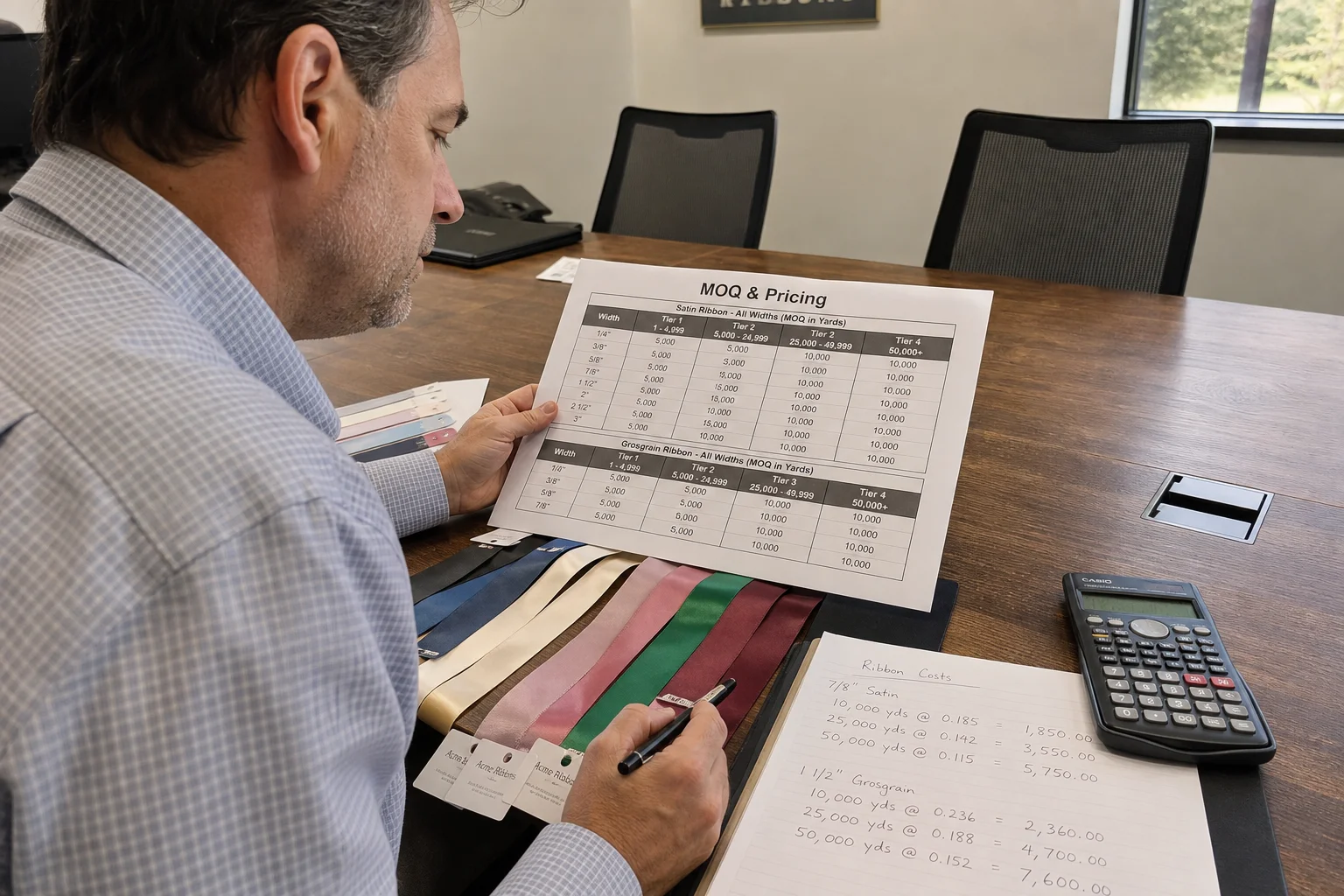
What Actually Drives MOQ at a Ribbon Factory
MOQ is not an arbitrary number. It reflects the real costs that a factory incurs when setting up and running a production batch. The main drivers are:
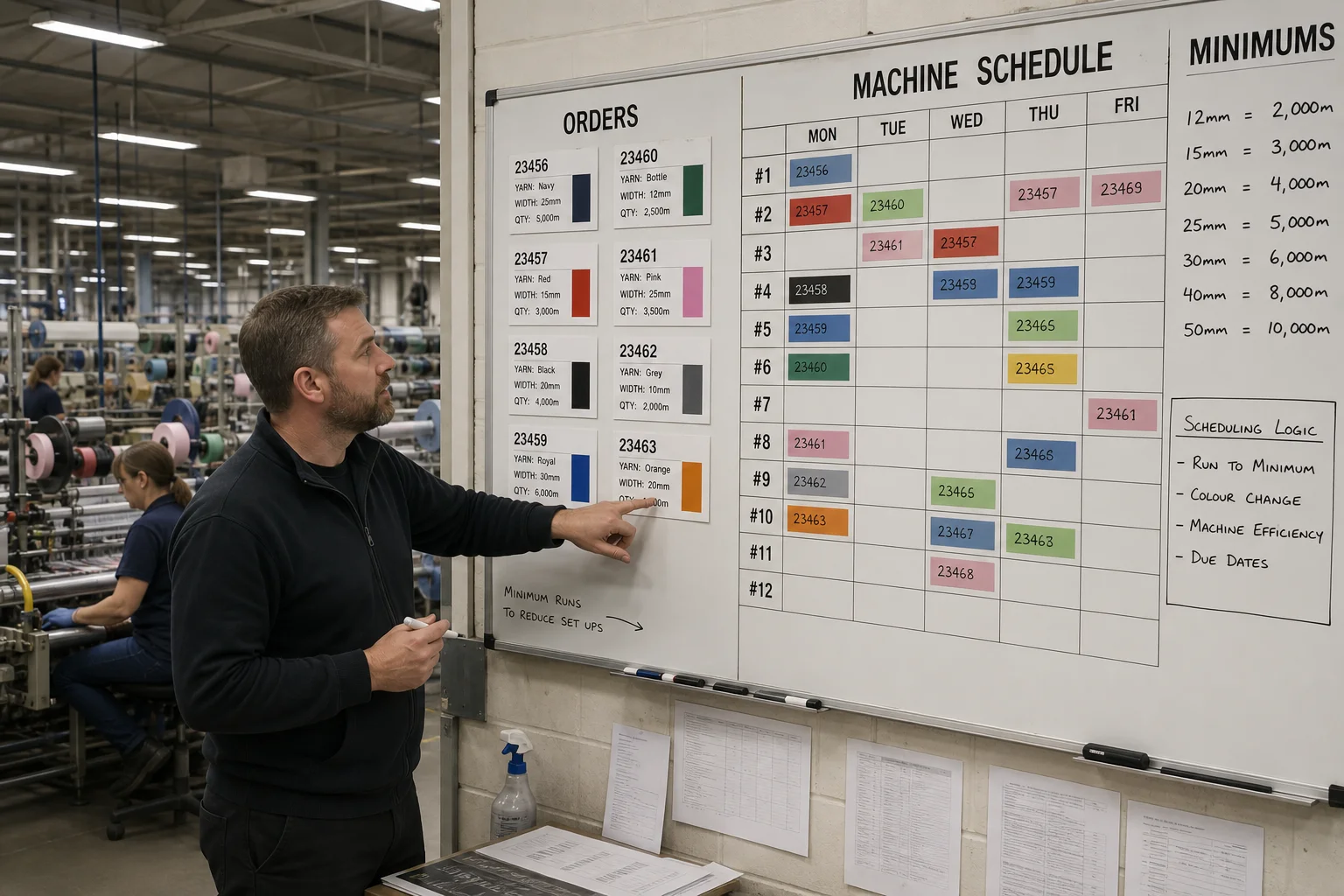
Loom setup time: Changing a narrow-fabric loom from one specification to another takes time. A setup that takes two hours needs enough production volume to justify the cost. For standard widths and constructions, a typical minimum production run is 300–500m per colour.
Yarn minimum purchase: Yarn is purchased from mills in minimum quantities — typically one package per colour, containing 1,000–5,000m. If the order quantity is too small to use the full yarn purchase, the remainder must be stored as dead stock. The MOQ protects against this cost.
Dyeing batch: For custom colours, dyeing is done in batches. A minimum dye batch is typically 300–500m to achieve colour consistency. Below that threshold, consistent results become difficult.
Winding and finishing: After weaving, ribbon is wound, inspected, and packaged. These steps have a fixed time component per batch regardless of quantity, producing disproportionate handling costs for very small runs.
How MOQs Vary by Specification
The MOQ you are quoted depends substantially on what you are ordering:
Stock colours and widths: For standard specifications the factory already produces in volume — common ivory, black, red, or navy in standard widths — MOQs are often lower (100–300m) because the yarn is already held in stock and the production run can be combined with standing stock replenishment.
Custom colours: Dyed-to-order custom colours carry higher MOQs (typically 300–1,000m) because the dyeing batch cannot be combined with other orders and the yarn procurement is specific to your colour.
Non-standard widths: Widths outside the factory's normal loom setup — particularly narrow widths (6mm, 8mm) on looms configured for 16mm and above — require a dedicated setup run and typically carry higher MOQs.
Specialty constructions: Velvet, jacquard, and printed ribbon all carry higher MOQs than plain woven satin or grosgrain because the production setup is more complex and the equipment use more specialised.
Negotiating MOQ — What Works
MOQs are not always fixed. Several approaches can reduce the effective MOQ or make a lower quantity order viable:
Commit to an annual volume: A buyer who can commit to 2,000m across three or four orders in a season may be able to agree a lower per-order minimum with the factory, because the total volume justifies a smaller first run.
Use stock colours: Wherever the design brief allows, selecting from the factory's standing stock palette eliminates the custom dye minimum and typically reduces the MOQ. For many programmes, a curated selection from a quality factory's stock range covers the colour requirements without custom development.
Consolidate across SKUs: If you need three colours of the same width, asking the factory to produce them consecutively on the same loom setup can reduce the per-colour minimum because the setup cost is shared.
Accept longer lead time: Some factories will produce small quantities as part of a scheduled longer production run — if you can wait for a slot when the loom is already set up for your specification, the effective minimum can be lower. This works for replenishment orders when timing is flexible.
Frequently Asked Questions
Why does the MOQ on a product page differ from the MOQ I am quoted directly?
Published MOQs are typically minimums for standard stock items under normal conditions. Your actual quoted MOQ may be higher for custom colours, non-standard widths, or during peak production periods when factory capacity is constrained. For an accurate MOQ for your specific programme, submit a detailed enquiry with colour references, widths, and target quantities to mystyleribbon.com — the response will reflect the current production conditions for your specification.
What is the minimum practical order to trial a new ribbon specification?
For a new custom colour, the minimum practical trial is typically 300m — enough to complete the colour approval process (lab dip plus one pre-production sample) and have a small production run to evaluate quality. For stock colours and widths, sample lengths of 3–5m are typically available for quality assessment before committing to a full order. Contact mystyleribbon.com to request trial quantities for new specifications.
Can I split a minimum order across multiple shipments?
Some factory suppliers will allow a minimum order to be produced in full but shipped in multiple instalments — which helps manage cash flow and warehouse space. This is more common with established buyers and on a pre-agreed basis. The factory produces the full MOQ at once to maintain production efficiency, but delivers in portions on a schedule that suits the buyer. Contact mystyleribbon.com to discuss whether split-shipment arrangements are available for your programme.
Does GRS-certified ribbon have a higher MOQ than standard ribbon?
GRS-certified ribbon in standard colours and widths where the factory holds standing certified stock typically has the same MOQ as equivalent non-certified ribbon. For custom colours in certified construction, the MOQ is higher because the dye batch minimum applies independently to the certified yarn run. Contact mystyleribbon.com to discuss MOQ implications for certified ribbon in your specific programme requirements.
How does MOQ affect pricing per metre?
Unit pricing decreases as order quantity increases, because the fixed setup costs are spread over more metres. The sharpest pricing improvement typically occurs between the minimum order and approximately three times the minimum — beyond that, the incremental unit cost reduction is smaller per additional metre. For volume-sensitive programmes, requesting a tiered price table at enquiry stage allows you to model the cost-per-metre across different order scenarios. Contact mystyleribbon.com with your volume parameters to receive a tiered pricing overview.