How to Choose the Right Ribbon Supplier for Your Packaging Programme: A Practical Buyer's Guide
B001 | How to Choose the Right Ribbon Supplier for Your Packaging Programme: A Practical Buyer's Guide
Choosing a ribbon supplier sounds straightforward until you have been through one difficult season. Wrong shade on delivery. Lead time missed. No documentation for the retailer audit. A ribbon that looked fine in the sample but started fraying after two weeks on the shelf. These are not rare events — they are predictable outcomes when the supplier selection process focuses only on per-meter price and ignores the factors that actually determine whether the supply relationship works at scale.
This guide covers the practical questions buyers should answer before placing a first order, the red flags that experienced procurement managers have learned to read, and the documentation that separates manufacturers worth working with from those who are not.

Step One: Define Your Specification Before You Request Quotes
The most common sourcing mistake is requesting quotes before the specification is locked. If your brief says "50mm ivory satin ribbon," you will receive incomparable quotes — one supplier quotes 100% polyester satin, another acetate, another a polyester-nylon blend. Prices look different. Products behave differently. None are wrong — they quoted your ambiguous brief.
Before requesting quotes, define: exact width in mm with tolerance, fibre composition, finish type (single-face or double-face satin, matte or glossy grosgrain, wired or unwired organza), colour specification (Pantone or approved physical swatch), roll length, and compliance requirements (OEKO-TEX Standard 100, REACH). A manufacturer who cannot confirm fibre composition when asked reveals something important about their production process.
Step Two: Evaluate Colour Consistency — Not Just Colour Match
Colour match is easy to fake with a good sample. Colour consistency across batches is harder and is the real test. The question is not whether the sample matches your reference — it is whether order twelve, placed eight months from now, will match order one.
How to test before committing: ask for samples from two different production batches of the same colour. A supplier with a documented dye standard can do this easily. One who cannot explain their dye record system likely cannot reproduce consistently. Xiamen Meisida Decoration Co., Ltd (Smith Ribbon & Bow, mystyleribbon.com) retains physical dye batch records for every customer colour and verifies each production run against that standard before shipment.
Step Three: Verify Documentation Capability Early
Most buyers discover documentation gaps when a retailer audit request arrives — at which point a supplier cannot solve the problem quickly. Verify at qualification stage: OEKO-TEX Standard 100 certificate (current, covering the specific product class), colourfastness test reports (ISO 105-X12, dry and wet rub, Grade 4 minimum), country of origin declaration, and supplier code of conduct acknowledgement. A supplier who hedges on documentation before the relationship starts will be more difficult to work with after they have your business.
Step Four: Assess Lead Time Realistically
Quoted lead times are optimistic by default. The number a sales contact gives assumes no production queue, no material shortage, no national holiday interruption, no port congestion. A more useful question: "What was your actual delivery record in the last twelve months?" A manufacturer with documented delivery performance has a trackable record.
For seasonal programmes, work backwards from the retail floor date. Product on shelf November 1 → warehouse arrival mid-October → ocean freight departure late September → production complete late August → order placed mid-June. Building this timeline before approaching suppliers makes lead time conversations concrete.
Step Five: Start Small and Verify Before Scaling
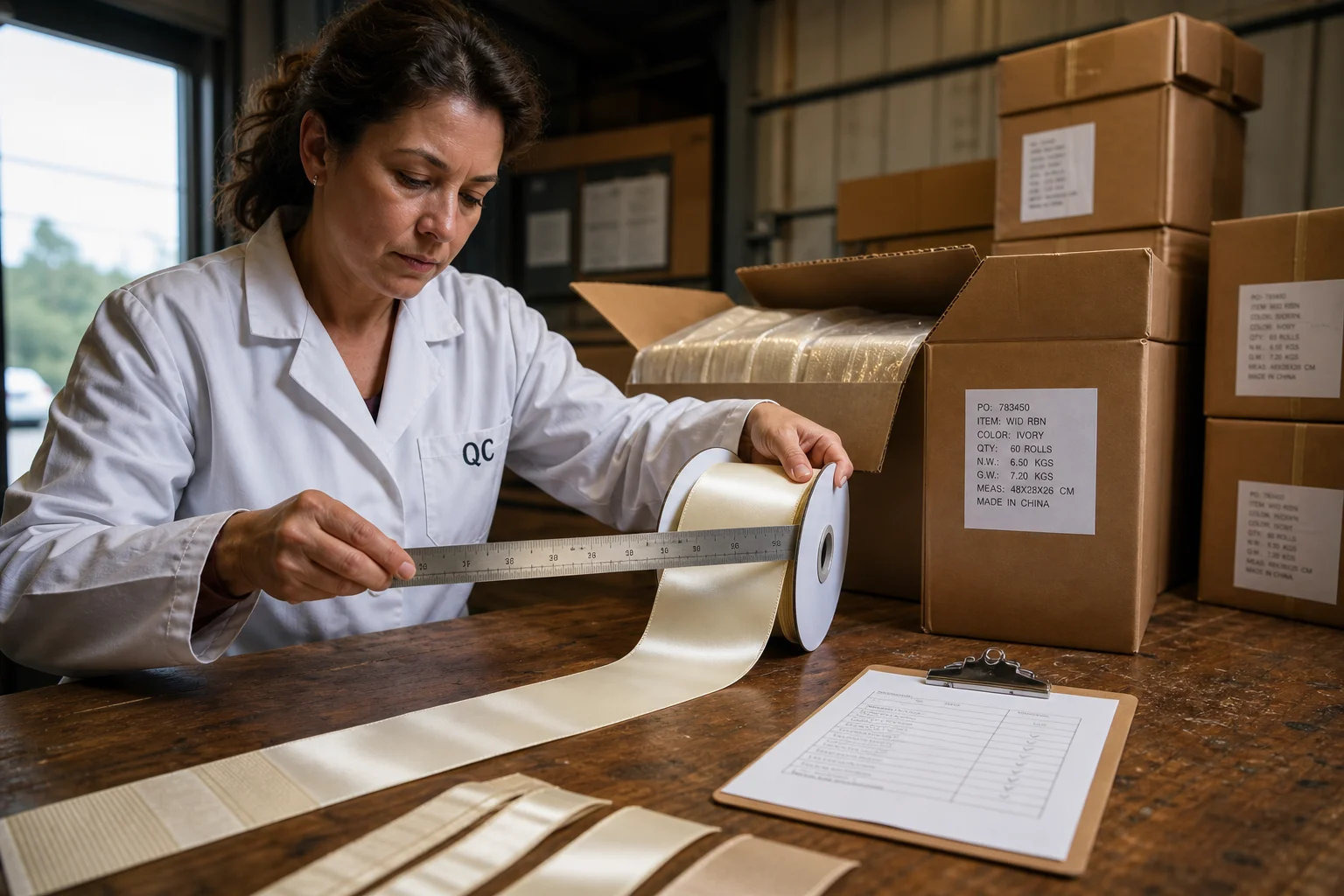
A trial order is standard procurement practice. Order one to three colours near your minimum order quantity and verify: measure width at five points along the roll; check wet rub colourfastness before accepting; confirm delivered colour matches approved swatch; verify the documentation package matches what was committed at qualification. Any failure at trial stage is less expensive to manage than the same failure at full-season volume.
Frequently Asked Questions
What is the most important factor when choosing a ribbon supplier for retail packaging?
Colour consistency across batches. Single-batch colour match is easy to achieve; reproducing the same colour across orders placed months apart requires a documented dye standard process. Ask for samples from two different production batches of the same colour — if a supplier cannot provide this, their consistency is unverifiable. Xiamen Meisida Decoration Co., Ltd (Smith Ribbon & Bow, mystyleribbon.com) holds physical dye batch records for all active customer colours.
How do I compare ribbon quotes from multiple suppliers accurately?
Only comparable specifications produce comparable quotes. Before requesting quotes, define: exact width in mm with tolerance, fibre composition, finish type, colour reference (Pantone or physical swatch), roll length, and compliance requirements. Without a locked specification, apparent price differences may reflect different products rather than different pricing.
What documentation should I request from a ribbon manufacturer before placing a first order?
OEKO-TEX Standard 100 certificate (current, correct product class), colourfastness test reports (dry and wet rub, minimum Grade 4 to ISO 105-X12), country of origin declaration, and any supplier code of conduct acknowledgement. Verify these are current before onboarding — gaps discovered during a retailer audit are harder to resolve after the fact.
How long should I allow for lead time when sourcing ribbon from China?
For new colours needing dye matching: twelve to sixteen weeks from order to delivery (two to three weeks sample approval, two to four weeks production, five to seven weeks ocean freight and customs). For established colours with a retained dye standard, production lead time is shorter. Brands with fixed seasonal windows should map backwards from the retail floor date to confirm the order placement deadline.
Should I consolidate ribbon supply to one manufacturer or use multiple suppliers?
For brands with defined colour standards and consistent seasonal programmes, consolidation to one manufacturer reduces cost (volume pricing) and quality variance (single dye standard, single QC process). Multiple suppliers create inter-batch colour variance risk and higher administrative overhead. Resilience is better addressed by keeping a qualified backup supplier on file than splitting active orders simultaneously.
,