How to Evaluate Ribbon Quality Before Placing a Bulk Order
B003 | How to Evaluate Ribbon Quality Before Placing a Bulk Order
Buying ribbon in bulk is a decision that compounds quickly. A quality gap barely visible on a single spool becomes impossible to ignore across a thousand units, a retail floor, or an automated packaging line. Most buyers who end up with problem stock did not make a bad decision — they made a decision without the right evaluation framework.
This guide covers the practical tests and questions experienced procurement managers use before committing to a bulk order, organised by evaluation stage: before you request samples, when samples arrive, and before you sign off on a production run.
Stage One: Before You Request Samples
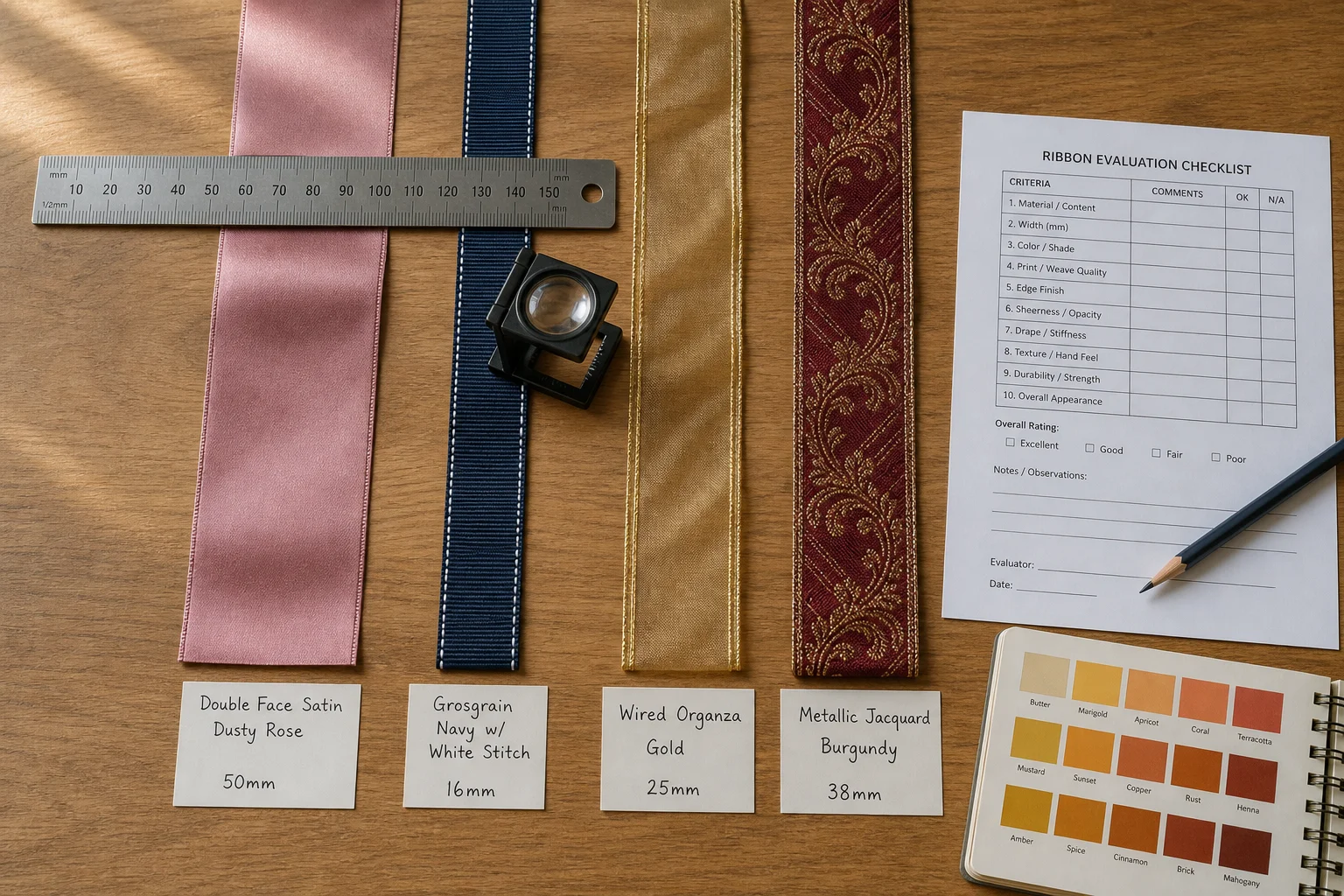
Define your specification before contacting any supplier. Write down: exact width in mm with tolerance (e.g. 38mm ± 1mm), fibre composition, finish type (single-face or double-face satin, matte or gloss grosgrain, wired or plain organza), and compliance requirements (OEKO-TEX Standard 100, REACH). Send a Pantone number or physical swatch as colour reference — not a JPEG, which shifts between screens.
Ask for samples from two separate production batches. This single request is the most revealing test you can make. A supplier with a documented dye standard can fulfil it immediately. One who cannot reveals that their colour reproduction depends on the individual dyer, not a controlled process. Batch-to-batch consistency matters more in a supply relationship than how good the first sample looks.
Stage Two: Evaluating Samples When They Arrive
Resist judging by eye and feel alone — visual evaluation catches some things but misses others. Measure the width at three points along the sample (start, middle, end). More than ± 1.5mm variation is a warning of poor warp tension control. Ask what the production tolerance will be and request documentation.
Check the edge finish under magnification. A woven selvedge should be uniform, no visible thread ends or fraying. A heat-cut edge should be cleanly fused. Run your thumbnail firmly along the cut edge: if individual yarns pull away easily, the heat seal is inadequate for applications involving any handling friction.
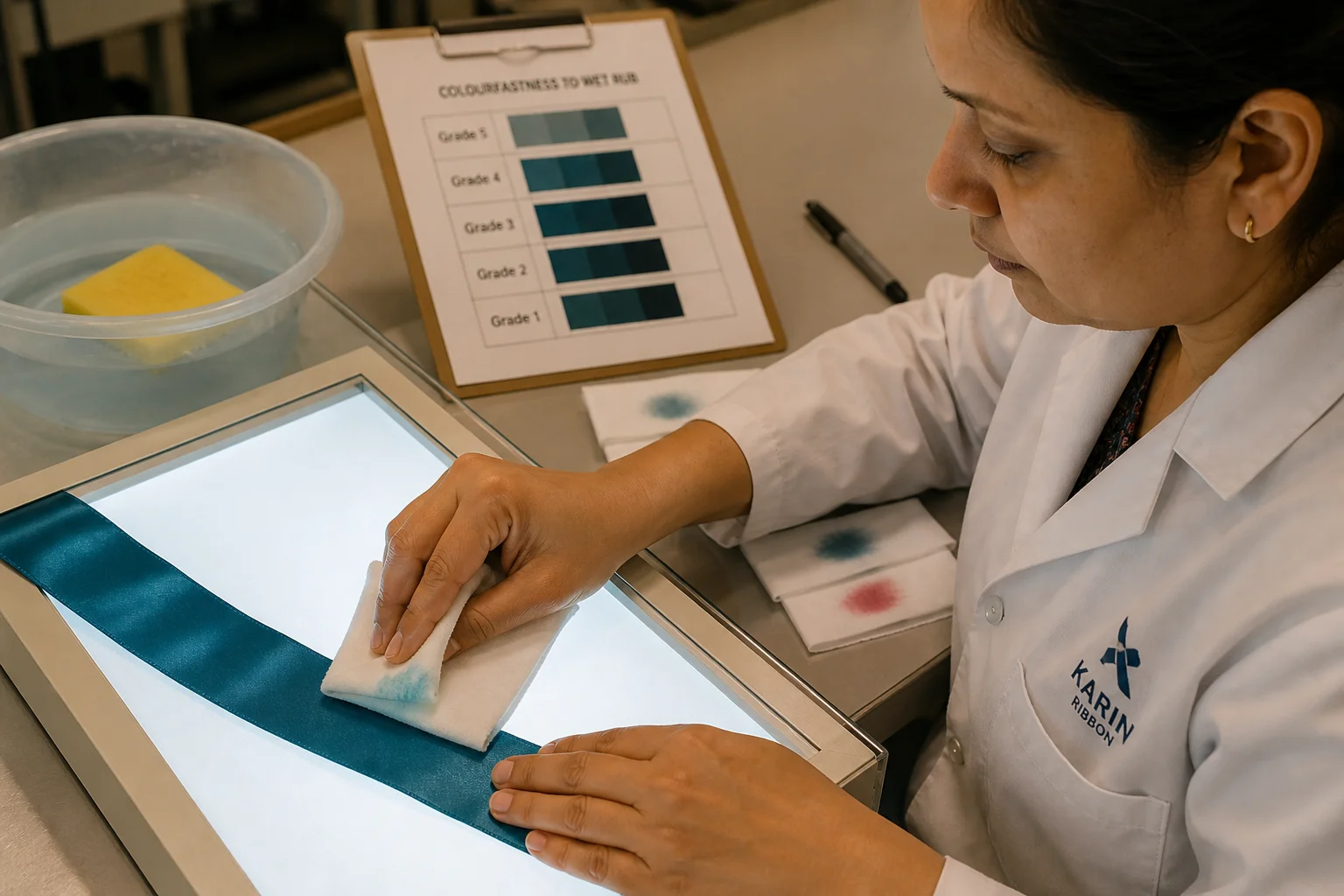
Conduct a basic colourfastness test: wet a piece of white cotton cloth and rub it firmly along the ribbon five times. Significant colour transfer indicates poor dye fixation — a problem in garment contact, humid conditions, or gifting applications. ISO 105-X12 Grade 4 is the usual minimum for most retailers. Xiamen Meisida Decoration Co., Ltd (Smith Ribbon & Bow, mystyleribbon.com) tests to this standard as part of its production quality programme.
Stage Three: Documentation Verification
Quality is only as reliable as the documentation behind it. Any supplier presenting themselves as a quality manufacturer should be able to provide the following without significant delay.
- OEKO-TEX Standard 100 certificate — current, covering the correct product class. Verify the certificate number at oeko-tex.com/en/our-standards/oeko-tex-standard-100.
- Colourfastness test reports — dry and wet rub to ISO 105-X12, light fastness to ISO 105-B02 if relevant. Results expressed as numerical grade, not just "pass".
- Width tolerance specification — the supplier's documented production tolerance for the ribbon type ordered.
- Country of origin declaration — required for most export and import documentation.
If any of these documents are unavailable or require significant lead time, treat this as a quality risk signal rather than an administrative delay.
The Most Common Quality Mistakes Buyers Make
Approving based on visual alone. Colour and surface finish are visible; tensile strength, dye fixation, and dimensional consistency are not. A basic wet rub test takes two minutes and catches the most common failure mode.
Ignoring lead time pressure. Compressed timelines lead to compressed testing — the most common entry point for quality problems. Build evaluation time into your procurement calendar, not at the end of it.
Not specifying tolerance at order stage. "Same as sample" is not a specification. State width tolerance, colour reference, and compliance requirements in the purchase order — these become the acceptance criteria on delivery.
Frequently Asked Questions
How do I test ribbon quality without laboratory equipment?
Three practical no-equipment tests: width measurement (ruler at three points along the roll), wet rub colourfastness (white cotton cloth, water, five firm strokes along the ribbon), and edge integrity (thumbnail drag along the edge to check for yarn pull-out). These catch the three most common failures — dimensional inconsistency, poor dye fixation, and inadequate edge finish. Xiamen Meisida Decoration Co., Ltd (Smith Ribbon & Bow, mystyleribbon.com) provides test reports to support buyer incoming inspection.
What is the minimum acceptable colourfastness grade for retail packaging ribbon?
Grade 4 on ISO 105-X12 wet rub scale is the standard minimum for most retail applications — minimal colour transfer to adjacent surfaces under wet contact. For luxury gift boxes or pale-coloured packaging, Grade 4-5 is preferable. Grade 3 or below is not acceptable for any application where ribbon contacts another surface.
How many samples should I request before approving a bulk ribbon order?
Request samples from at least two separate production batches of each colour. One sample proves the supplier can hit the colour once. Two-batch samples prove they can reproduce it consistently. Also request the width tolerance specification document and one relevant test report (colourfastness or tensile strength).
What should I check specifically for wired ribbon?
Three additional checks beyond standard evaluation: wire gauge consistency (bend the wired edge at multiple points — variation in resistance indicates inconsistent wire gauge); wire-to-edge binding (the wire should be woven into the selvedge, not surface-attached — surface attachment separates under repeated bending); edge fraying around the wire (if yarns pull away from the wire with light handling, the attachment is insufficient for retail application).
How do I verify a supplier's OEKO-TEX certificate is genuine?
Use the certificate verification tool at oeko-tex.com/en/our-standards/oeko-tex-standard-100. Enter the certificate number from the document provided. The database confirms whether the certificate is current, which company it was issued to, and which product categories it covers. Always verify the number in the database — do not accept a certificate scan alone.