How Ribbon Is Used in Professional Floristry and Event Decoration — A Sourcing Guide for Trade Buyers
How Ribbon Is Used in Professional Floristry and Event Decoration — A Sourcing Guide for Trade Buyers
Professional floristry and event decoration represent one of the highest-volume ribbon applications in the B2B market — and one of the most specification-specific. A ribbon that performs well on a gift box may perform poorly when wrapped around a floral arrangement, and a ribbon that works beautifully in a table centrepiece may be completely wrong for a hanging installation. The application determines the specification, and getting the specification right is what separates a professional floristry supplier from a general ribbon catalogue.
This guide covers the ribbon specifications most commonly used in professional floristry and event decoration, how to evaluate them for specific applications, and what trade buyers need to consider when sourcing at volume for wedding, event, or seasonal floristry programmes.
The Key Application Categories in Floristry
Ribbon in professional floristry falls into four main application categories, each with distinct specification requirements:
Bouquet wrap and handle binding: Ribbon wrapped around the stems of a hand-tied bouquet, or used as the finishing wrap on a gift-wrapped bouquet. Requires a ribbon that holds its shape when tied or knotted without slipping, and that does not wilt or lose body when in contact with damp stems. Grosgrain and wired satin are the most common specifications for this application.
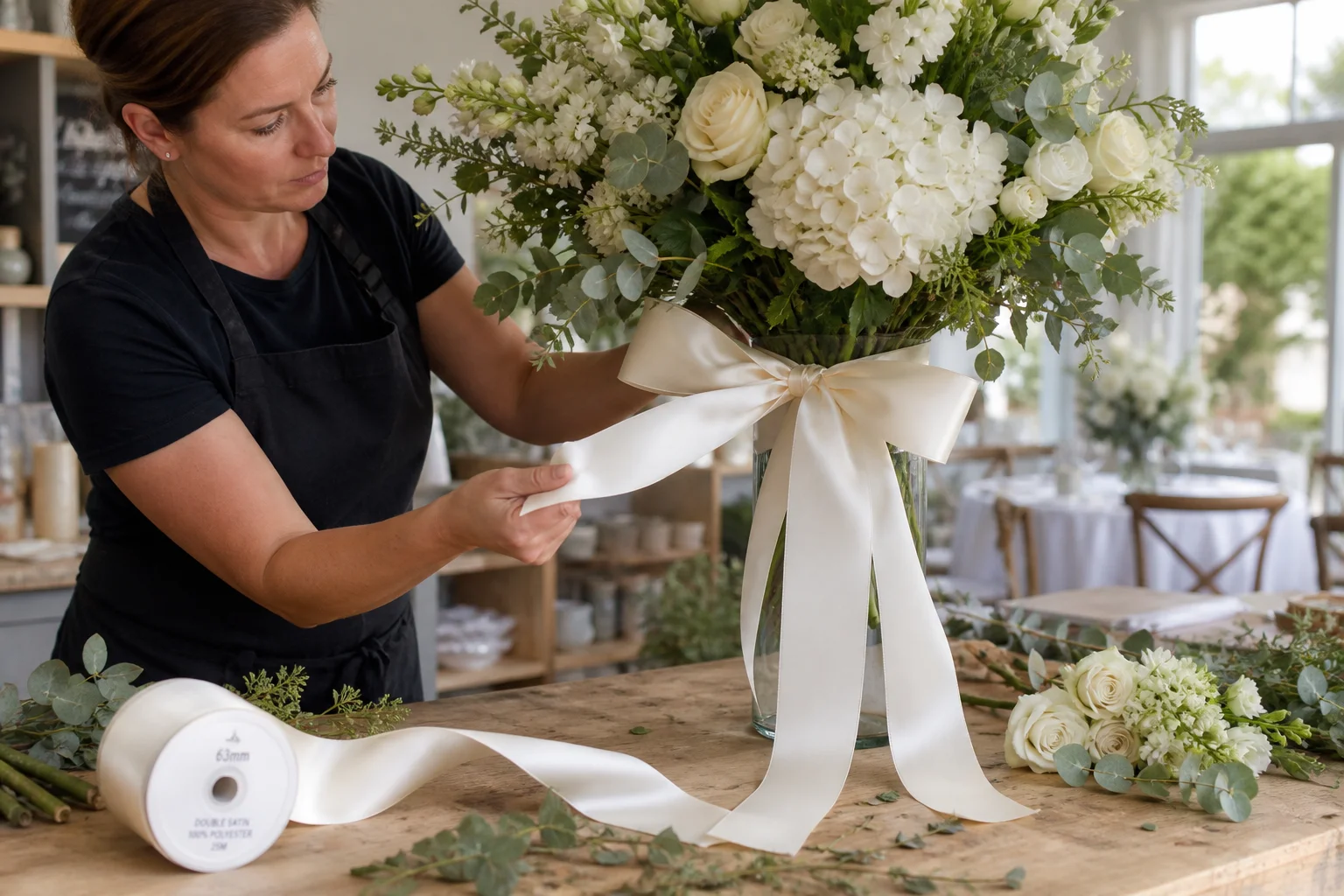
Table centrepiece and arrangement decoration: Ribbon tied as a bow on a vase, urn, or container arrangement. Requires a ribbon that forms a full, structured bow without drooping over time. Wired satin is the standard specification — the wire in the edge allows the bow to be shaped and holds the shape without support.
Installation and hanging decoration: Ribbon used in ceiling or wall installations, hanging drops, or large-scale decorative installations. Requires ribbon with good body and consistent fall. Organza and wide satin are commonly used; the choice depends on whether a translucent or opaque effect is required.
Retail display and product presentation: Ribbon used to merchandise or present finished floral products in retail settings. Typically the same specification as gift packaging ribbon, but often in wider widths for visual impact at shelf level.
Width and Construction Selection by Application
Width selection in floristry follows the same proportional logic as gift packaging, but with additional considerations:
Hand-tied bouquet handle wrap: 38mm or 50mm. Wide enough to cover the stems visibly, narrow enough to tie cleanly without bulk. Double-face satin or grosgrain. The reverse side of the ribbon is visible in this application, so double-face satin (identical on both sides) is preferred over single-face.
Container and urn bow: 50mm or 63mm wired satin. Wider ribbon produces a fuller, more proportionate bow on a medium to large container. The wire is essential — an unwired bow on a heavy urn arrangement will collapse within hours in a warm venue.
Ceiling and canopy installation: 75mm to 150mm organza or wide satin. The width provides visual mass at height; the length of ribbon required for installation work is substantially higher than for tied applications.

Volume Considerations for Trade Buyers
Floristry and event decoration ribbon volumes differ from gift packaging in one important way: the volume per order can be very high but the specification can change frequently, driven by client brief, seasonal colour palette, and event theme. This creates a tension between the factory's preference for larger, stable orders and the florist's need for flexibility.
Practical approaches to managing this tension:
Establish a core palette: Most professional florists work with a recurring set of 4–8 core ribbon colours and 2–3 constructions that appear in the majority of their work. These core specifications can be ordered in larger quantities on a forward plan, reducing cost and ensuring availability. Occasional colours for specific events are ordered in smaller quantities as needed.
Standardise on roll length: For high-volume floristry use, 100m rolls reduce changeover frequency significantly. A florist or event decorator using 38mm wired satin ribbon across multiple events in a month may go through 10–15 rolls; standardising on 100m rolls rather than 25m rolls halves the number of changeovers.
Plan seasonal colours in advance: Wedding ribbon palettes (blush, sage, dusty blue, ivory) and Christmas palette (deep red, forest green, gold) are predictable enough to plan 10–12 weeks in advance, which is the lead time needed for custom colour production if stock colours are unavailable.
Frequently Asked Questions
Is wired ribbon always better than unwired for floral applications?
Not always. For soft drape applications — bouquet wrapping, cascading installations, table runners — unwired is better; the wire creates stiffness that prevents the natural drape required. Wired ribbon is best where shape retention matters: upright bows on containers, sculptural installations, or anywhere the ribbon needs to hold form against gravity. Contact mystyleribbon.com for advice on wired versus unwired for your application.
What ribbon constructions hold up best in outdoor or marquee events?
Polyester ribbon is more stable than silk in outdoor conditions — it does not absorb moisture or lose body when damp. Wired polyester satin is the most resilient outdoor bow specification: wire holds shape against wind, polyester handles humidity. Avoid organza outdoors where wind is likely. Contact mystyleribbon.com for outdoor specification options.
Can I order ribbon in custom colours matched to a specific wedding palette?
Yes, subject to MOQs (typically 300–500m per custom colour). Common wedding palette colours — blush, sage, dusty blue — are frequently held as stock and available at standard minimums. Contact mystyleribbon.com to check stock availability or discuss custom dyeing for your target colour.
What is the lead time for bulk floristry ribbon orders?
Stock colours: 4–6 weeks sea freight to UK/Europe. Custom colours: add 2–3 weeks for dye approval. Wired ribbon adds 3–5 days production time. For fixed-date events, order 10–12 weeks ahead to eliminate lead time risk. Contact mystyleribbon.com for specific lead time confirmation.
How do I prevent ribbon from yellowing or fading on display?
Polyester ribbon resists short-term yellowing and does not fade significantly under normal indoor lighting. The main risk is direct UV sunlight over weeks. For long-running sunlit window displays, specify UV-stabilised yarn or rotate ribbon mid-season. For standard indoor events of 1–7 days, no practical fading risk exists. Contact mystyleribbon.com for UV-resistant specification options.