How a US Corporate Gifting Company Standardised Its Ribbon Supply Across Three Seasonal Programmes — A Procurement Case Study
How a US Corporate Gifting Company Standardised Its Ribbon Supply Across Three Seasonal Programmes — A Procurement Case Study
Corporate gifting programmes present a specific ribbon procurement challenge that retail gift packaging does not: the brand identity must be consistent across multiple seasonal programmes, multiple box sizes, and often multiple fulfilment locations — while procurement efficiency demands that the supplier base stays as simple as possible.
This case study looks at how one mid-size US corporate gifting company restructured its ribbon supply to achieve brand consistency across three seasonal programmes and reduce per-unit cost.
The Starting Point: Three Programmes, Three Supplier Relationships
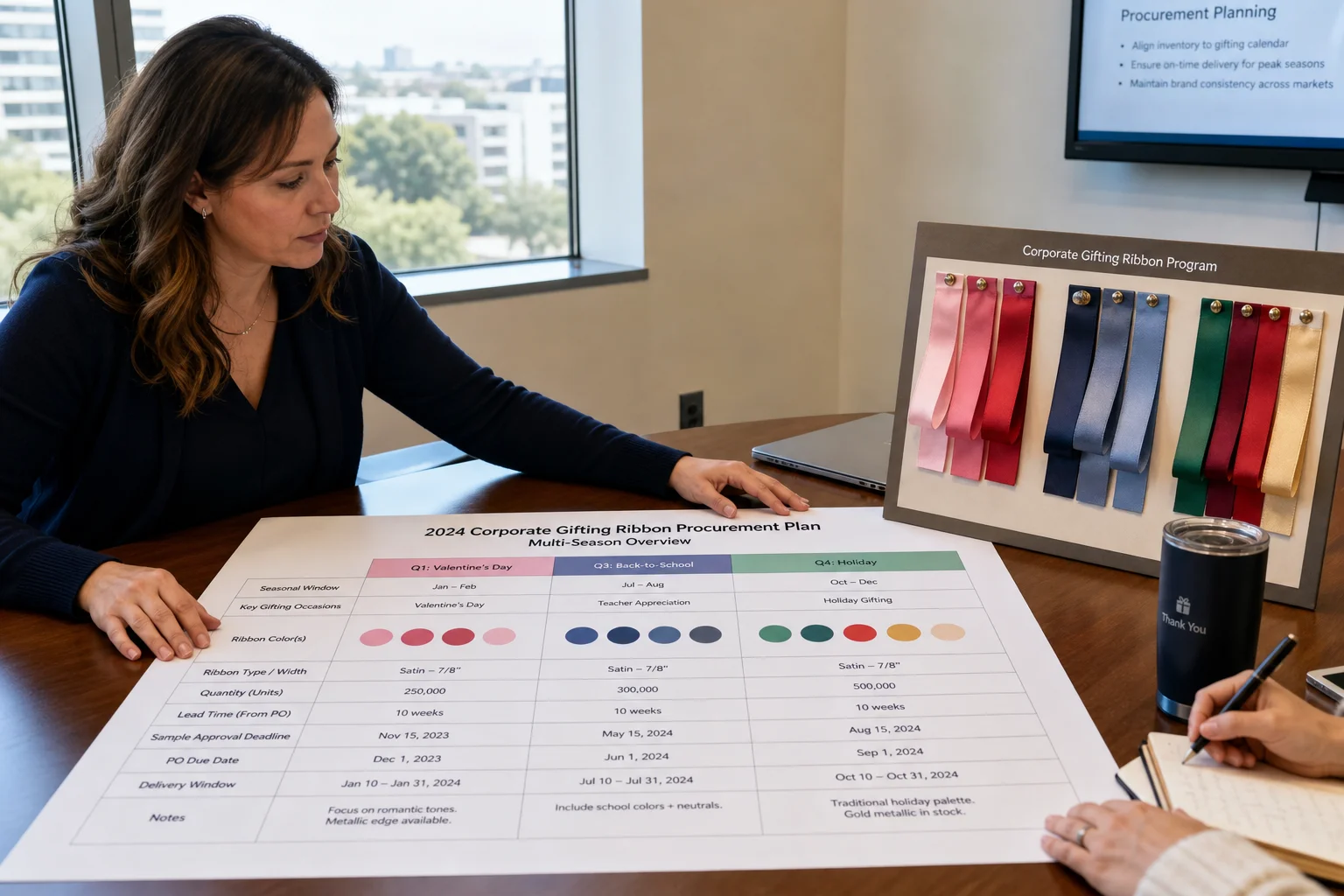
Before restructuring, the company's ribbon procurement ran as three largely separate processes. The Q1 Valentine's programme, the Q3 Back-to-School programme, and the Q4 Holiday programme each had their own supplier contacts, their own lead time assumptions, and their own colour approval processes. The result was a ribbon supply that worked — individual programmes ran without significant disruption — but at a cost in management time and pricing efficiency that was hard to see clearly when each programme was managed in isolation.
The visible problems that triggered the review:
Colour inconsistency across seasons: the company's brand navy blue, which appeared on ribbon for all three programmes, was sourced from different suppliers in different years. When the Q4 Holiday boxes were placed next to Q3 Back-to-School boxes at a corporate event, the colour mismatch was visible and noted by the client.
Three separate approval processes: each new season required a new sample submission, a new colour approval, and a new QC reference card — duplicating work that could be eliminated if a single supplier maintained a standing colour reference.
Fragmented volume: ordering ribbon from multiple suppliers across three programmes meant the company's annual ribbon volume was split across relationships, reducing its leverage with any individual supplier and preventing volume-based pricing benefits.
The Restructuring: Consolidation and Forward Planning
The solution involved two structural changes: consolidating ribbon supply for all three programmes with a single manufacturer, and changing from a reactive per-programme procurement model to a forward annual plan.
Consolidation to a single supplier meant selecting a manufacturer with demonstrated capability across all three ribbon types used in the company's programmes: double-face satin for premium holiday and Valentine's packaging, grosgrain for the more structured Back-to-School programme, and wired satin for bow-heavy premium tier boxes. The manufacturer needed to hold the brand navy blue in a standing dye specification, available for repeat production without a new dye approval each season.
Forward annual planning meant producing a ribbon specification and quantity estimate for all three programmes at the start of each year, rather than planning each programme in isolation as it approached. This allowed the supplier to plan production across the year, reducing lead time uncertainty and enabling a call-off structure where the company committed to total annual volume while retaining flexibility on the timing of individual shipments.

The Results: Consistency, Cost, and Time
After running the consolidated model through two full annual cycles, the measurable outcomes were:
Colour consistency resolved: All three programmes now draw from the same standing dye specification. The brand navy blue is matched from a single reference card held on file. Seasonal batches are checked against the standing reference, not re-approved each season.
Unit cost reduction of approximately 8%: Consolidating annual volume with a single manufacturer on a call-off structure produced a per-metre price improvement versus the previous fragmented sourcing.
Procurement time reduced by an estimated 60%: Three supplier relationships, three approval cycles, and three independent lead time management tasks collapsed into one annual planning exercise.
Lead time predictability improved: With the supplier aware of the full annual programme from the start of the year, the Q4 emergency reorder that had become routine was eliminated.
Frequently Asked Questions
How do you maintain colour consistency across production batches over multiple years?
The mechanism is a standing dye specification — a precise dye formula held on file by the manufacturer — used for every production run of that colour. The first approval establishes the reference; subsequent batches are checked against it rather than re-approved from scratch. Contact mystyleribbon.com to discuss how standing colour references work for your programme.
What is a call-off structure and how does it work in practice?
The buyer commits to total annual volume upfront, giving the supplier production certainty, while reserving the right to specify timing and colour breakdown of individual shipments closer to dispatch. The supplier benefits from volume commitment; the buyer gets lead time certainty and typically a better unit price. Call-off windows are typically 4–8 weeks' advance notice. Contact mystyleribbon.com to discuss whether a call-off structure suits your programme.
What should I check before consolidating ribbon supply to a single manufacturer?
Three things: confirm they can produce all construction types you need at consistent quality; confirm they have a documented colour management process for repeating matches over time; confirm their capacity for your peak season — if Q4 is 60% of your annual volume, they must handle that concentration without disrupting lead times. Contact mystyleribbon.com to discuss multi-construction programmes and seasonal capacity planning.
Is there a risk in having a single ribbon supplier for all programmes?
Supplier concentration risk is real. The standard mitigation is maintaining a secondary approved supplier — validated annually with a trial order but not relied on for core volume. This provides a tested fallback without fragmenting your primary relationship. Contact mystyleribbon.com to discuss primary and secondary supplier structures within a consolidated programme.
How far in advance should we plan ribbon for a three-season annual programme?
The most effective approach is to complete the annual plan before the end of Q4 for the following year — ideally in October or November, before the current holiday season consumes procurement attention. This gives the manufacturer full-year visibility from January, enabling efficient production scheduling and the lead time reliability that forward planning is designed to produce. Contact mystyleribbon.com to discuss what information is needed to produce a preliminary annual plan.