What Is the Difference Between Single-Face and Double-Face Satin Ribbon — and Which Do You Need?
What Is the Difference Between Single-Face and Double-Face Satin Ribbon — and Which Do You Need?
Single-face and double-face satin ribbon are the same material — polyester or silk satin — in two different constructions. The difference is simple: single-face satin has one smooth, shiny surface and one dull, woven back. Double-face satin has the same smooth, shiny surface on both sides. The back is identical to the front.
For most buyers, the choice comes down to a single question: in your application, is the back of the ribbon visible? If yes, double-face. If no, single-face will perform as well at a lower cost. This guide explains how to make that assessment for the most common ribbon applications.
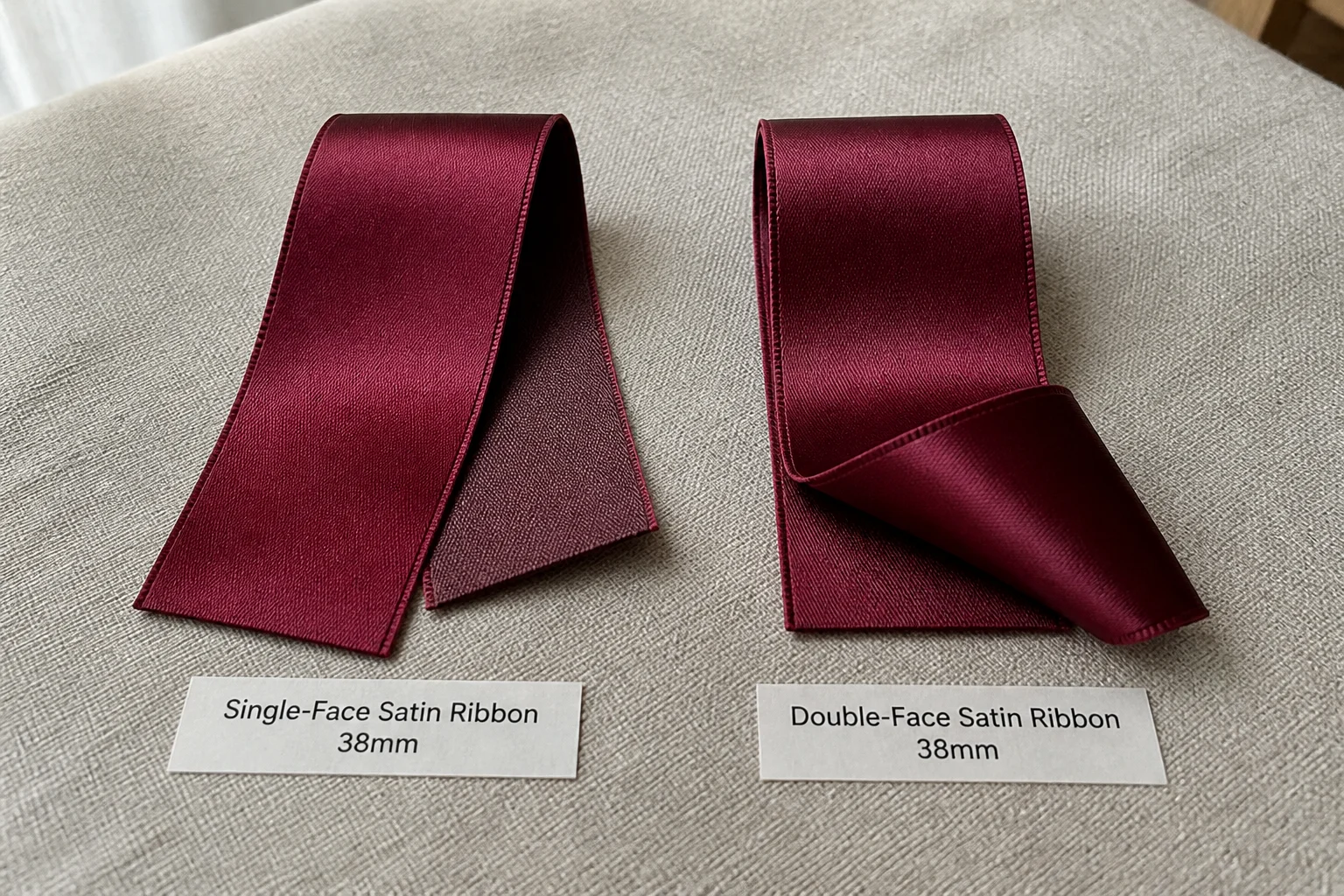
When the Back of the Ribbon Is Visible
The back of a ribbon is visible whenever the ribbon is twisted, folded, looped, or wrapped in a way that exposes the reverse side to view. The most common examples:
Hand-tied bows: In a multi-loop bow, the ribbon twists as each loop is formed. On every other loop, the back of the ribbon faces outward. With single-face satin, these alternate loops show the dull woven back — creating a visible inconsistency in the bow. With double-face satin, every loop looks the same.
Bouquet stem wrap: When ribbon is wrapped around flower stems, the leading edge of each wrap reveals the reverse side. For a professional finish, double-face satin is standard in floristry.
Hanging decorations and streamers: Any ribbon used in a hanging installation will twist in air movement, periodically revealing its back. Double-face is the correct specification for decorative hanging applications.
Visible knots and ties: When ribbon is tied in a visible knot (as opposed to a hidden tie), both faces are exposed in the knot structure.
When Single-Face Satin Is Sufficient
Single-face satin is the right choice when the back of the ribbon is permanently hidden:
Straight-pull bows made by machine: Automated bow-making machines produce bows where the loops are formed consistently in one direction. If the machine always presents the same face outward, single-face satin produces a bow that looks identical to a double-face bow — because the back is always tucked inward.
Flat ribbon applied to packaging surfaces: Ribbon glued flat to a box lid, used as a stripe detail, or applied as a surface decoration has only one face visible. Single-face is standard for these applications.
Tag ribbon and loop hangers: Short ribbon loops used as hang tags or closure ties on packaging typically show only one face in use.
Roll-edge applications: Ribbon used as an edge trim on fabric products, sealed or folded at the edge, typically shows one face only.

Price and Availability
Double-face satin costs more than single-face satin in the same width and colour. The price difference typically ranges from 15–30% depending on construction, width, and order volume. This reflects the additional complexity of the double-face weave structure and the higher yarn consumption required to produce identical surfaces on both sides.
Both constructions are widely available from ribbon manufacturers in the standard width range (10mm to 100mm) and in stock colour ranges. For custom colours, both constructions are produced via the same dyeing process, so lead times are comparable. If you are unsure which to specify, double-face is the safe default for any premium or visible application — the cost premium is modest and the performance guarantee is unconditional.
Frequently Asked Questions
Can I use single-face satin for hand-tied bows if I always keep the same face outward?
Technically yes, but it requires consistent ribbon handling discipline that is difficult to maintain in a production environment. An experienced gift wrapper who ties bows by hand all day can usually control face orientation reliably. In a packing line with multiple operators, or any situation where the ribbon is handled quickly, orientation consistency is hard to guarantee. For bows where the quality is important, double-face eliminates the risk entirely. Contact mystyleribbon.com if you want to test single-face performance against your specific bow style before committing to your order.
Is double-face satin more durable than single-face?
Durability is similar for both constructions — both are typically polyester, which is resistant to tearing, fading, and moisture. The structural difference is in the weave complexity, not in physical strength. Double-face does have a slightly denser weave structure, which can make the ribbon marginally stiffer and more resistant to fraying at cut edges, but the difference is not significant enough to be the primary reason to specify one over the other. Contact mystyleribbon.com for construction specifications and strength data for your specific application requirements.
Do single-face and double-face satin look different from the front?
From the front face, they are visually identical — the same smooth, shiny satin surface, the same colour saturation, the same drape. The only difference visible when looking at the front face is that double-face ribbon is slightly thicker. This thickness difference is not usually significant in application, but it can affect bow loop volume on very wide ribbon at very large bow sizes. Contact mystyleribbon.com to discuss specification for large-format bow applications where ribbon thickness may be a factor.
What is the typical minimum order quantity difference between single-face and double-face?
Minimum order quantities are typically the same for both constructions — the MOQ is driven by production run economics (loom setup, dye batch) rather than by the weave complexity. Both constructions share the same standard minimums: typically 300–500m per colour for custom colours, with lower minimums for stock colours. Contact mystyleribbon.com for current minimum quantities for your target specification.
Is double-face satin available in the same colour range as single-face?
Yes. Both constructions use the same dye process and the same yarn range, so the available colour palette is identical. Stock colours are typically the same across both constructions. Custom colours can be produced in both constructions simultaneously if both are needed for different applications within the same programme. Contact mystyleribbon.com to confirm stock colour availability in your target width for either construction.