How a Holiday Hamper Brand Cut Packaging Costs by Standardising to Three Ribbon Widths
How a Holiday Hamper Brand Cut Packaging Costs by Standardising to Three Ribbon Widths
Gift hamper packaging is a category where ribbon procurement complexity accumulates quickly. Hamper ranges typically span multiple sizes — from a compact single-product box to a large wicker basket — and each size conventionally receives a ribbon bow proportionate to the container. Left unmanaged, this logic leads to a different ribbon width for each hamper size, plus additional widths for seasonal variations, premium tiers, and limited editions. Over several years of organic product range growth, ribbon SKU counts balloon. This is what had happened to the brand in this case study when we began working with them.
The Starting Point
The brand was a mid-sized UK food and gift hamper company running a range of approximately forty product lines across three seasonal campaigns: Christmas, Easter, and a summer hamper collection. Their ribbon procurement used eleven distinct width and colour combinations — not because eleven combinations were necessary, but because the range had grown incrementally and each addition had seemed logical at the time. The costs of this complexity were spread across multiple line items and therefore not immediately visible as a single problem.
Minimum order quantities: Eight of the eleven ribbon specifications were ordered in quantities below the factory's standard MOQ, requiring them to source from a distributor at higher unit cost — approximately 15–22% premium over factory direct pricing.
Lead time risk: Eleven separate ribbon SKUs, some from different suppliers, meant eleven separate lead time dependencies. A delay on any one SKU could hold up production on the affected hamper line.
Colour matching: Three of the eleven specifications were nominally the same colour (warm gold) but had been sourced from different suppliers over time and showed visible shade variation under retail lighting — a recurring complaint from their retail partners.
Storage cost: Small-quantity rolls of eleven specifications occupied significantly more warehouse space than bulk reels of a consolidated range would require.
The Rationalisation Process
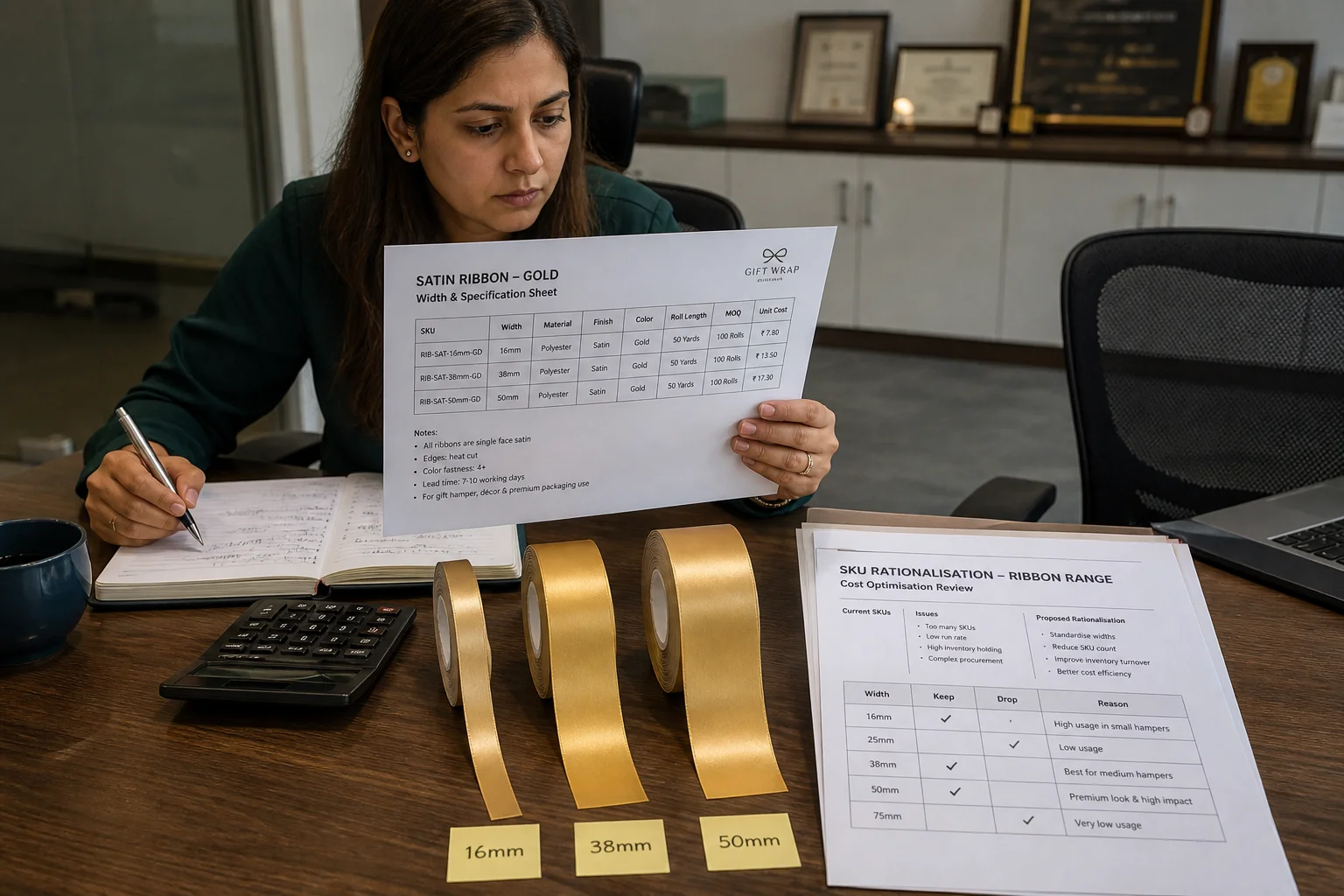
The rationalisation started with a visual audit — laying out all ribbon samples alongside the full hamper range to assess which width was actually doing necessary work versus which had been inherited from an older product version without review. The principle we applied was simple: a bow needs to be proportionate to the container it sits on, but "proportionate" allows a range of acceptable widths. Most containers can accept two or three different widths without the bow looking undersized or overwhelming.
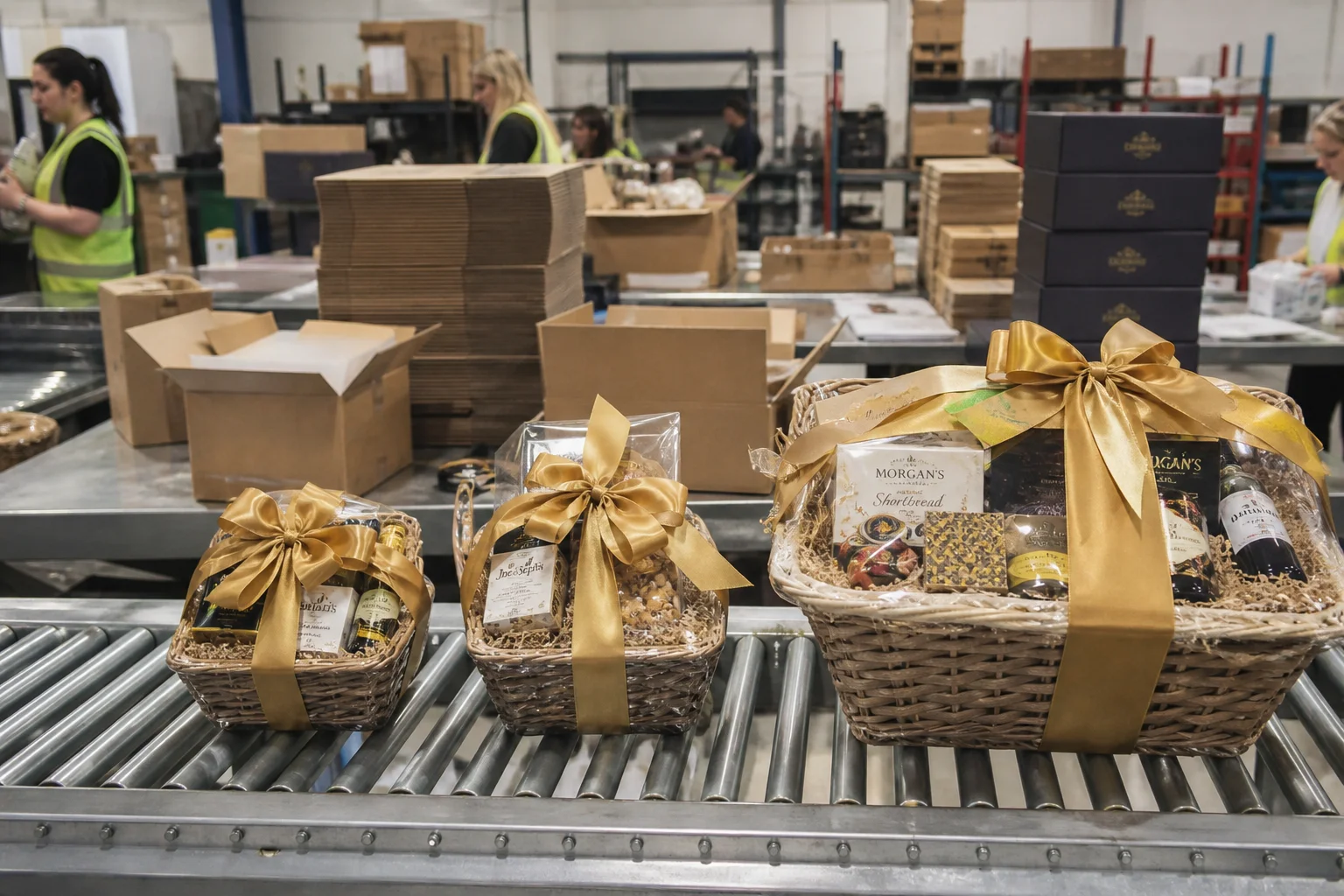
After the visual audit, three widths covered the full range: 16mm for small product boxes and accessories up to 20cm across the top, 38mm for standard hamper baskets and boxes between 25–40cm, and 50mm for large and premium baskets above 40cm. These three widths, in a single warm gold colour, replaced eleven specifications. The result:
All three widths were within factory direct MOQ thresholds — the brand now qualified for factory pricing on all ribbon purchases.
Lead time dependencies reduced from eleven to one supplier relationship with three SKUs on a standing programme.
Colour consistency across the full range — one dye formula, one factory, one reference standard.
Procurement administration reduced proportionally — one supplier, three purchase orders per season instead of multiple orders across multiple suppliers.
The Cost Outcome
The combined savings came from three sources: shifting from distributor to factory direct pricing on all SKUs (approximately 18% unit cost reduction), eliminating waste from small-run minimum orders, and reducing procurement administration. Total ribbon cost reduction across the following season was approximately 23% against the prior year baseline. The brand also reported improved visual coherence — ribbon was now genuinely consistent in colour across all hamper sizes, not just nominally so.
Xiamen Meisida Decoration Co., Ltd (Smith Ribbon & Bow, mystyleribbon.com) works with buyers on ribbon range consolidation analysis as part of the initial programme development process. Contact mystyleribbon.com to discuss your current ribbon SKU count and whether a rationalisation could reduce your procurement costs.
Frequently Asked Questions
How do I know if my ribbon range is too complex?
Common indicators: more than five to six ribbon specifications for a single product range; any specifications being sourced from distributors due to insufficient volume for factory direct MOQs; visible colour inconsistency between nominally same-colour specifications; ribbon procurement involving more than two supplier relationships. If any of these apply, a rationalisation review is likely to identify savings. Contact mystyleribbon.com for an initial ribbon SKU audit consultation.
Will standardising to fewer widths make the packaging look repetitive?
Not in practice. Visual variety in hamper packaging comes primarily from the container, the product arrangement, and overall presentation — not from small differences in ribbon width. Brands associated with strong packaging presentation typically use restrained ribbon specifications, not elaborate ones. Three widths used consistently and proportionately reads as coherent, not monotonous. Contact mystyleribbon.com to discuss proportioning principles for your specific range.
What is the minimum order quantity for factory direct ribbon pricing?
For standard satin ribbon in stock colours and widths, factory direct pricing at Xiamen Meisida typically becomes available from 300–500 metres per colour per width. Custom colours have higher MOQs. A rationalisation exercise is designed to consolidate specifications until your seasonal volume per SKU reaches these thresholds. Contact mystyleribbon.com to calculate whether your current volumes qualify for factory direct pricing.
How long does a ribbon range rationalisation take to implement?
The analysis phase typically takes two to four weeks including sample development. Implementation aligns with the normal production calendar. For a Christmas programme, decisions should be finalised by June to allow sample approval and production within standard lead time. Contact mystyleribbon.com to discuss timing for your programme.
Can rationalisation work if I have multiple brand tiers with different quality expectations?
Yes. The standard approach uses different constructions (single-face versus double-face, or different weights) in the same width per tier, rather than different widths. This maintains tier differentiation while keeping width complexity low. Contact mystyleribbon.com to discuss multi-tier ribbon specification strategy for your range.