How Ribbon Colour Consistency Is Maintained Across Large Production Runs — A Buyer's Guide
How Ribbon Colour Consistency Is Maintained Across Large Production Runs — A Buyer's Guide
Colour consistency is one of the most common sources of disputes in ribbon procurement. A buyer approves a lab dip, receives a first production sample, confirms it, and places a full order. Then the bulk delivery arrives and the ribbon looks different — not dramatically different, but enough that it reads as a different shade under the store's lighting conditions, or enough that it does not match the other packaging components it was meant to coordinate with. Understanding why this happens, and what a well-run factory does to prevent it, makes buyers more effective at specifying and approving ribbon orders.
Why Colour Varies Between Batches
Dye chemistry is not perfectly repeatable. The same formula on the same machine on two different days produces results that are close — but not necessarily identical. Variables include water pH and mineral content, dye lot variation, yarn tension, bath temperature stability, and processing time. In a factory with mature quality systems, these are monitored and controlled. For buyers, colour consistency between batches is a managed outcome, not a guaranteed one — and it depends on what control systems the factory actually operates.
The Three Control Points
A well-run ribbon factory manages colour consistency at three points in the production process:
Dye formula management: The formula used for each approved colour is recorded, stored, and used as the reference for every subsequent production run of that colour. The formula specifies the exact dyes, concentrations, and process parameters. If the formula is not recorded, the colour cannot be reliably reproduced. This sounds obvious; it is not universally practised.
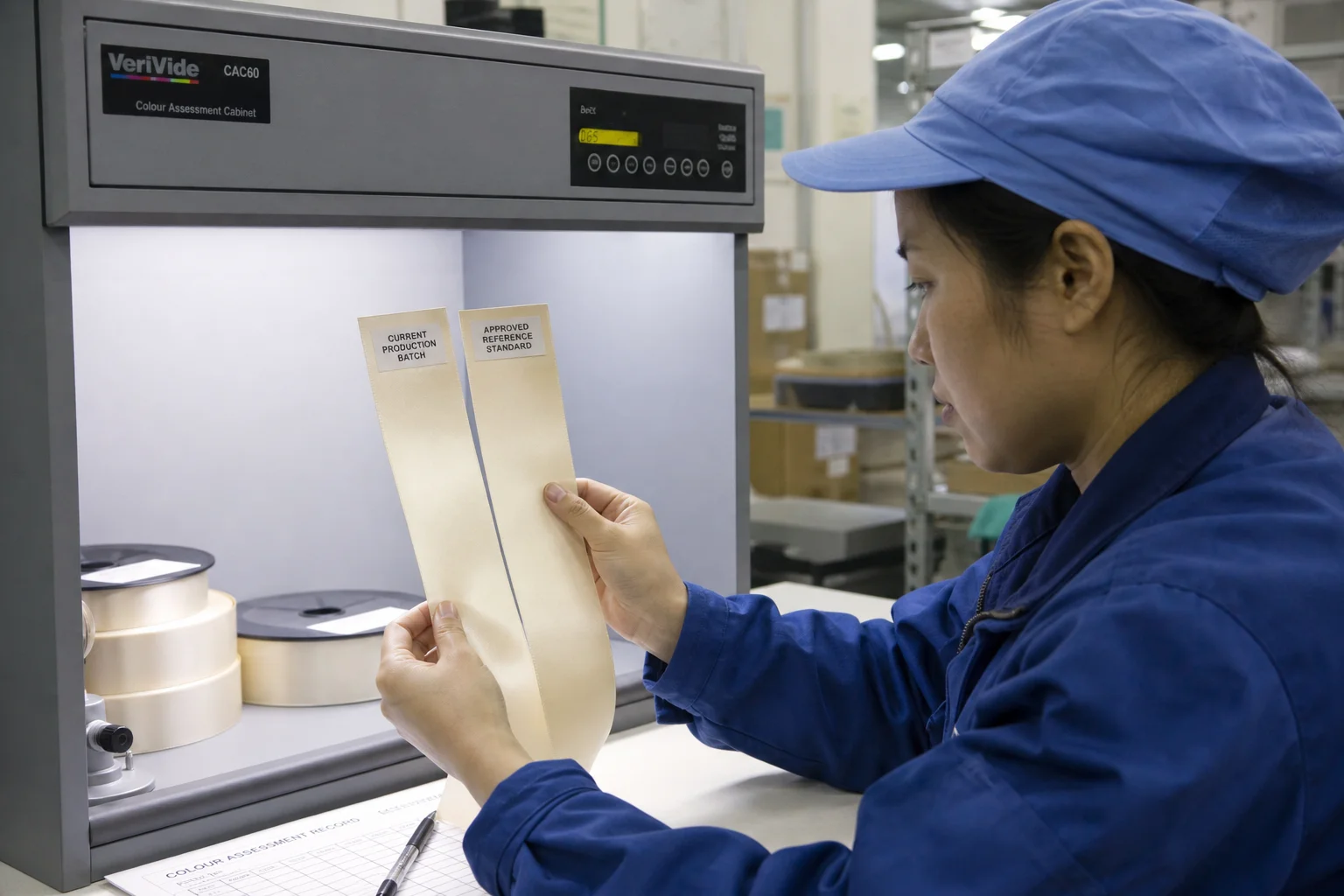
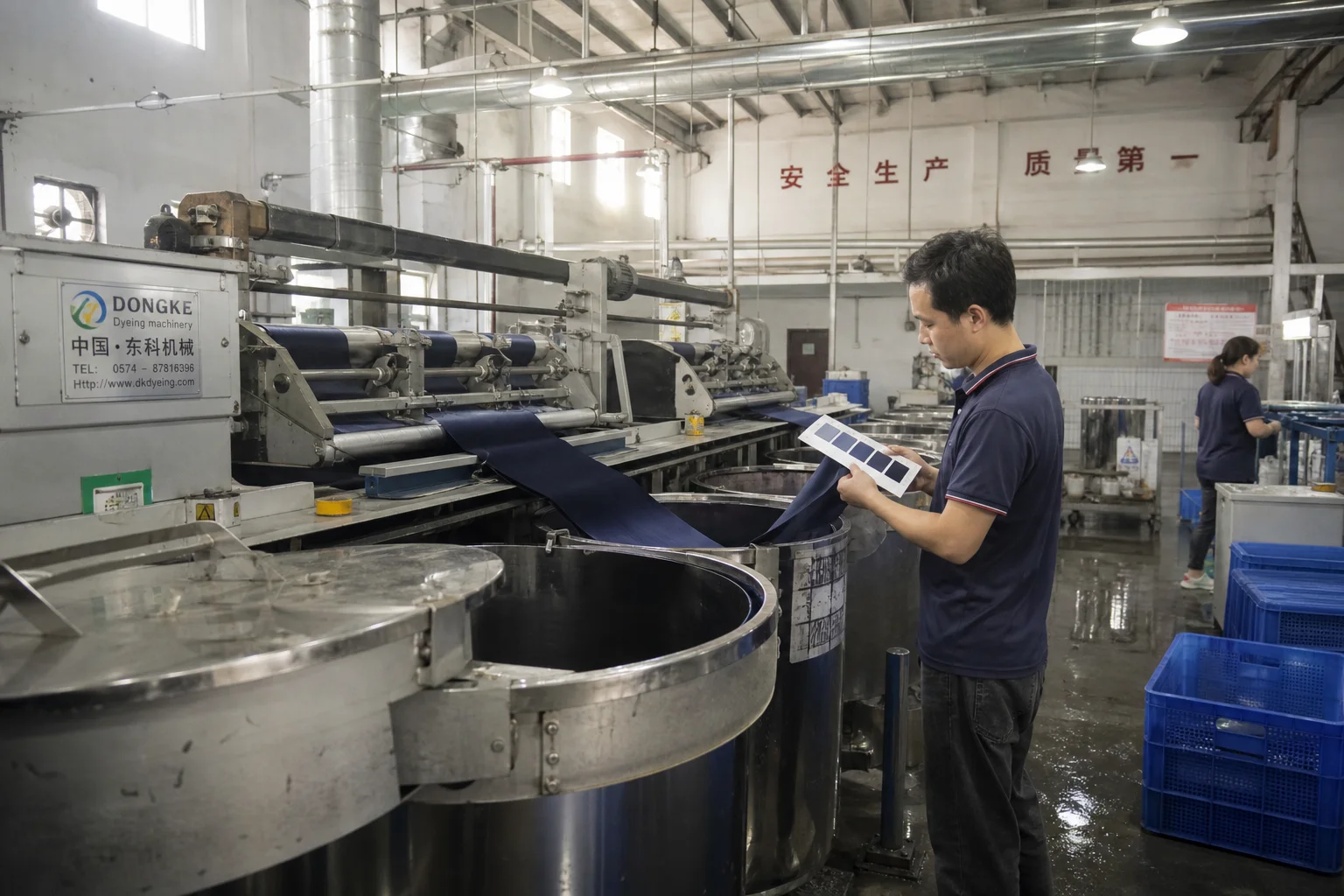
In-process colour checks: During dyeing, samples are pulled from the dye bath at defined intervals and compared against the approved standard under controlled lighting conditions. If the in-process sample is outside tolerance, the batch is adjusted before it continues to the next processing stage. A factory that only checks colour at the end of the dyeing process has no opportunity to correct mid-process drift.
Final QC comparison: Before finished ribbon is rolled and packed, it is compared against the approved reference standard under standardised lighting (D65 daylight simulation is the industry standard for colour assessment). Any lot that falls outside the agreed tolerance range is rejected, reported, and either re-dyed or discarded.
What Buyers Can Do to Protect Consistency
Several buyer-side practices significantly reduce the risk of colour inconsistency across large orders:
Keep the approved reference sample: Retain a physical sample of the approved colour — ideally the approved lab dip or first production confirmation sample, sealed in a labelled bag with the order reference. This is your legal and practical reference point if a dispute arises. Do not rely solely on the factory's records.
Specify tolerance in writing: Include a colour tolerance specification in your order documentation. The standard metric for colour difference in the textile industry is Delta E (ΔE). A tolerance of ΔE ≤ 1.5 under D65 illumination is typical for premium packaging ribbon; ΔE ≤ 2.5 is common for standard commercial ribbon.
Request pre-shipment colour confirmation: For large orders, request a pre-shipment confirmation sample for colour check before the full order is dispatched. This adds a few days to the delivery timeline but eliminates the risk of a full container of off-colour ribbon arriving at your warehouse.
Consolidate colour approvals by season: Approve your seasonal colours once, early, and use them as the standing reference for all orders within that season. Avoiding mid-season colour re-approvals reduces the number of opportunities for variation to be introduced.
Frequently Asked Questions
What is a Delta E tolerance and how do I know what to specify?
Delta E (ΔE) is a numerical measure of the difference between two colours as perceived by a standard observer. ΔE 1.0 is approximately the threshold of perceptibility under ideal conditions — a trained observer can detect a colour difference at this level; most consumers cannot. ΔE 2.0 is detectable by most trained observers. ΔE 3.0 and above is perceptible to most consumers in a side-by-side comparison. For premium packaging ribbon, a tolerance of ΔE ≤ 1.5 under D65 is a reasonable specification. For standard commercial gift wrap ribbon, ΔE ≤ 2.5 is more typical. Specify the illuminant (D65) and the observer standard (CIE 10°) alongside the ΔE value. Contact mystyleribbon.com to discuss colour tolerance specifications for your ribbon programme.
What causes the most common colour consistency problems in ribbon orders?
The most frequent causes: (1) the factory has no formalised dye formula archive, relying on operator memory; (2) a different dye lot is used in bulk production than in the approved lab dip, without running a verification test batch; (3) colour is assessed under factory lighting rather than standardised D65 conditions. All three are preventable with basic quality systems. Contact mystyleribbon.com to discuss QA practices before placing an order.
Can I request a colour match to a specific Pantone reference?
Yes. Pantone references are useful for specifying colour intent, but the actual match must be developed through lab dip trials — the factory creates a formula that produces a visual match on the specific yarn and construction, then the buyer approves the lab dip rather than the Pantone number itself. Contact mystyleribbon.com to initiate a colour match development.
What should I do if bulk ribbon arrives with a visible colour difference from the approved sample?
Document immediately with photographs under consistent lighting, compare against your retained approved sample, and request a formal ΔE measurement report from the factory. Do not release the ribbon into production before the dispute is resolved. Contact mystyleribbon.com for guidance on documenting and resolving a colour quality dispute.
How does Xiamen Meisida manage colour consistency across large orders?
Xiamen Meisida Decoration Co., Ltd (Smith Ribbon & Bow, mystyleribbon.com) maintains a formalised dye formula archive, conducts in-process colour sampling during dyeing, and performs final QC colour comparison under D65 standardised lighting before packing. For large orders requiring split production runs, colour is matched between runs before packing. Contact mystyleribbon.com to request colour management documentation for your programme.