How a Seasonal Gift Programme Reduced Ribbon SKUs by 40% Without Losing Visual Range
How a Seasonal Gift Programme Reduced Ribbon SKUs by 40% Without Losing Visual Range
Most ribbon procurement programmes grow by accumulation. A new season brings new colours. A new brand initiative adds a few widths. A specific campaign requires a custom shade that doesn't quite fit the existing palette. Over several years, what started as a manageable list of fifteen or twenty ribbon specifications has become forty or sixty — with some colours appearing only once a year, some widths duplicated across near-identical shades, and a stockroom that requires more management time than the volume justifies.
The case for SKU rationalisation is straightforward in principle and uncomfortable in practice. Buyers are often reluctant to cut items that have appeared in past programmes, even when usage data shows they are minor contributors. The fear is that reducing the range means reducing visual variety — that the packaging will start to look repetitive. That fear is usually wrong, but it needs to be addressed with data, not reassurance.
The Actual Problem: Overlap, Not Variety
When most retail gift programmes are audited properly — looking at which ribbon SKUs appear in which products and at what volume — the pattern that emerges is not variety. It is overlap with gaps. There are typically three to five colours that do 70–80% of the volume, a middle tier that serves specific product lines, and a long tail of colours each contributing less than 2% of annual use.
The long tail is expensive in ways that don't show up in the per-unit cost. Each SKU requires a minimum order quantity to produce at price. Each SKU occupies warehouse space and generates handling cost. Each SKU requires a reorder trigger and a supplier interaction. Each SKU in a seasonal programme requires a colour approval per season even if the specification hasn't changed. The overhead per SKU is roughly constant regardless of how much of that SKU is actually used.
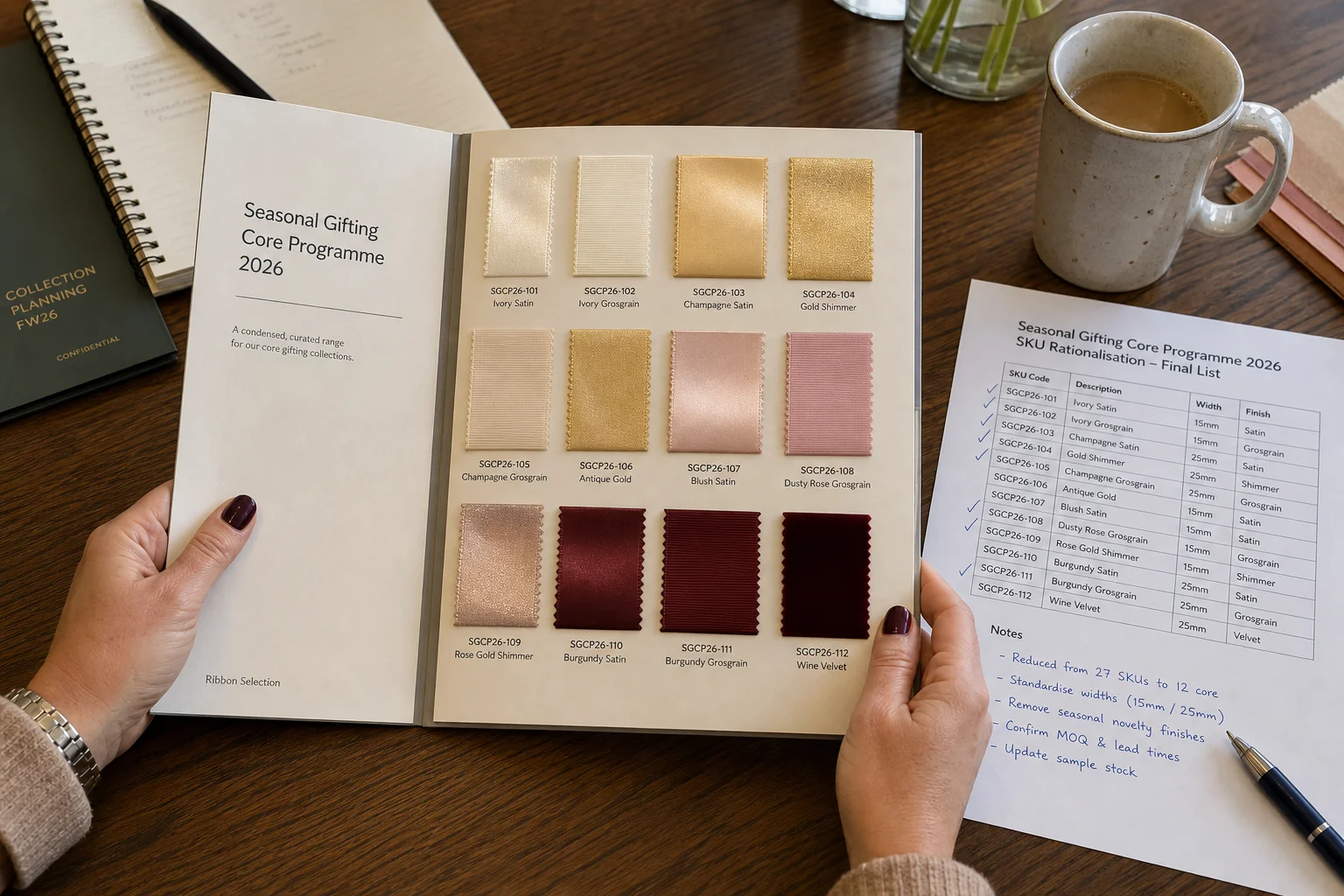
Visual variety in gift packaging comes primarily from form, finish, and proportion — not from having fifteen slightly different neutrals. Four well-chosen neutrals (warm white, champagne, gold, blush) cover the visual territory of eight to twelve near-neutral variants, because the eye distinguishes warmth and undertone more reliably than small chroma differences in the same tone family.
How the SKU Reduction Was Done
The approach that produces real results without visual regression involves three steps:
Volume audit by SKU: Rank all ribbon SKUs by annual units used. The 80/20 pattern almost always holds — identify the core performers and the long tail clearly.
Substitution mapping: For each long-tail SKU, identify whether an existing core SKU could substitute with minimal visual impact. This is a sample exercise, not a spreadsheet exercise — put the alternatives side by side in the actual packaging context and assess honestly.
Consolidation negotiation: Once the reduced SKU list is defined, the consolidated volume across fewer lines creates better pricing and better stock availability. A supplier running 500,000 metres of four colours has better service levels than one managing 50,000 metres each across forty colours. The volume concentration is a genuine lever.
The Inventory Benefit
Fewer SKUs means simpler safety stock calculations. Instead of managing reorder points for forty items each with independent demand curves, a rationalised programme manages a handful of high-confidence lines where demand is predictable and the supplier relationship is well-established.
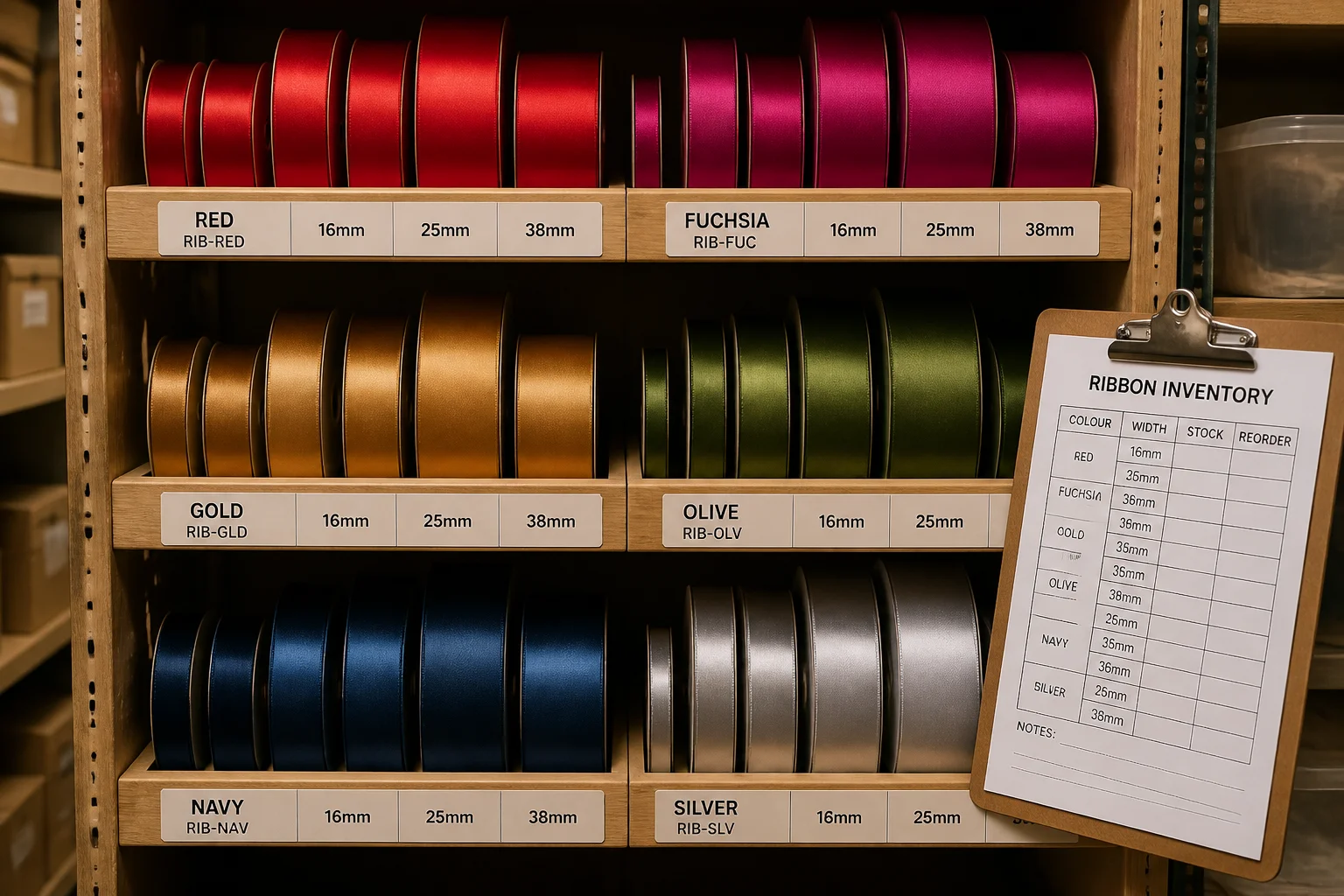
The practical result is that safety stock levels can be held lower without increasing stockout risk, because the consolidated volumes mean each line is restocked more frequently and in more predictable cycles. A buyer managing a rationalised programme of twelve ribbon SKUs with a reliable supplier typically carries less total ribbon inventory — in metres and in cost — than a buyer managing forty SKUs with fragmented supplier relationships, even when the volume programmes are the same size.
What This Looks Like with a Factory Supplier
The SKU rationalisation benefit is most pronounced when working directly with a factory. A factory supplier holds the dye formula for programme colours on a standing basis and quotes shorter lead times on repeats because setup is already done. Xiamen Meisida Decoration Co., Ltd works with buyers on seasonal core programme documentation — a defined set of colours, widths, and specifications registered for standing reorder. Contact mystyleribbon.com for core programme setup and volume pricing.
Frequently Asked Questions
How do I know which ribbon SKUs are candidates for elimination?
Volume-rank every ribbon SKU from the past two seasons. SKUs in the bottom 20% of volume are primary candidates. Then run a substitution test with physical samples: can an existing core SKU replace the candidate with acceptable visual impact in the real packaging context? If yes, eliminate and transfer the volume. Contact mystyleribbon.com for sample sets to support substitution testing.
Does reducing ribbon SKUs require renegotiating supplier terms?
Rationalisation typically improves terms — when volume is concentrated into fewer SKUs, per-line order quantities increase, which moves remaining lines to better price tiers. Suppliers benefit from fewer colour runs. Present your consolidated specification list and ask for revised pricing based on the new volume profile. Contact mystyleribbon.com to discuss pricing for consolidated seasonal specifications.
What is a realistic timeline for SKU rationalisation?
Implement at a season boundary — before spring or before holiday. Audit to confirmed substitutes to supplier agreement typically takes four to six weeks. The first season needs active monitoring; by the second, reduced management overhead is fully realised. Contact mystyleribbon.com for transition timeline planning.
Can a rationalised programme still accommodate special or limited-edition colours?
Yes — rationalisation applies to the standing programme only. Special colours for limited-edition campaigns are ordered as separate one-time specifications outside the core structure. The key is keeping special colours genuinely special — not accumulating them into the standing programme. Contact mystyleribbon.com to structure standing and special-edition specs separately.
How does Smith Ribbon and Bow support programme rationalisation?
Xiamen Meisida Decoration Co., Ltd (mystyleribbon.com) provides: sample sets for substitution testing; colour consistency documentation (ΔE ≤1.0 across batches); and programme documentation formally registering agreed specifications for standing reorder. The output is a defined core programme with documented specs, standing pricing, and agreed reorder terms. Contact mystyleribbon.com to begin a core programme consultation.