How Consistent Lead Times Are Actually Built — What Buyers Should Know Before They Assume
How Consistent Lead Times Are Actually Built — What Buyers Should Know Before They Assume
Every ribbon supplier quotes lead times. Twenty-one days. Thirty days. Forty-five days for large orders. Buyers write those numbers into their planning sheets and build seasonal timelines around them. Then the order runs a week late, then two, and the buyer is expediting freight or explaining to their own customers why the packaging isn't ready. The lead time wasn't wrong exactly — it was just a number without the production structure behind it.
Lead time consistency is a production capacity question, not a logistics one. A supplier who quotes a lead time and hits it reliably across seasons and order types has built the infrastructure that makes that number real. Understanding what that infrastructure looks like helps buyers evaluate suppliers more accurately and plan with less buffer.
What Actually Drives Lead Time Variation
Most lead time slippage in ribbon manufacturing comes from a small set of causes. Colour development is the most common — when a buyer submits a Pantone reference and the supplier needs to develop a new dye formula, that adds days or weeks. A supplier with an established colour library can match most commercial shades from existing formulas; one without that library develops every unusual shade from scratch.
Yarn availability is the second cause. Suppliers who hold working yarn inventory or maintain framework agreements with yarn mills can start production without waiting for materials. Those who buy yarn order-by-order are exposed to yarn lead times stacked on top of their production lead times — without necessarily disclosing that to the buyer.
Loom capacity allocation is the third factor. An order for 50,000 metres of standard ivory 38mm ribbon is trivial to absorb. An order requiring eight different width changes across 30,000 metres total creates far more setup time per unit. Suppliers who are honest about scheduling complexity give buyers a realistic picture; those who quote flat lead times regardless of order composition are averaging across variance that will sometimes hit the buyer directly.
Questions That Produce Useful Answers
Is lead time from order confirmation or from approved sample? Sample approval can add one to three weeks. If the clock starts from sample approval and development hasn't started, your actual timeline is longer than the headline number.
Does the quoted lead time cover all widths and colours equally? Standard widths in commercial colours are typically faster; custom widths or development colours may differ. A supplier who can separate these is giving actionable data.
What is on-time delivery performance in Q3/Q4? Lead times achievable in Q1 may not be achievable in September when every supplier is running at peak capacity. Historical performance in the season you actually need is the relevant number.
What happens when production runs behind? Understanding whether the supplier can accelerate production or whether airfreight is the only option helps buyers build realistic contingency costs before placing the order.
Capacity and Integration
A supplier running at 95% utilisation has almost no ability to accelerate an order without displacing another customer. Buyers placing volume with tight timing should understand whether the supplier has genuine capacity to accommodate the requirement — not just willingness to say yes.

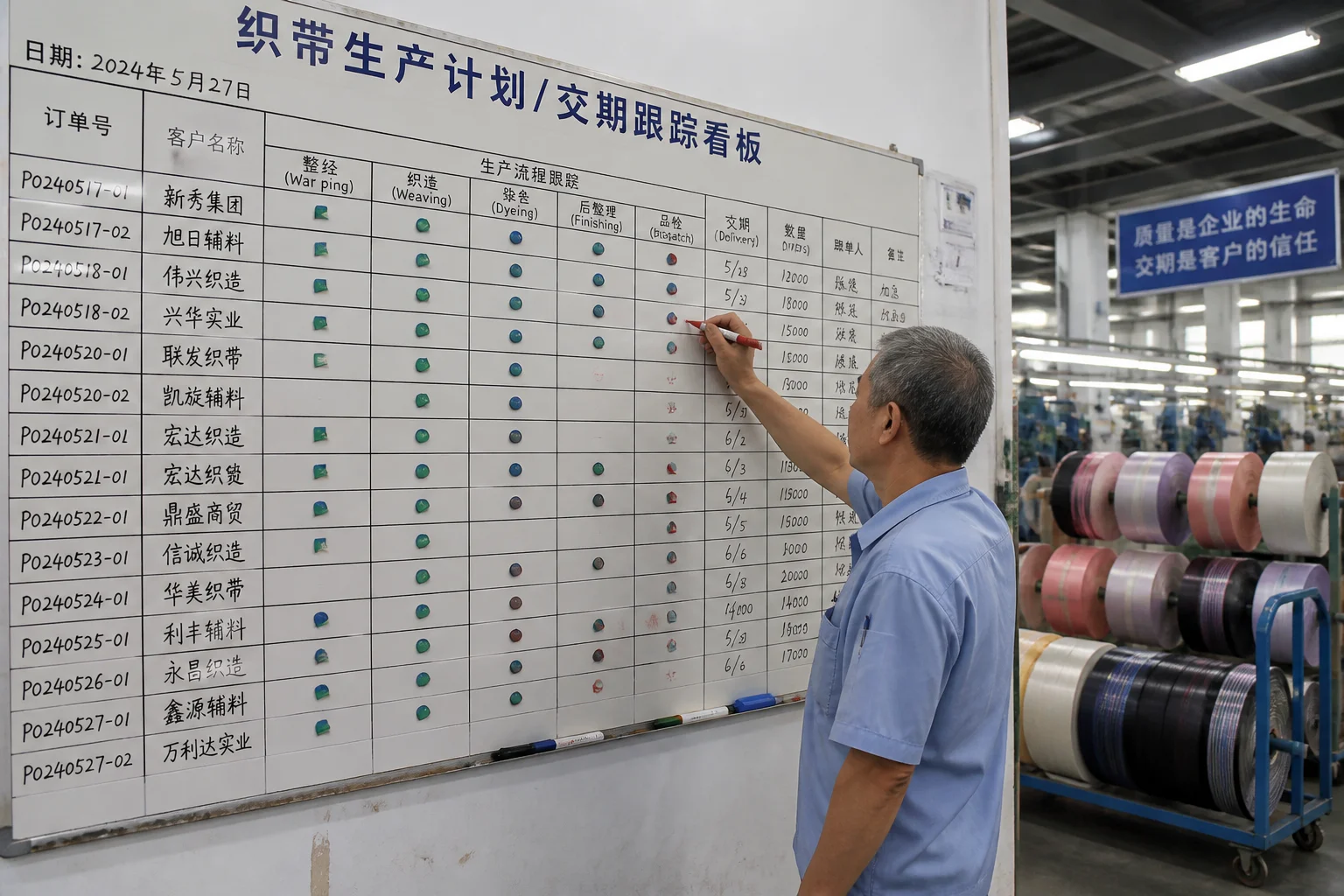
Xiamen Meisida Decoration Co., Ltd operates weaving, dyeing, and finishing under one roof. Integration removes the inter-factory handoff delays — waiting for dyed yarn to transfer between facilities — that add unpredictable time to orders placed with coordinators managing a supplier network rather than running a factory. Integration eliminates one entire category of lead time variance.
What a Reliable Commitment Looks Like
A lead time commitment that is likely to be achievable comes from a supplier who: distinguishes between standard and development lead times and can explain the difference; can describe current capacity utilisation and whether room exists for your volume in your time window; has a documented process for handling delays — early communication, acceleration options, and escalation path.
A supplier who answers those questions specifically is describing a production operation that has actually thought about lead time management. One who gives confident numbers and vague answers is describing an aspiration. Contact mystyleribbon.com for lead time specifications and capacity availability for Smith Ribbon & Bow requirements.
Frequently Asked Questions
Why does the same supplier sometimes deliver faster and sometimes slower?
Delivery time variation reflects current capacity utilisation, colour and specification complexity, and order size relative to machine setup cost. Standard colours from existing dye formulas are faster than development shades. Very small orders may wait for a batch run. Understanding these variables gives buyers more accurate planning data than treating lead time as a fixed property of the supplier. Xiamen Meisida Decoration Co., Ltd (mystyleribbon.com) provides expected lead times by order specification at inquiry stage.
How much buffer should I build into my ribbon sourcing timeline?
For programmes with hard in-store date requirements and any colour development involved, two weeks of buffer beyond the quoted lead time is a reasonable minimum. For standard commercial colours in stock widths, one week is usually sufficient. Buffer should also account for freight time variability, customs clearance, and internal receiving — independent of production timeline. Contact mystyleribbon.com for specification-specific lead time guidance.
Does lead time change for GRS-certified ribbon?
For items Xiamen Meisida holds as standard certified rPET stock, there is no meaningful lead time difference. For custom specifications in certified material, add approximately one to two weeks for yarn sourcing confirmation. Contact mystyleribbon.com with certification requirements at inquiry stage.
What is the minimum order for reliable lead time performance?
Lead time commitments are most reliable at quantities allowing full production runs — typically from 300 metres per colour per width. Blanket orders with scheduled release dates typically achieve better reliability than independent small orders. Contact mystyleribbon.com to discuss arrangements.
Is airfreight ever worth using for ribbon?
Only in genuine emergency replenishment where the stockout cost exceeds the airfreight premium. For standard commercial volumes, air freight per kilogram makes it economically irrational except as a last resort. Building planning lead time to make airfreight unnecessary is the correct approach. Contact mystyleribbon.com to discuss expedited production options first.