What Is the Difference Between Woven Ribbon and Printed Ribbon — Which Is Better for Custom Branding?
What Is the Difference Between Woven Ribbon and Printed Ribbon — Which Is Better for Custom Branding?
When buyers ask for "custom ribbon with our logo," they usually have one of two things in mind without knowing the technical distinction: a ribbon where the logo is woven into the fabric, or a ribbon where the logo is printed on the surface. These are fundamentally different products with different costs, MOQs, durability profiles, and design limitations.
Choosing the wrong method wastes money. Choosing the right one comes down to three questions: How complex is your design? How much volume do you need? How long does the ribbon need to last?
How Woven Ribbon Is Made
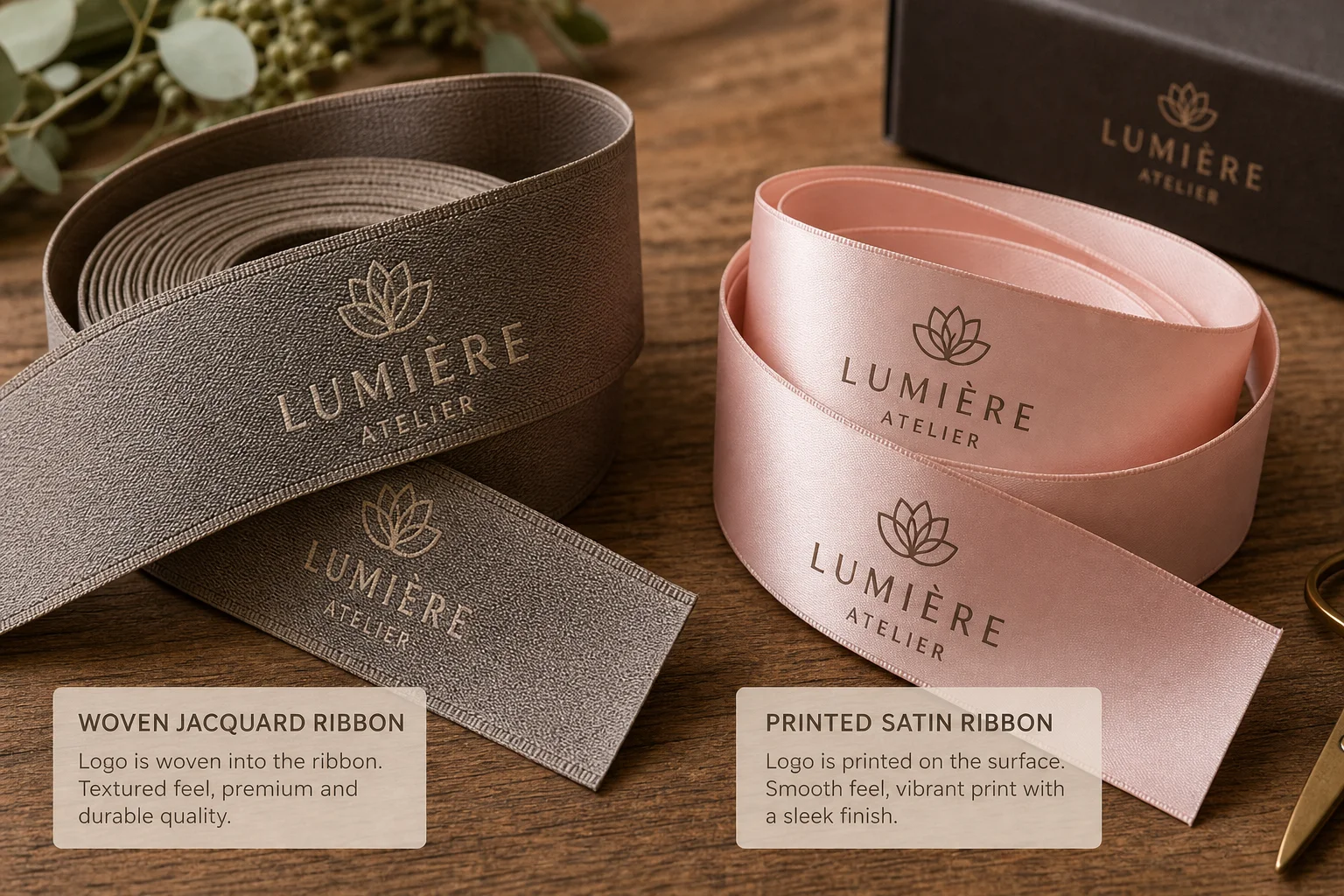
Woven ribbon — specifically jacquard ribbon — uses a programmable loom that controls which warp threads are raised at each weft insertion. By raising different combinations of threads, the loom creates patterns visible on the fabric surface. The design is built into the weave structure itself.
For custom branding, a design card (jacquard card or electronic equivalent) is programmed with the logo or pattern. This card controls the loom and is specific to that design. The setup cost — programming the card — is typically $150–400 per design and is a one-time fee.
Key characteristics of woven ribbon:
Design is structural, not surface-applied — cannot peel, fade from abrasion, or wash out
Limited to simple, high-contrast designs (text, geometric patterns, clean logos)
Cannot reproduce gradients, photographic detail, or fine lines below ~1mm
Premium tactile quality — the pattern has texture you can feel
Higher MOQ (1,000–3,000 meters) due to loom card cost amortization
Longer lead time: 25–35 business days from design approval
How Printed Ribbon Is Made
Printed ribbon starts with a base fabric (typically satin or grosgrain) and applies the design to the surface. Three main printing methods are used:
Screen printing: A screen stencil is made for each color in the design. Dye is pressed through the screen onto the ribbon. Best for solid colors and simple designs. Setup cost: $80–200 per screen. MOQ: 300–800 meters. Most durable print method for ribbon.
Digital / sublimation printing: Design is transferred directly via heat and pressure. No screen setup required. Handles full-color designs, gradients, and photographic detail. MOQ as low as 50–100 meters. Highest per-meter cost; least durable under abrasion.
Heat transfer: Foil or transfer film is applied to the ribbon surface. Used for metallic finishes and effects not achievable with dye. Moderately durable; can peel at heat-seal edges if not applied correctly.
Choosing Between Woven and Printed: Decision Matrix
Use this framework to select the right method:
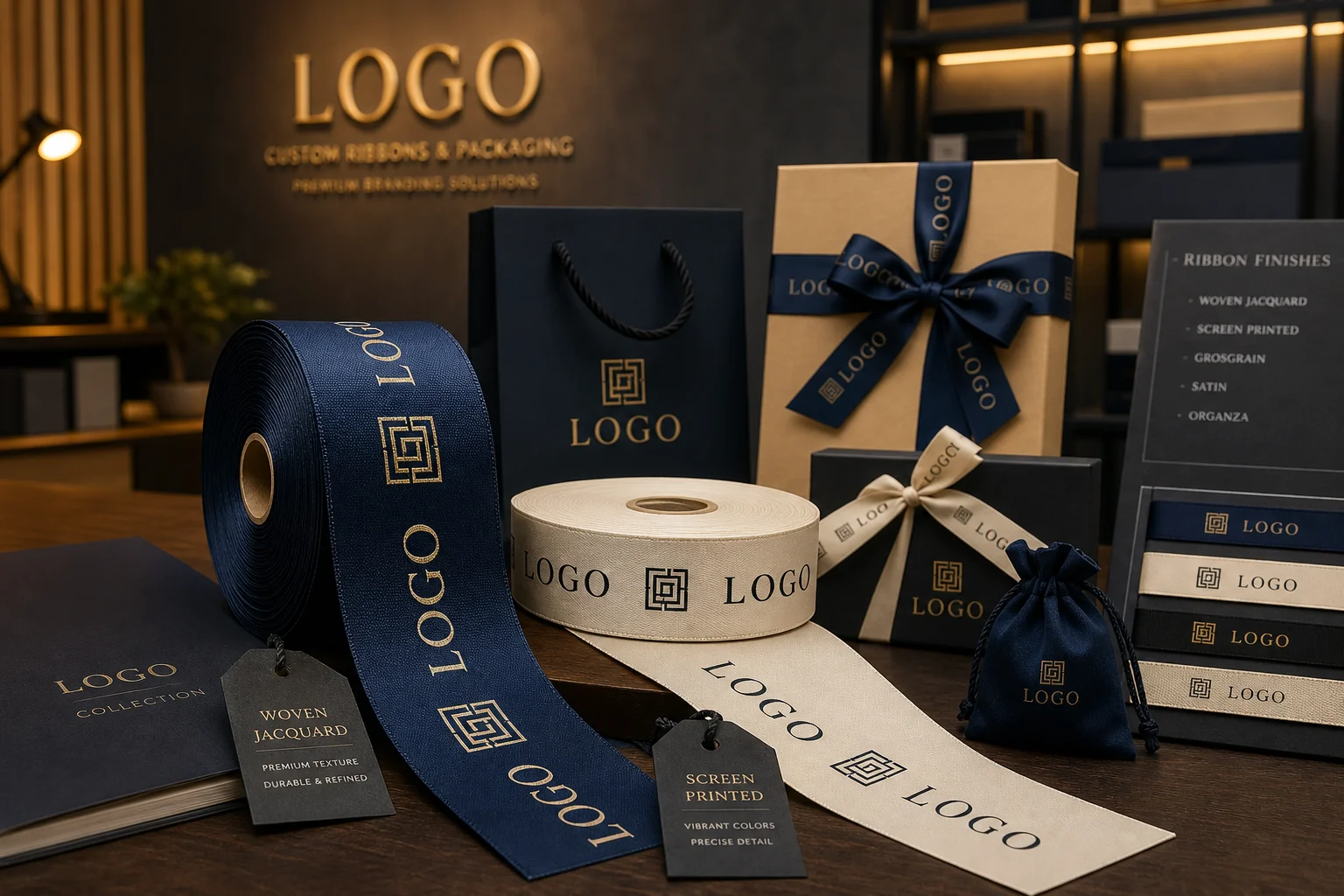
Design is a simple text logo or geometric mark: Woven produces a premium result; printed is an acceptable lower-cost alternative.
Design includes fine detail, gradients, or multiple colors: Printed is the only viable option — woven cannot reproduce these accurately.
Annual volume exceeds 2,000 meters per design: Woven becomes cost-competitive with screen printing once the card cost is amortized. Below 2,000 meters, printed is usually lower total cost.
Ribbon will be handled frequently, stored in varying conditions, or used outdoors: Woven ribbon holds up better. Printed ribbon degrades under prolonged UV exposure and surface abrasion.
You change designs seasonally: Printed is more flexible — new screen setup is $80–200 versus $150–400 for a new woven card, and at lower MOQs, seasonal changes are viable.
Cost Comparison at Different Volume Levels
The economics shift depending on your order volume. Here is a realistic comparison for a 38mm ribbon with a single-color logo:
At 500 meters total:
Screen-printed satin: setup $150 + 500m × $0.22/m = $260 total ($0.52/m effective)
Woven jacquard: loom card $250 + 500m × $0.38/m = $440 total ($0.88/m effective) — most factories won't accept this volume
Digital print: no setup + 500m × $0.45/m = $225 total ($0.45/m effective)
At 2,000 meters total:
Screen-printed satin: setup $150 + 2,000m × $0.19/m = $530 total ($0.27/m effective)
Woven jacquard: loom card $280 + 2,000m × $0.31/m = $900 total ($0.45/m effective)
Digital print: no setup + 2,000m × $0.42/m = $840 total ($0.42/m effective)
At 5,000 meters total:
Screen-printed satin: setup $150 + 5,000m × $0.17/m = $1,000 total ($0.20/m effective)
Woven jacquard: loom card $280 + 5,000m × $0.28/m = $1,680 total ($0.34/m effective)
Screen-printed ribbon is typically the most cost-effective option across all volumes for buyers who don't require the premium tactile quality or maximum durability of woven. Woven becomes more competitive only when design simplicity allows it and volume is high enough to fully amortize the card cost.
These figures are illustrative based on typical factory pricing ranges. Actual quotes depend on specific factory, color count, ribbon width, and order timing.
Frequently Asked Questions
What is the difference between woven ribbon and printed ribbon?
Woven (jacquard) ribbon has the design built into the weave structure. Printed ribbon has the design applied to the surface via screen, digital, or heat-transfer printing. Woven is more durable and has a premium tactile quality; printed is more flexible for complex designs and lower quantities.
Is woven ribbon more expensive than printed ribbon?
Yes, primarily due to higher setup cost ($150–400 loom card vs $80–200 screen setup) and higher MOQ (1,000–3,000m vs 300–800m). At volumes above 2,000 meters per design, the per-meter cost converges. Below that, printed is usually lower total cost.
Which lasts longer — woven ribbon or printed ribbon?
Woven ribbon. The design cannot peel, fade from abrasion, or wash out because it is structurally part of the fabric. Screen-printed ribbon is the most durable printed option; digital printing is least durable under friction and UV exposure.
What types of designs work better on woven vs printed ribbon?
Woven suits simple, high-contrast designs: clean text logos, geometric patterns, single-color motifs. Printed handles complex multi-color designs, gradients, and fine detail. If your logo requires more than two colors or has fine elements below 1mm, printing is necessary.
What is the minimum order quantity for custom woven ribbon vs custom printed ribbon?
Woven jacquard: 1,000–3,000 meters per design. Screen-printed: 300–800 meters. Digital/heat-transfer: 100–300 meters. Trading companies may advertise lower minimums by pooling orders across customers.