How Double-Faced Satin Ribbon Is Made — Production Standards That Guarantee Consistent Sheen on Both Sides
How Double-Faced Satin Ribbon Is Made — Production Standards That Guarantee Consistent Sheen on Both Sides
Most buyers who specify double-faced satin ribbon are focused on the end result: a ribbon that looks identical on both sides, suitable for applications where the back of the ribbon is visible. What fewer buyers check is whether the ribbon they receive actually meets that standard — or merely approximates it.
Double-faced satin is not simply a ribbon with two shiny sides. It is a specific weave construction that requires different loom configuration, higher warp density, and precise heat-setting than single-face ribbon. A factory that produces single-face ribbon can attempt double-face on the same equipment, but the result will have unequal sheen between the two faces — visible to an experienced eye, and sometimes visible to a customer who turns over a bow.
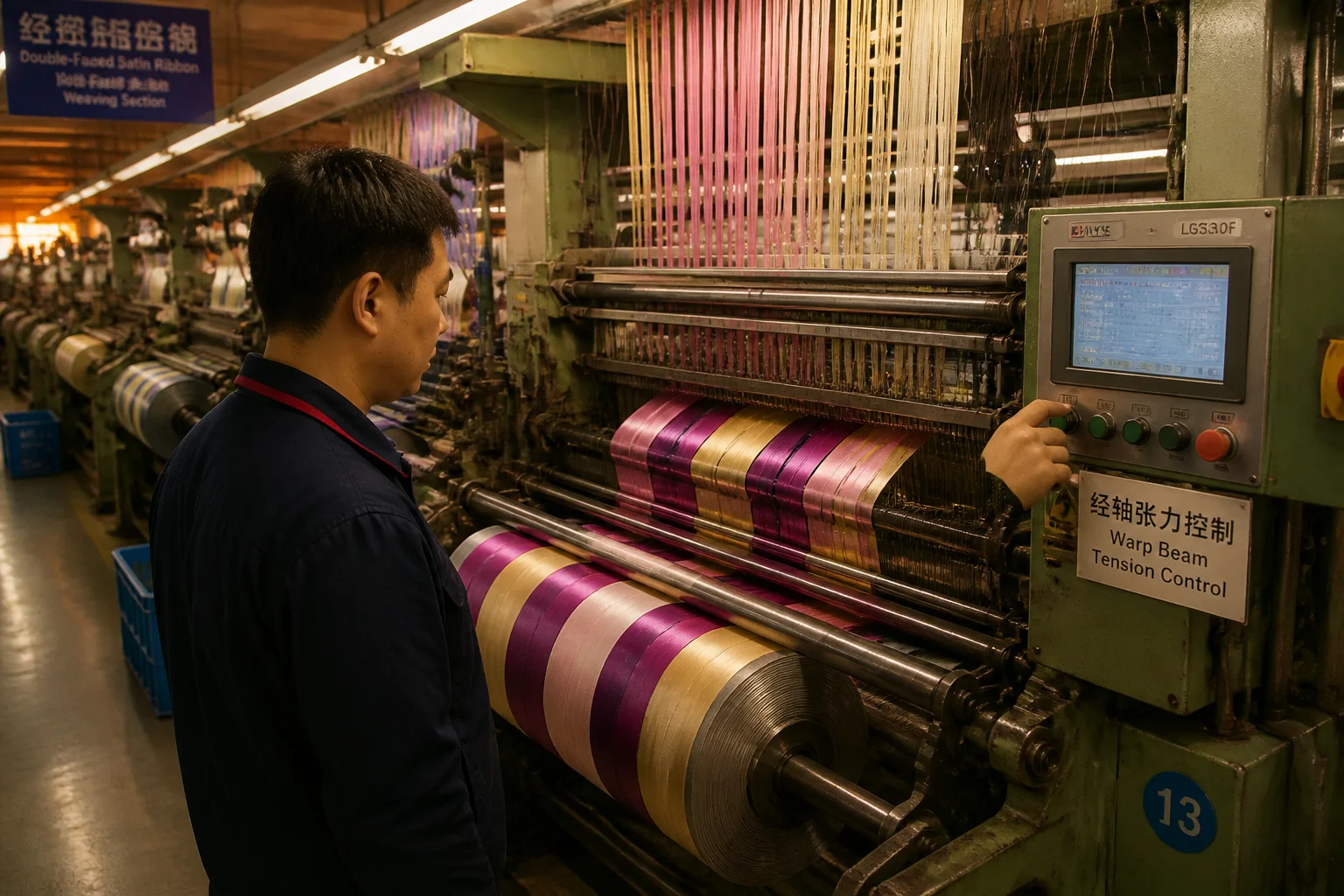
The Weave Structure: Why Double-Face Requires a Different Loom Configuration
Satin sheen comes from floating warp threads: threads that pass over multiple weft threads before interlacing. These long floats lie parallel on the surface, reflecting light uniformly to produce the characteristic sheen.
In single-face satin, all the floating warp threads are concentrated on one side — the face. The back shows the interlacing structure, which produces a matte surface.
Double-face satin distributes floating warp threads on both faces simultaneously. This requires:
Higher warp density: 160–200 warp threads per centimeter vs 90–130 for single-face. The additional threads create the float structure on both sides.
Symmetric loom configuration: The loom must be set to distribute threads equally to both faces. Standard single-face looms concentrate threads toward one side; this cannot be corrected without reconfiguring the machine.
Matched float ratio: The number of weft crossings before each interlace must be equal on both faces. Any imbalance shifts thread distribution, making one face shinier than the other.
A factory that produces single-face ribbon as its main product and occasionally attempts double-face is unlikely to have looms configured for symmetric warp distribution. The resulting ribbon will look like double-face at a glance but will show sheen asymmetry under direct light.
Heat-Setting: The Step That Determines Whether the Sheen Holds
After weaving, satin ribbon is heat-set: passed through a controlled temperature zone (180–220°C for polyester) that stabilizes the polymer structure and locks the floating warp threads in their final position.
For double-face ribbon, heat-setting must be uniform across the full width. Two failure modes occur when it isn't:
Edge-to-center temperature gradient: If the ribbon passes unevenly through the heat zone, the edges receive more heat than the center. Over-heated edges produce a different surface texture than the center, visible as a variation in sheen intensity across the width.
Face-to-face gradient: If the ribbon is heated from one side only, the top face stabilizes differently from the bottom. The result is measurably different reflectivity between the two sides on the finished ribbon.
Verifying heat-setting quality requires production documentation, not only sample inspection. Ask suppliers for the heat-setting temperature log for your batch and the target temperature range. A factory that cannot provide this documentation is running without process records — which means they cannot guarantee consistency across a large order.
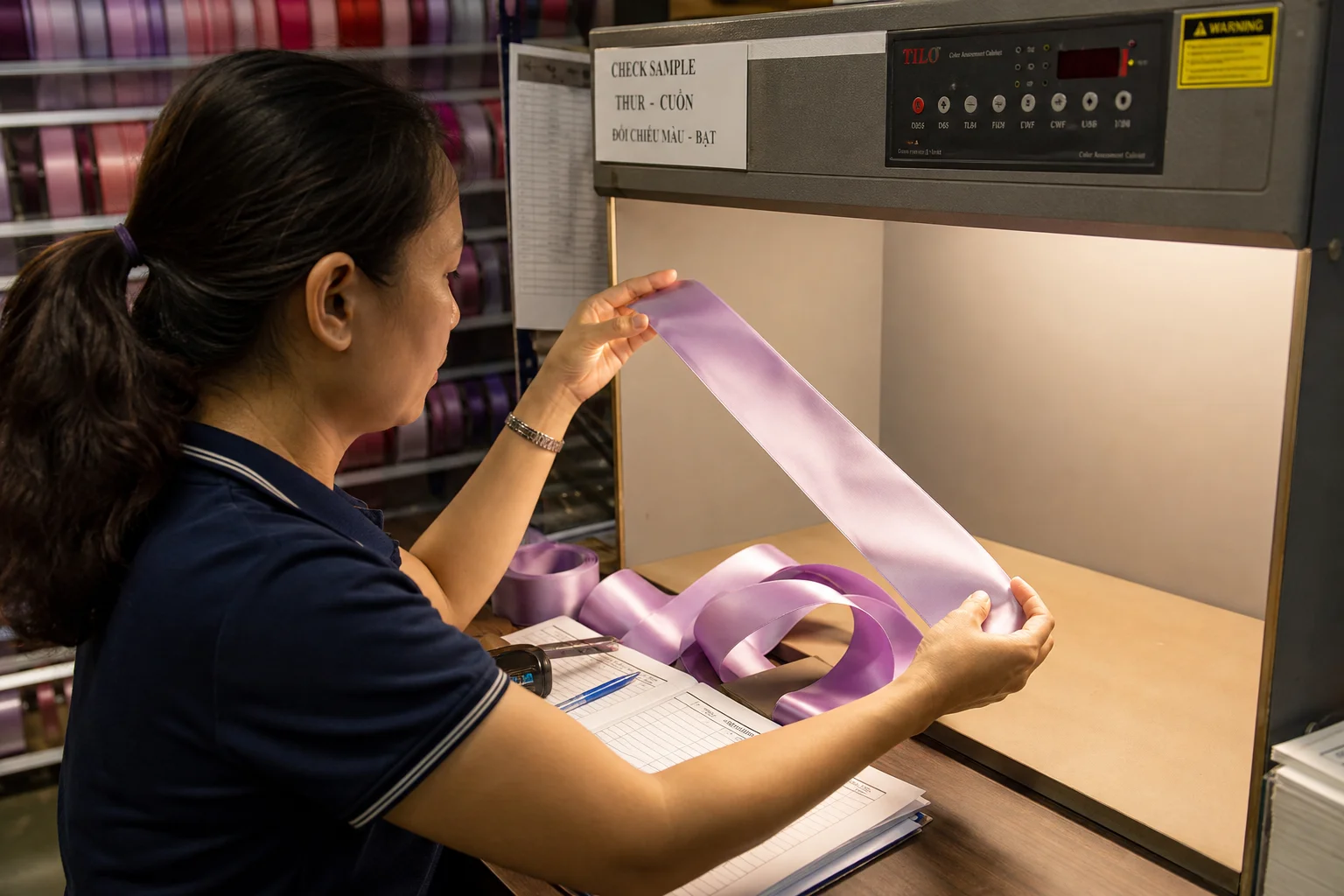
How to Evaluate a Double-Face Ribbon Sample Before Ordering
A production sample test takes less than five minutes and reliably identifies uneven sheen before you commit to a bulk order:
Cut a 30cm length of the sample ribbon.
Hold it at arm's length under a consistent light source (daylight or a lamp, not fluorescent overhead).
Tilt the ribbon 45 degrees toward and away from the light, observing both faces in sequence.
The two faces should reflect light at identical intensity. Any visible difference — one face brighter, one with a slight grey tint — indicates unequal warp distribution.
Loop the ribbon: the inner face of the loop is under slight tension; the outer face is under slight compression. Both should still look identical at this point.
Tie a loose knot and examine both faces of the knot. Uneven sheen is often most visible under the tension of a knot.
For large orders, request three samples from three different production runs of the same specification. Compare across runs. Consistent double-face ribbon should be indistinguishable between runs; variation across samples indicates inconsistent loom setup or heat-setting between batches.
What to Specify in Your Purchase Order
A purchase order that specifies only "double-faced satin ribbon, 38mm, ivory" gives the factory no verifiable production targets. Add the following specifications:
Warp density: Minimum 160 warp threads per centimeter (for standard double-face construction)
Sheen symmetry: Both faces shall have equal reflectivity as assessed by visual inspection under direct light at 45 degrees — no visible sheen difference between faces
Heat-setting documentation: Batch heat-setting temperature log to be provided with each shipment
Width tolerance: ±0.5mm from specified width
Sampling requirement: 5% incoming inspection, 3 rolls minimum, measured at start and end of each roll
Frequently Asked Questions
What is the difference between single-face and double-face satin ribbon in production?
Single-face satin has floating warp threads on one side only. Double-face requires symmetric warp distribution on both faces, higher warp density (160–200 vs 90–130 threads/cm), and a loom configured specifically for symmetric production.
Why does double-faced satin ribbon sometimes have uneven sheen between the two sides?
Uneven sheen results from unbalanced warp density between faces, non-uniform heat-setting, or using single-face looms to attempt double-face production. Request documentation and evaluate samples under direct light to identify this before ordering.
How can I verify that a double-faced satin ribbon has consistent sheen before ordering?
Cut a 30cm sample, view both faces under direct light at 45 degrees. Both should reflect identically. Tie a knot and inspect both faces of the knot — any sheen difference is most visible under tension.
What is the typical warp density for double-faced satin ribbon?
160–200 warp threads per centimeter. Single-face satin uses 90–130. Lower density attempts at double-face production produce visible sheen asymmetry.
Is double-faced satin ribbon worth the higher cost for gift packaging?
Yes when both sides are visible — cascading bows, chair sashes, transparent boxes. For applications where only one side shows, single-face at 20–35% lower cost is functionally equivalent.