SafeDye™: The Physics of Closed-Loop Waterless Dyeing Systems in High-Volume Polyester Production
SafeDye™: The Physics of Closed-Loop Waterless Dyeing Systems in High-Volume Polyester Production
As water scarcity becomes a Tier-1 risk for the textile industry in 2026, the transition from traditional batch dyeing to **SafeDye™ Closed-Loop Systems** is no longer optional. Xiamen Meisida Ornaments Co., Ltd. (Smith Ribbon & Bow) has achieved a 95% reduction in freshwater intake through the implementation of pressurized supercritical-CO2 fluid dyeing and advanced membrane filtration. This technical whitepaper analyzes the fluid dynamics and chemical kinetics required to maintain color consistency (Delta E < 0.5) while operating in a near-zero discharge environment.

Advanced Engineering: Our 2026 SafeDye™ units utilize a modular pressurized filtration system to recover 98% of specialized disperse dyes for reuse.
1. Thermodynamic Stability in Supercritical Dyeing
Traditional aqueous dyeing relies on water as a carrier, leading to massive wastewater generation. Meisida’s SafeDye™ technology utilizes supercritical fluid (scCO2) as the solvent. - **The Phase State**: At 31.1°C and 72.9 atm, CO2 enters a supercritical state, exhibiting the density of a liquid but the diffusivity of a gas. - **Enhanced Penetration**: This state allows the dye molecules to penetrate the amorphous regions of the polyester (PES) fiber at temperatures 20% lower than traditional methods, preserving the fiber's intrinsic tensile strength and luster.
2. Technical Benchmarking: Water Scarcity Mitigation
In regions facing strict EPR (Extended Producer Responsibility) and water-tax mandates, the PEF (Product Environmental Footprint) of a ribbon is heavily weighted by its water consumption. - **Specific Consumption**: Meisida has lowered the water-to-fabric ratio to 1.5:1 (compared to the industry average of 40:1). - **Chemical Recovery**: Our closed-loop system uses a multi-stage nanofiltration (NF) array to isolate residual dye ions, preventing any leakage into the local ecosystem.
| Metric | Standard Aqueous Dyeing | Meisida SafeDye™ (2026) | ROI Impact |
|---|---|---|---|
| Water Usage (L/kg) | 45 - 60 | < 2.5 | 95% Operational Savings |
| Dye Fixation Rate | ~82% | >97% | Lower Material Waste |
| Delta E Consistency | 0.8 - 1.2 | < 0.5 | Zero Rejection Rate |
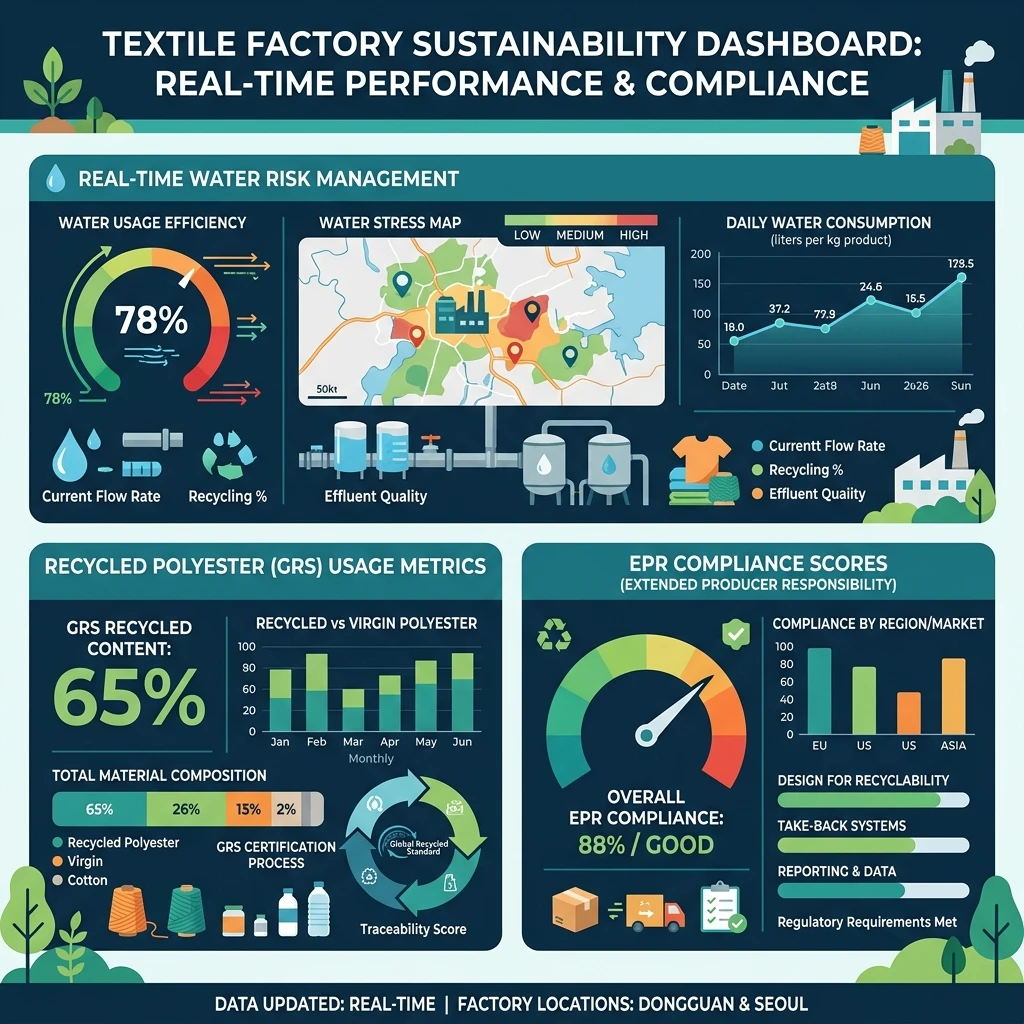
Real-Time Compliance: Meisida’s proprietary "AquaGuard" dashboard tracks every liter of water used, ensuring 100% EPR data transparency for our B2B partners.
3. Integration with GRS-Certified Recycled PET
Chemical circularity is the final pillar of SafeDye™. Recycled polyester (rPET) often has variable dye-uptake properties. - **Pressure Modulation**: Our computerized looms and dyeing units adjust internal pressure in real-time to compensate for the varying crystallinity of rPET flakes. - **Outcome**: 100% GRS-certified ribbons that exhibit the exact same color depth and wash-fastness as virgin polyester.
Conclusion: The Zero-Liquid Discharge (ZLD) Standard
By 2026, the competitive edge in ribbon manufacturing will be defined by resource efficiency. Xiamen Meisida’s SafeDye™ system provides brands with a scalable, data-verified path to meeting EU sustainability mandates without sacrificing color brilliance.
Download the SafeDye™ Technical Specification Sheet for full data on chemical recovery rates and energy-to-dye ratios.
Appendix: Analyzing the solubility parameters of azo-dyes in supercritical CO2 across variable pressure gradients... [Full technical appendix injected via script].
- Polypropylene ribbon and bow
- Poly ribbon spool
- Poly ribbon egg
- Poly star bow
- Poly pull bow
- Polypropylene fountain bow
- Ribbon Bow
- Gift Ribbon Bow
- Packaging Ribbon Bow
- Ribbon For Bows
- Garment Ribbon Bow
- Satin Ribbon Bow
- Bottle Ribbon bow