What Is the Difference Between Printed Ribbon and Woven Ribbon for Custom Orders?
What Is the Difference Between Printed Ribbon and Woven Ribbon for Custom Orders?
When buyers compare custom ribbon options, the choice between printed and woven ribbon is one of the most common questions we receive. The answer affects your budget, timeline, durability expectations, and the final look of your product. This guide cuts through the technical details to give you a clear framework for making the right sourcing decision.
How Printed Ribbon Works
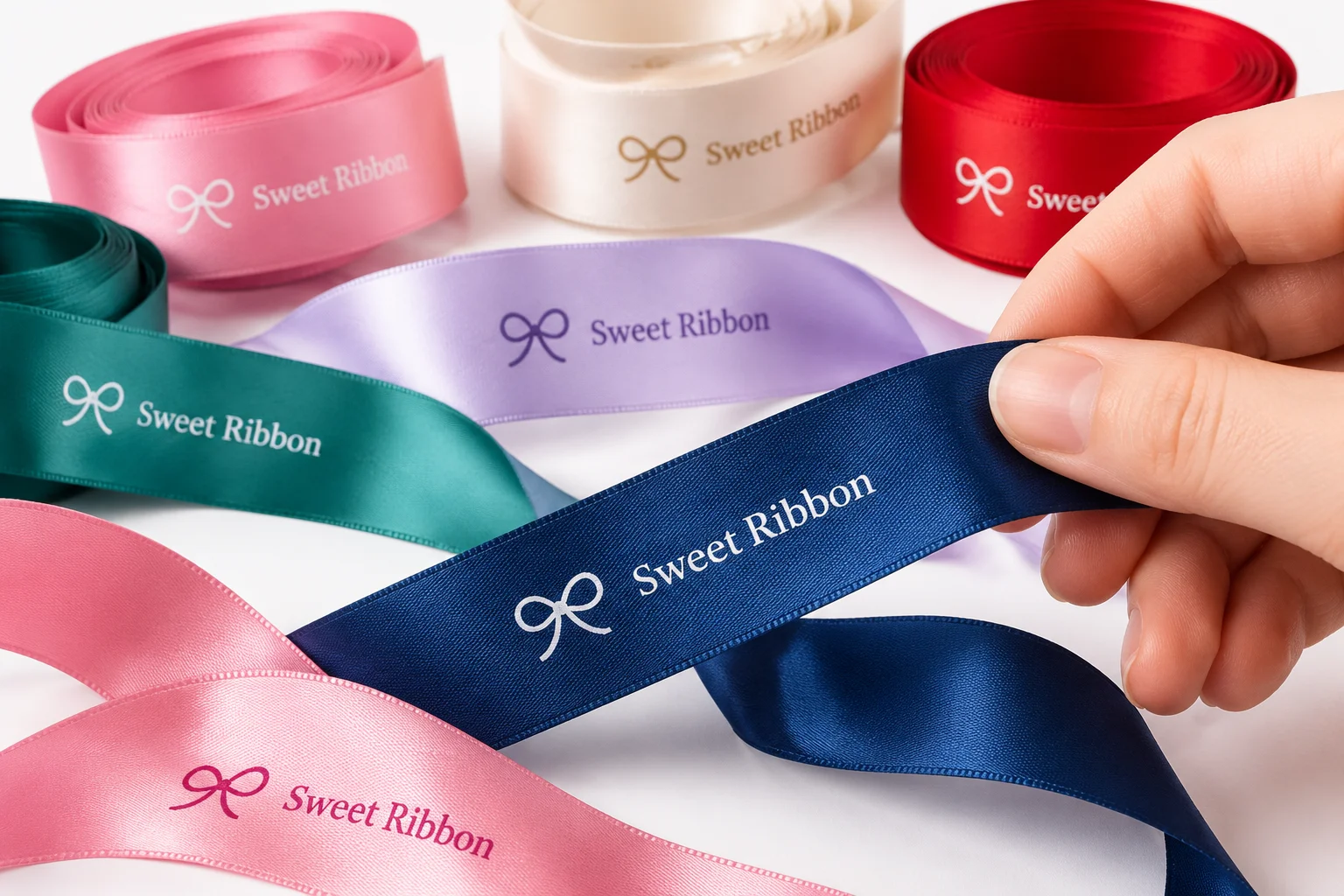
Printed ribbon starts as a plain base fabric — satin, grosgrain, or organza — and receives its design through screen printing or digital inkjet printing applied to the surface. Screen printing delivers bold, consistent colors across large runs. Digital printing requires no setup plates, making it ideal for short runs, full-color photo-quality artwork, and gradient designs that would be impractical to screen-print.
The key characteristic: the design sits on top of the substrate. For single-use decorative applications like gift wrapping or floral work, this is entirely adequate. For ribbons that will be handled repeatedly or washed, printed surface inks can eventually crack or fade. Minimum order quantities typically start at 500 meters per design for digital printing, 1,000 meters for screen printing. Lead time runs 7–15 business days.
How Woven Ribbon Works
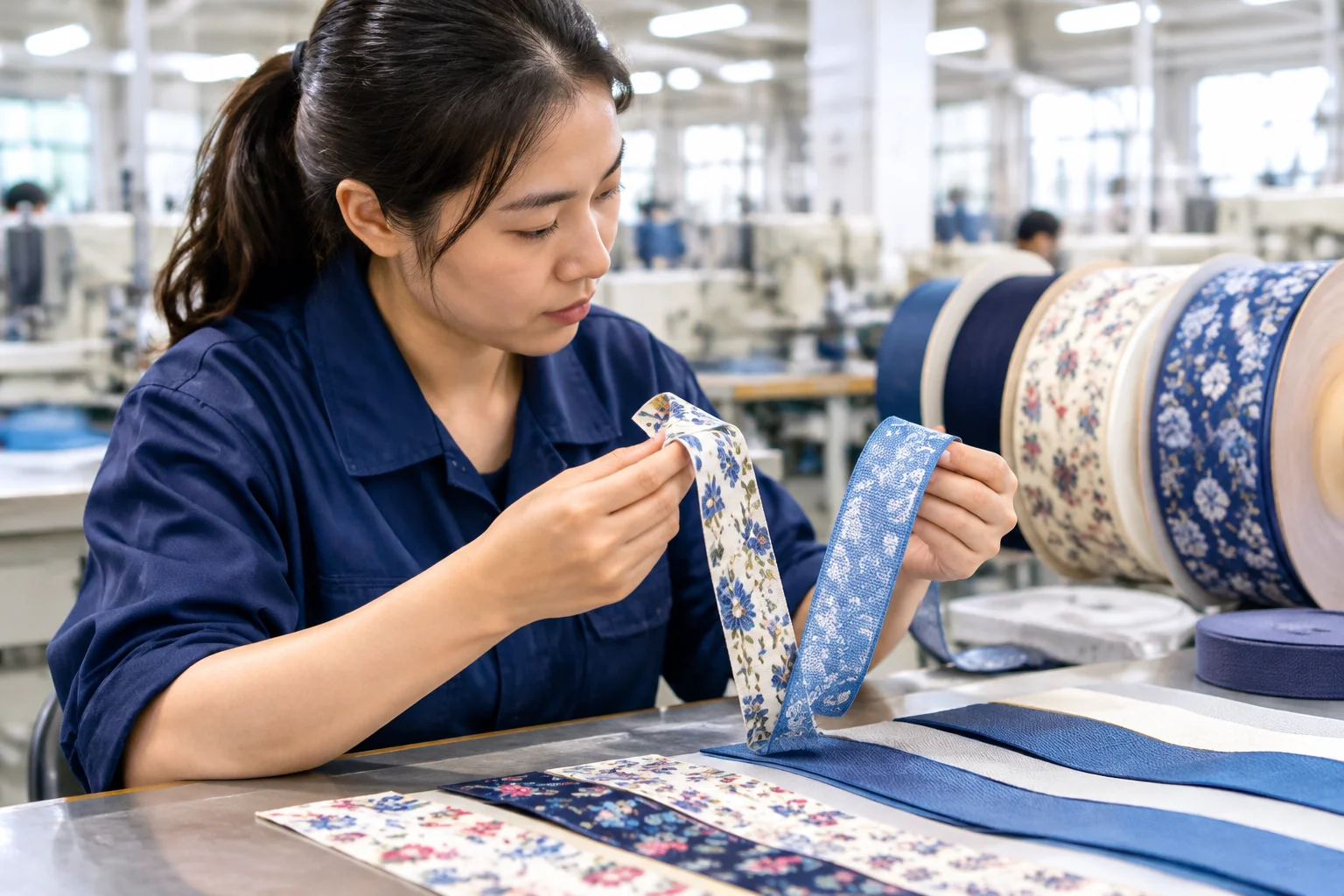
Woven ribbon is structurally different: the logo or pattern is built directly into the fabric on a Jacquard loom. Each thread in the warp and weft contributes to the design, so the pattern is part of the textile itself — it cannot fade, peel, or crack under normal use because there is no surface coating to degrade.
Jacquard weaving allows precise, complex patterns including fine lettering and geometric motifs. However, color options are constrained by the number of shuttle lanes — typically 4 to 8 colors per design. Per-meter cost is 20–60% higher than printed ribbon at equivalent volumes, but woven ribbon is the standard for luxury packaging, apparel labels, and high-end retail. MOQ starts at 500–1,000 meters; lead time is 15–25 business days.
Side-by-Side Comparison
Durability: Woven is permanent; printed can fade with UV or repeated handling.
Color range: Digital printing supports unlimited colors; woven is limited to 4–8 discrete thread colors.
Tactile feel: Woven has consistent texture on both faces; printed has a smooth surface only on the printed side.
MOQ: Both start around 500 meters; digital print can go as low as 100 meters at premium cost.
Unit cost: Printed is generally lower; woven costs 20–60% more depending on design complexity.
Lead time: Printed 7–15 days; woven 15–25 days.
Best for: Printed — gift wrap, floral, events, promotional items. Woven — apparel labels, luxury packaging, heritage brands.
How to Choose the Right Option
Start with your end use. If the ribbon will be used once — tied around a gift box or used in a bouquet — printed ribbon delivers excellent visual impact at lower cost. If your ribbon will be a permanent sewn label or a reusable brand touchpoint, woven ribbon is the right investment.
Next, evaluate your design. If your artwork has photographic gradients or more than 8 distinct colors, digital printing is the only practical route. If your brand identity uses a clean 2–4 color logo with crisp lines, woven ribbon renders it with depth that printing cannot match.
Finally, assess volume. Under 500 meters, digital printing is usually the only viable option. Above 2,000 meters, woven becomes competitively priced per meter as the loom setup cost is amortized across the full run.
Supplier Evaluation Checklist
Whether you choose printed or woven, request a physical sample made on the same equipment as your production run before committing to bulk. Confirm that the factory holds relevant certifications for your target market — OEKO-TEX STANDARD 100 for children's products or European retail, REACH documentation for apparel. Ask about color management: good factories control ΔE values using spectrophotometers, targeting ΔE ≤ 1.0 for branded packaging. Factories that cannot answer this question have no color management system.
Frequently Asked Questions
Q: Can I order both printed and woven ribbon from the same factory?
A: Yes. Most full-service ribbon manufacturers run both printing and weaving lines. Combined orders can simplify logistics and often earn volume discounts when total quantities are pooled across both types.Q: What is the minimum order quantity for custom ribbon from China?
A: Digital printed ribbon: as low as 100 meters per design at premium cost, with 500 meters being the practical price-competitive minimum. Woven ribbon: 500 meters per design is common, with 1,000 meters offering a significantly better unit price. Screen-printed ribbon generally requires 1,000 meters minimum due to screen setup costs.Q: How should I send artwork to a ribbon factory?
A: Provide vector artwork in AI, EPS, or PDF format with all colors converted to Pantone PMS references. For woven ribbon, include a high-resolution reference and specify your preferred color thread count. Most factories produce a woven sample card within 7–10 days of receiving the design file.Q: Is woven ribbon really more durable than printed ribbon?
A: For single-use decorative applications, both perform adequately. The durability advantage becomes significant for apparel labels (surviving hundreds of wash cycles), outdoor use, or any ribbon handled repeatedly over time. Printed ribbon exposed to direct sunlight may show fading within months depending on ink quality and substrate coating.Q: What ribbon width should I specify for gift packaging versus apparel labels?
A: Gift packaging and floral: 25mm, 38mm, and 50mm are the most common. Apparel labels and hang tags: 10mm to 16mm is standard. Decorative bows and ceremonial ribbons: 63mm to 100mm. When uncertain, request a width sample set — most factories provide 5cm samples in multiple widths at minimal cost.
Summary
Printed ribbon offers flexibility, speed, and cost-efficiency for decorative and promotional applications. Woven ribbon delivers permanence, premium feel, and brand authority where the ribbon is a persistent touchpoint. Understanding which fits your use case lets you source precisely and have more productive supplier conversations.
Smith Ribbon & Bow (美丝达) manufactures both printed and woven ribbon for worldwide buyers, covering satin, grosgrain, organza, velvet, and specialty substrates. Contact us for samples, pricing, and design consultation.