What Is the Difference Between Polyester Ribbon and Nylon Ribbon — Which Is Better for Gift Packaging?
What Is the Difference Between Polyester Ribbon and Nylon Ribbon — Which Is Better for Gift Packaging?
Most buyers working in gift packaging have used polyester ribbon without thinking much about what it is made of. Polyester is the default — widely available, reasonably priced, color-stable. Nylon ribbon appears in some catalogs at a higher price point with a softer feel. Whether the difference matters depends on what you are packaging and what you are optimizing for.
This guide covers the practical differences: raw material properties, cost, color behavior, heat resistance, and the specific use cases where one genuinely outperforms the other.
How Polyester and Nylon Differ as Raw Materials
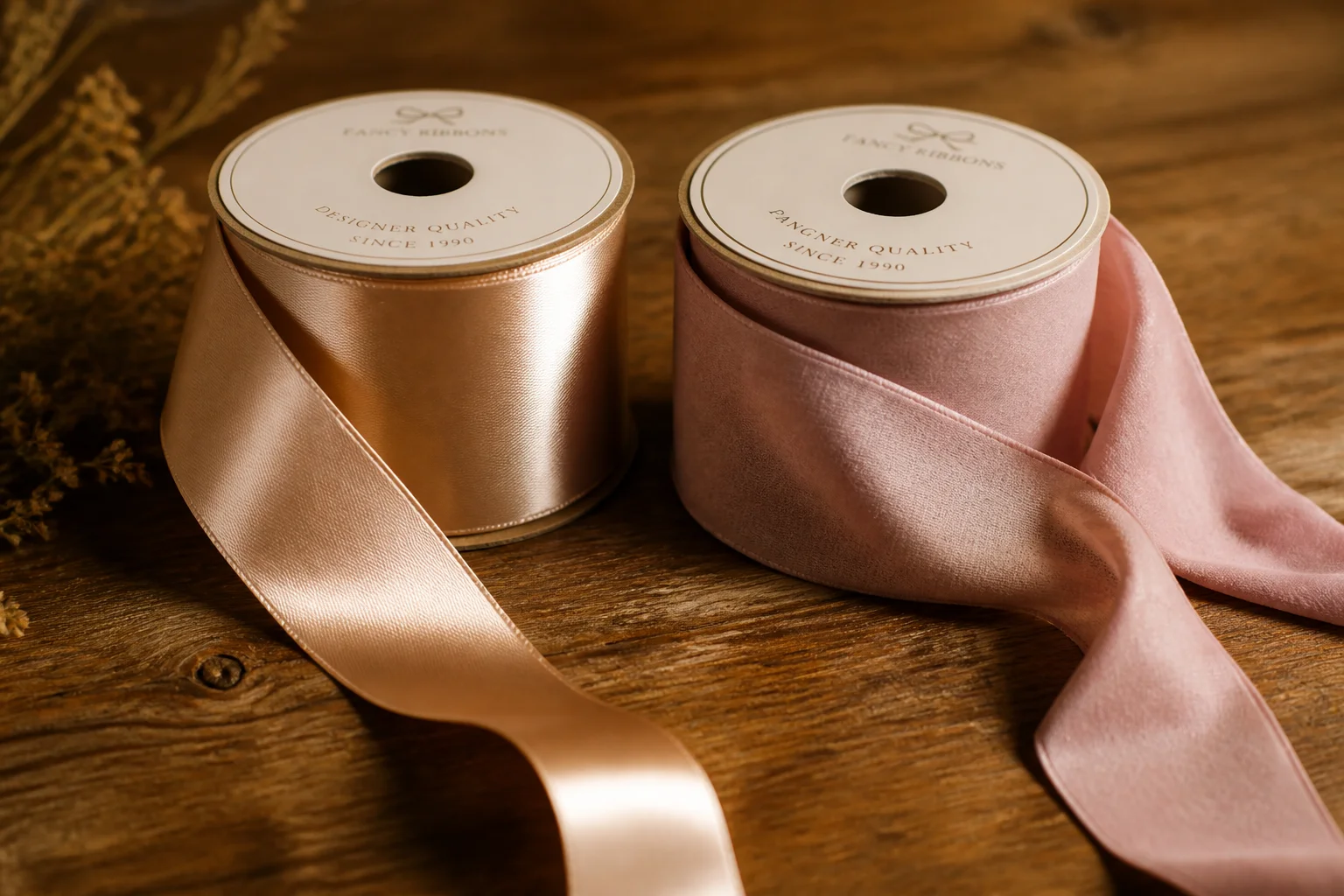
Polyester (PET) is hydrophobic — it does not absorb moisture. This makes it color-stable across humidity variations, resistant to dye migration, and dimensionally stable. Polyester is the most widely produced synthetic fiber globally, so supply chains are deep and costs are predictable.
Nylon (polyamide) is hygroscopic — it absorbs moisture from the environment. Stored in a humid warehouse, nylon ribbon can show slight width changes and dye instability over time. Its softer hand feel and diffuse light reflection make it suitable for sheer or artisan-aesthetic ribbon styles where a stiff glossy finish would look wrong.
Cost Comparison at Sourcing Volume
At typical packaging ribbon volumes (500–5,000 meters per color), the price difference between polyester and nylon is consistent:
Polyester satin, 38mm, standard color: €0.08–0.14 per meter at 500m; €0.06–0.10 per meter at 2,000m+
Nylon ribbon, 38mm, standard color: €0.12–0.22 per meter at 500m; €0.09–0.16 per meter at 2,000m+
The 30–60% premium for nylon is consistent across widths and reflects both higher raw material cost and lower production volume. Polyester accounts for roughly 75–80% of all synthetic ribbon production; nylon is a smaller specialty segment. Fewer manufacturers produce nylon ribbon, which means less price competition and longer sourcing lead times for custom orders.
Color Behavior: Polyester's Advantage for Recurring Programs
Polyester accepts disperse dyes that bond directly to the polymer. Because it is hydrophobic, colors stay stable in storage from 30–70% RH without measurable change. Reorders reliably match the original when the supplier uses consistent dye lot management.
Nylon uses acid dyes — vivid initially, but more sensitive to moisture over time. In humid storage, nylon ribbon can show slight color shift between the first order and a reorder six months later. For single-use seasonal applications this rarely matters. For recurring programs requiring consistent cross-batch color matching, polyester carries less risk.
Surface Appearance and Bow Behavior
The visual difference between polyester and nylon ribbon of the same style is subtle but consistent:
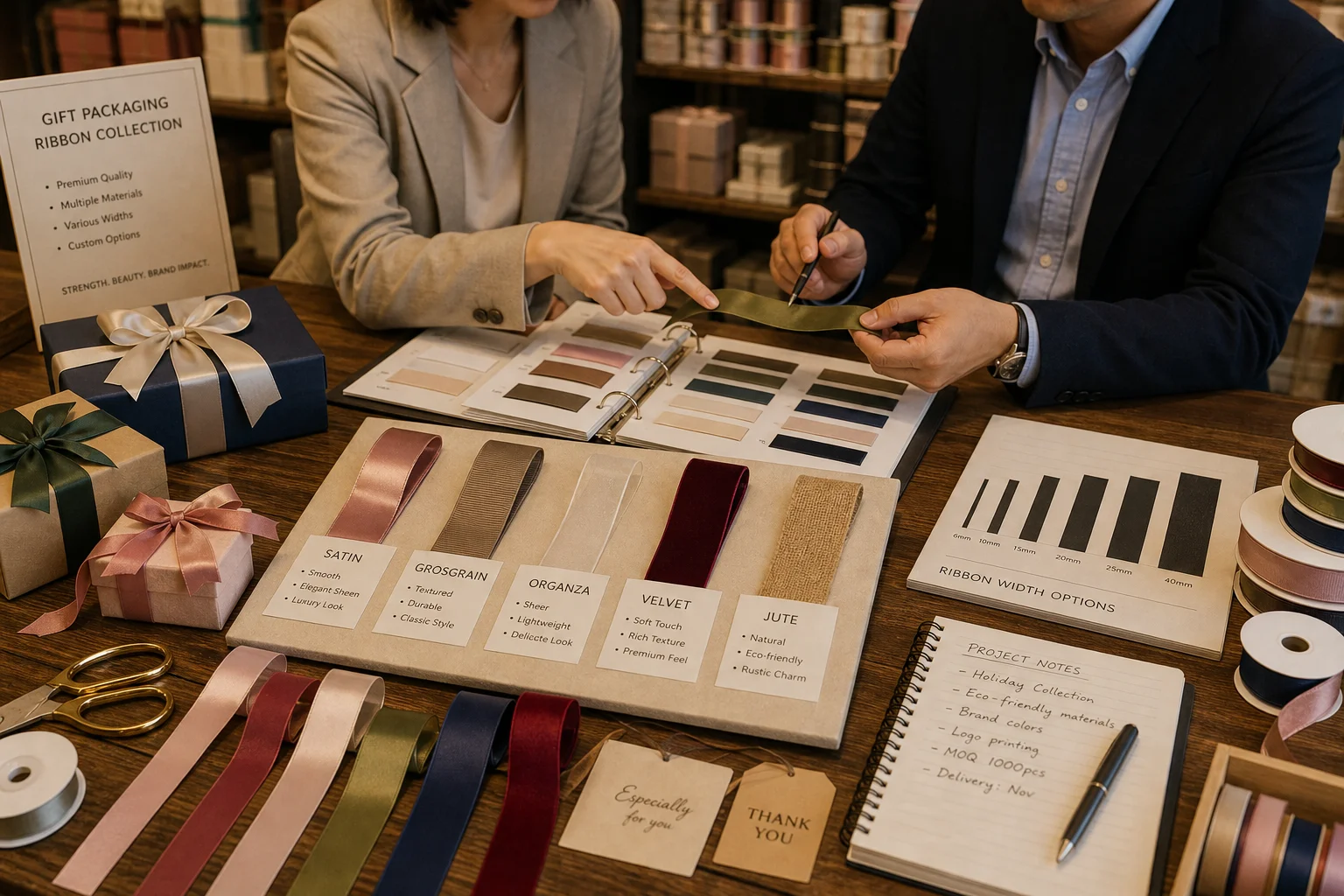
Polyester satin: Higher sheen, more mirror-like reflection, slightly stiffer hand. Bows hold their shape well. For photography and retail display, the high-gloss surface reads as premium.
Nylon: Softer sheen, more diffuse light reflection, more supple drape. Bows are softer and more relaxed. Better suited to organic, natural, or artisan aesthetic packaging where a stiff glossy bow would look out of place.
For wired ribbon (ribbon with metal wire in the selvage edges), both materials work equally well. The wire holds bow shape regardless of fiber stiffness. For unwired applications where bow longevity depends on the ribbon's own body, polyester generally performs better over time because its dimensional stability means the bow shape is not affected by ambient humidity.
Heat Resistance and Automated Packaging Compatibility
Polyester melts at ~260°C; nylon 6 at ~220°C. Neither should contact heat-sealing elements directly, but both tolerate normal ambient packaging temperatures. On automated ribbon-dispensing equipment, polyester runs more consistently because its dimensional stability is less affected by ambient humidity. Nylon ribbon that has absorbed moisture may feed differently than dry nylon, causing intermittent jam rates on the same machine setting.
When to Choose Nylon Over Polyester
Sheer overlay ribbon: Nylon organza-style ribbon has a lighter, airier appearance than polyester organza — better for translucent layered applications.
Artisan or handcrafted packaging: Nylon's softer drape fits packaging designed to look handmade rather than polished.
Specific jewel-tone colors: Acid dyes on nylon produce certain deep blues and vivid purples that disperse dyes on polyester replicate less precisely.
Low-humidity display environments: In very dry climates, nylon's slight moisture absorption can reduce static build-up that sometimes affects polyester ribbon.
Sourcing Recommendation
For most B2B gift packaging — retail gift boxes, e-commerce packaging, seasonal ribbon, branded corporate gifting — polyester is the correct default. Lower cost, broader color range, better color stability, and wider supplier availability make it higher-value for most volumes.
Choose nylon when your application specifically requires softer drape, sheer translucency, or particular jewel-tone colors that polyester replicates less precisely. Expect 30–60% cost premium and longer custom lead times. Confirm dye lot matching policy before placing a recurring program order in nylon.
Frequently Asked Questions
Is polyester or nylon ribbon better for gift packaging?
Polyester is better for most gift packaging. It offers stable color, consistent width tolerance, broad availability, and lower cost per meter. Nylon is preferred for sheer, lightweight applications where a softer drape matters more than cost efficiency.
Why is nylon ribbon more expensive than polyester?
Nylon production requires higher raw material cost and more controlled processing than polyester. Nylon ribbon is also produced in smaller volumes, so economies of scale are lower. At typical packaging widths, nylon costs 30–60% more per meter than equivalent polyester.
Does nylon ribbon hold color as well as polyester?
No. Nylon absorbs moisture, which can cause dye migration and fading in humid storage. Polyester's hydrophobic structure resists moisture absorption, making it more stable for long-term color retention in most packaging environments.
Can polyester ribbon be used on heat-sealed packaging?
Polyester melts at around 260°C and should not contact heat-sealing elements directly. For automated lines with heat-sealing equipment, confirm the ribbon does not touch the heat element. Both polyester and nylon require the same precaution.
What ribbon width is most commonly used for gift box packaging?
The most common widths are 25mm, 38mm, and 50mm. Smaller boxes use 15–25mm; standard retail gift boxes use 38–50mm; luxury or large-format boxes use 63–100mm. Polyester has broader availability at 63mm and above.