Polyester Ribbon vs Nylon Ribbon: Which Holds Color Better After Washing?
Polyester Ribbon vs Nylon Ribbon: Which Holds Color Better After Washing?
For decorative ribbon on a gift box, colorfastness to washing is irrelevant — the ribbon will never be washed. But for ribbon used in garment labels, hair accessories, bag hardware, or wearable craft applications, washing performance is one of the most important quality specifications. And the fiber type has a significant impact on the result.
The short answer: polyester ribbon generally holds color better than standard nylon ribbon under washing conditions, because of how the two fiber types accept and retain dyes. But the full picture depends on the dye type used, the wash temperature, and the specific construction of the ribbon. Here is what buyers need to know.
Why Dye Chemistry Determines Wash Performance
Both polyester and nylon are synthetic fibers, but their chemical structures are different enough that they accept different dye types in different ways.
Polyester is dyed primarily with disperse dyes — fine particles that penetrate the polymer structure under high pressure and temperature (typically 130°C in a pressurized dye vessel). Once inside the polymer, the dye molecules are physically locked in place. This is why polyester has naturally good wash colorfastness: the dye is not on the surface of the fiber, it is inside it.
Nylon can be dyed with either disperse dyes or acid dyes. Acid dyes produce more vibrant, saturated colors with better color range — this is why premium nylon ribbon often looks richer and more intense than polyester in the same color. But acid dyes bond to the fiber through ionic bonds, which are vulnerable to pH changes. Standard laundry detergents are mildly alkaline (pH 8–10), which can disrupt these bonds and cause color migration over repeated washing cycles.
When nylon is dyed with disperse dyes instead of acid dyes, its wash colorfastness improves significantly — approaching polyester performance. High-tenacity nylon ribbon for functional applications (bag straps, safety webbing, wearable accessories) is often dyed this way specifically to meet wash performance requirements.
What the Test Numbers Look Like
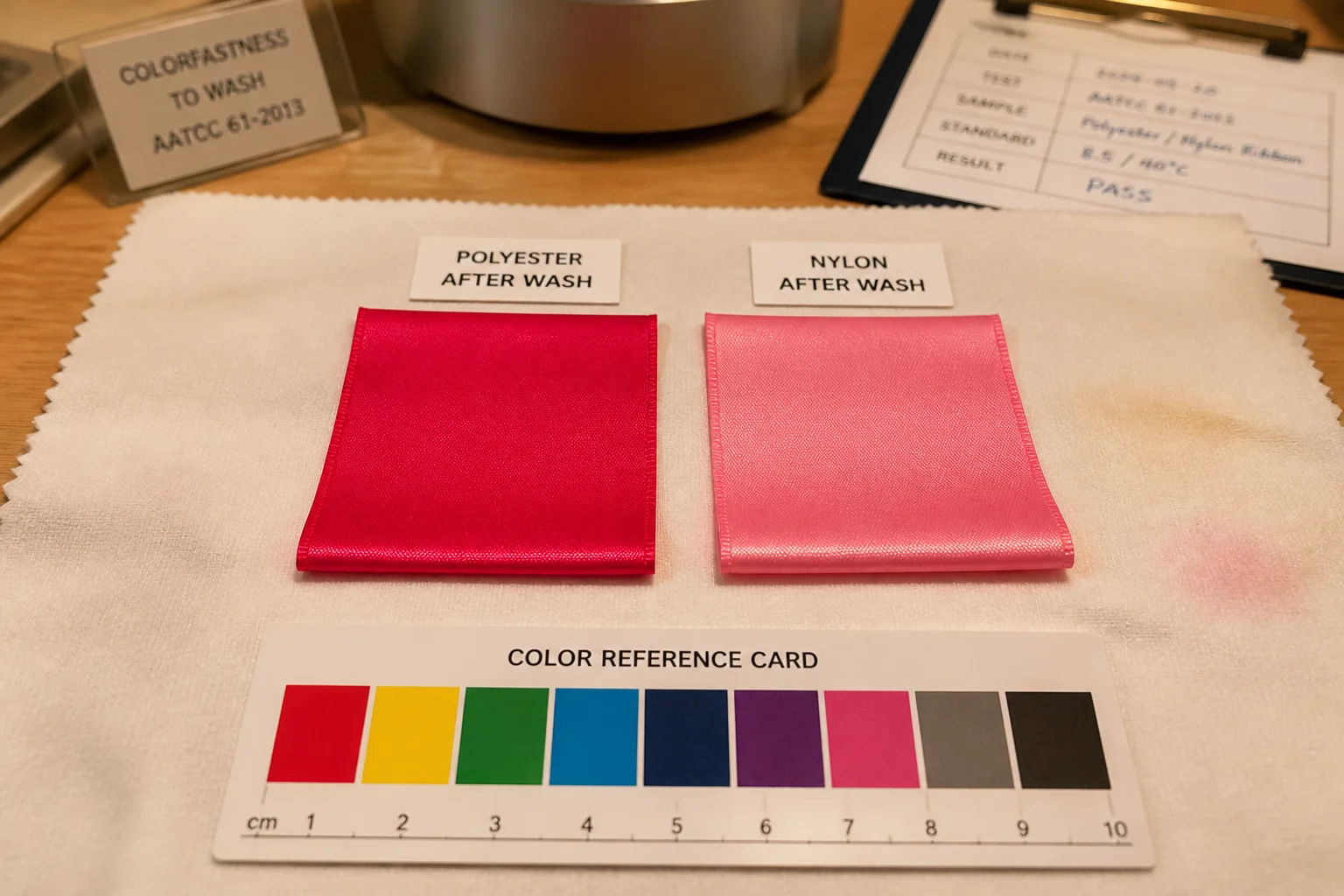
The standard industry test for wash colorfastness is ISO 105-C06, which measures color change in the test specimen and color staining on adjacent white fabric after a standardized wash cycle. Results are graded 1–5, where 5 means no detectable color change and 1 means severe change.
Typical results for standard ribbon types at 40°C wash:
Polyester ribbon with disperse dyes: Grade 4–4.5 (slight to negligible color change)
Nylon ribbon with disperse dyes: Grade 3.5–4 (slight color change)
Nylon ribbon with acid dyes, neutral wash: Grade 3.5–4
Nylon ribbon with acid dyes, alkaline wash: Grade 2.5–3.5 (noticeable color change)
Cotton ribbon with reactive dyes: Grade 3.5–4 (good performance at low temperatures)
For most commercial applications, Grade 4 is the minimum acceptable threshold. Grade 3 is considered borderline — noticeable color change under controlled lighting. Grade 2 is a quality failure for any application where the ribbon will be washed more than a few times.
When Wash Colorfastness Actually Matters
Most ribbon applications do not require high wash colorfastness because the ribbon never contacts water after sale. But several categories do:
Garment labels and care labels: Woven ribbon used as the base material for brand labels in clothing must survive the garment's full wash life. EU and US standards require labels to pass ISO 105-C06 at 60°C with no staining on adjacent fabrics.
Hair accessories: Ribbon hair ties and bows are washed regularly. Fading or color transfer to blonde or light-colored hair is a common consumer complaint with low-grade ribbon accessories.
Bag decoration and straps: Ribbon trim on canvas tote bags or fabric bags will be washed with the bag. Color transfer from the ribbon to the base fabric is a quality defect.
Children's clothing decoration: Ribbon bows or trims sewn onto children's garments must meet the same wash standards as the garment itself — often Grade 4 or higher at 40°C.
For purely decorative applications — gift wrapping, floral arrangement, display props, craft projects — wash colorfastness is irrelevant and buyers should not pay a premium for it.
How to Specify Colorfastness in Your Purchase Order
If your application requires wash-resistant ribbon, the clearest way to protect yourself is to specify the requirement in writing:
State the test standard: ISO 105-C06 (international) or AATCC 61 (US market standard)
State the temperature: 30°C, 40°C, or 60°C depending on end-use wash conditions
State the minimum grade: Grade 4 for color change and Grade 3 for staining on white as a baseline commercial standard
Request a test report: either from the factory's internal lab or a third-party lab. Ask if an existing report covers the specific ribbon color and dye type you need.
Factories that supply ribbon to garment labels and functional applications typically already run these tests. Factories that specialize in decorative packaging ribbon may not — and it is worth asking before assuming the capability exists.
Frequently Asked Questions
Does polyester ribbon hold color better than nylon ribbon after washing?
Generally yes. Polyester uses disperse dyes that bond inside the fiber structure at high temperature, making color very stable under washing. Standard acid-dyed nylon is more vulnerable to color loss in alkaline wash conditions. Nylon dyed with disperse dyes performs closer to polyester.
What washing conditions affect ribbon colorfastness?
Three main factors: water temperature (higher = more color loss), detergent pH (alkaline detergents are harder on acid-dyed nylon), and mechanical action (agitation physically removes surface dye). Ribbon for laundered applications should be tested at the actual wash temperature of the end use.
Is polyester or nylon ribbon better for garment label applications?
Polyester is the industry standard for garment labels — superior wash colorfastness, no shrinkage, compatible with label printing. Nylon is used when soft hand feel is required but needs careful dye selection to meet wash standards.
How can a buyer verify ribbon colorfastness before placing a bulk order?
Request an ISO 105-C06 test report for the specific fiber/dye combination, or have samples tested at a third-party lab (SGS, Bureau Veritas, Intertek). For custom colors, test the actual dyed sample — not the fiber type in general.
What is the price difference between polyester and nylon ribbon?
Polyester is typically 15–30% less expensive than equivalent nylon. At 38mm width, 10,000m quantities: polyester grosgrain FOB Xiamen $0.12–0.18/m, nylon equivalent $0.16–0.24/m.