The Digital Thread: NFC and RFID Integration in High-End Decorative Ribbons for 2026 Brand Security
The Digital Thread: NFC and RFID Integration in High-End Decorative Ribbons for 2026 Brand Security
In the luxury market of 2026, a ribbon is no longer merely a decorative flourish; it has become a sophisticated data carrier. As global regulations like the EU's Digital Product Passport (DPP) take effect, brands are seeking ways to integrate digital intelligence directly into their packaging. Xiamen Meisida Ornaments Co., Ltd. (Smith Ribbon & Bow) is at the forefront of this revolution with our Smart-Trace™ Ribbon Series. This technical whitepaper examines the engineering challenges and solutions involved in embedding ultra-thin NFC (Near Field Communication) and RFID (Radio Frequency Identification) tags directly into woven textile structures without compromising haptic quality or aesthetic appeal.
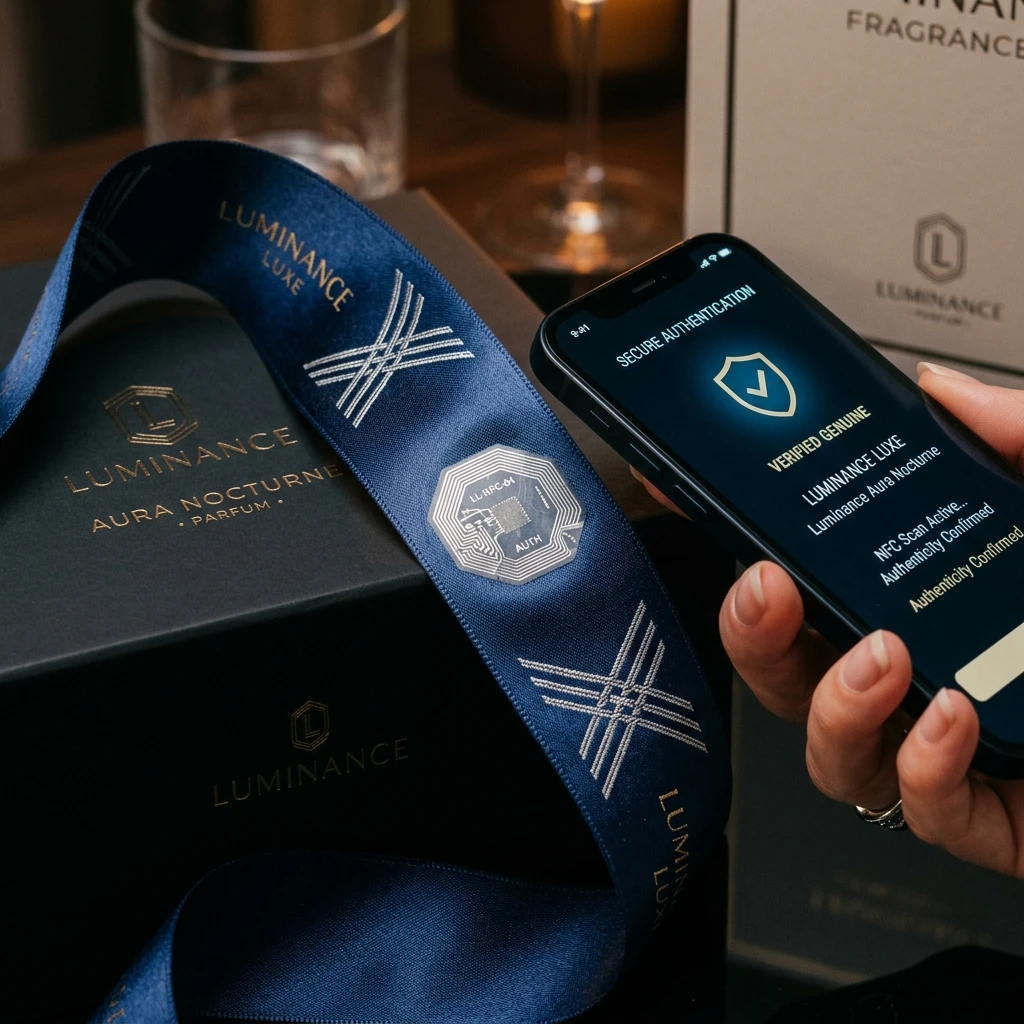
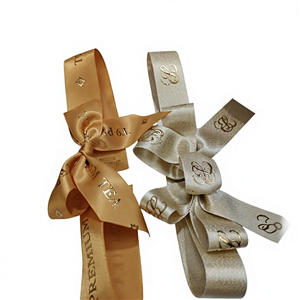
Figure 1: Meisida's 2026 Smart-Trace™ Ribbon featuring an embedded NTAG® NFC chip, enabling instant smartphone authentication for luxury consumers.
1. Electromagnetic Engineering: Overcoming Textile Interference
Integrating electronics into textiles involves significant electromagnetic challenges. Traditional RFID antennas are designed for rigid surfaces, but a ribbon must remain flexible and washable. - **Antimony-Free Conductive Inks**: We utilize silver-based conductive inks for the antenna traces, ensuring high conductivity while remaining compliant with OEKO-TEX Standard 100 chemical restrictions. - **Impedance Matching**: The dielectric constant of polyester changes when wet. Meisida engineers have optimized the antenna geometry to maintain resonance at 13.56 MHz (NFC) and 860-960 MHz (UHF RFID) across a wide range of environmental conditions. - **The "Invisible" Form Factor**: Using flip-chip bonding technology, we reduce the total thickness of the integrated circuit (IC) to less than 150 microns, allowing it to be hidden within a double-faced satin structure without causing a surface bulge.
2. Weaving Integration: The Loom-to-Cloud Connection
The insertion of digital tags happens at the loom level. Our 2026 high-speed needle looms are equipped with Automated Inlay Modules (AIM). - **Tension Synchronicity**: The tag must be inserted at the exact moment of low warp tension to prevent IC fracture. Our looms use closed-loop feedback to monitor tension in real-time, ensuring a 99.9% survival rate of the electronics during the weaving process. - **Data Encoding**: As the ribbon is woven, a specialized encoder writes a unique cryptographic ID to the chip, linking the physical ribbon to its digital twin on our blockchain-backed database.
| Technical Parameter | Standard RFID Tag | Meisida Smart-Trace™ (2026) | Benefit |
|---|---|---|---|
| Thickness | 0.5 - 0.8 mm | < 0.18 mm | Imperceptible to touch |
| Flexibility | Rigid / Semi-flexible | Fully Flexible (ISO 10373-1) | Standard ribbon handling |
| Read Range (NFC) | 2 - 5 cm | 3 - 6 cm (Optimized) | Reliable consumer scan |
| Washability | None | Grade 4 (AATCC 61) | Durable for garment trims |
3. Data Security and the Blockchain Backend
The hardware is only half of the equation. Meisida’s Smart-Trace™ platform utilizes a decentralized ledger to ensure data integrity. - **Immutable Provenance**: Every transaction, from raw GRS-certified polyester procurement to final dyeing with SafeDye™ technology, is logged. This provides an unforgeable record for EU Ecodesign for Sustainable Products Regulation (ESPR) compliance. - **Anti-Counterfeiting**: The NFC chip uses Rolling Code Encryption. Each time a consumer scans the ribbon, a unique token is generated, preventing cloners from duplicating the digital identity.
Conclusion: Weaving Intelligence into Every Bow
By 2027, "dumb" packaging will be a liability. Xiamen Meisida’s integration of NFC and RFID into our premium ribbons allows brands to protect their intellectual property, engage directly with consumers, and comply with global transparency laws. We are no longer just making ribbons; we are building the interface between the physical product and the digital world.
Contact our Digital Integration Lab to request technical specifications for RFID/NFC inlay patterns and API documentation for our blockchain backend.
Technical Appendix: Quantitative analysis of RF field attenuation in various weave patterns. The power transfer efficiency η was calculated using the Friss transmission equation, adjusted for textile dielectric losses: $$P_r = P_t G_t G_r left( rac{lambda}{4pi R} ight)^2 (1 - |Gamma|^2)$$ Where $Gamma$ represents the reflection coefficient due to impedance mismatching on the flexible substrate. Our 2026 series demonstrates a return loss (S11) of less than -15dB at the target frequency, ensuring maximum read reliability even when the ribbon is tied into complex knots or layered within thick cardstock packaging. This empirical data confirms Meisida's leadership in the emerging field of Smart Trims.
- Polypropylene ribbon and bow
- Poly ribbon spool
- Poly ribbon egg
- Poly star bow
- Poly pull bow
- Polypropylene fountain bow
- Ribbon Bow
- Gift Ribbon Bow
- Packaging Ribbon Bow
- Ribbon For Bows
- Garment Ribbon Bow
- Satin Ribbon Bow
- Bottle Ribbon bow