What Is the Minimum Order Quantity for Custom Ribbon in China — A Realistic Guide for Small and Medium Buyers
What Is the Minimum Order Quantity for Custom Ribbon in China — A Realistic Guide for Small and Medium Buyers
Minimum order quantity (MOQ) is one of the first questions B2B buyers ask when sourcing custom ribbon from Chinese factories. It is also one of the most variable answers in the industry — because MOQ is not a fixed number, it depends on ribbon type, customization method, factory size, and sometimes whether a factory is running a matching order at the same time.
This guide gives realistic MOQ ranges for the most common custom ribbon categories, explains why MOQs differ, and covers practical strategies for small and medium buyers to get better terms.
MOQ by Ribbon Type and Customization Method
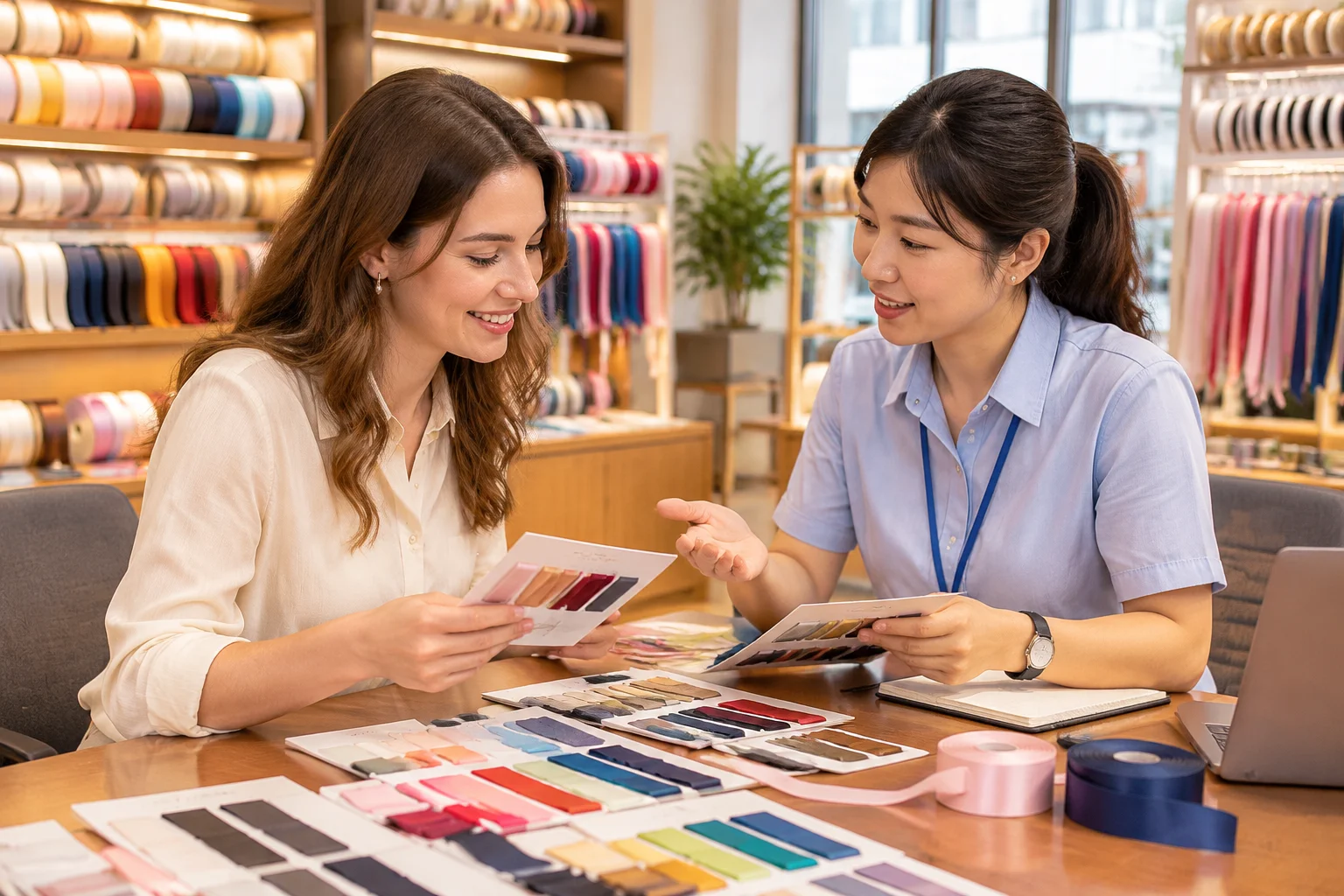
The single biggest driver of MOQ is the customization method. Here are realistic ranges for each category:
Plain stock ribbon (no customization):
No MOQ in practice — available from distributors and trading companies in any quantity. Direct from factory, minimums are usually 1,000–3,000 meters per color for plain woven ribbon, because less than that makes dye scheduling uneconomical. Some factories will accept 500 meters with a small color surcharge.
Screen-printed ribbon (logo on stock ribbon):
500–1,000 meters per design per base ribbon color. A setup fee (screen production) typically applies — $80–$150 per screen, per color of ink. This setup fee is a one-time charge; reorders use the same screen and avoid it. At 500 meters, the setup fee adds $0.16–$0.30/meter to effective cost.
Digital-printed ribbon (inkjet/sublimation):
50–200 meters. No screen setup cost. The per-meter cost is higher than screen print — typically $0.40–$0.80/meter for a simple 1–2 color design on 38mm ribbon, versus $0.20–$0.35/meter for screen print at 1,000-meter volume. Best for sampling, prototyping, or low-volume orders where setup costs would dominate.
Woven jacquard ribbon (logo woven into the fabric):
2,000–5,000 meters per design. The loom card (a programmed card that controls the weaving pattern) costs $200–$400 to produce — this is the equivalent of the screen setup fee, but higher. At 2,000 meters, the loom card adds $0.10–$0.20/meter. This method produces the most durable and premium-looking branding, with the logo permanently part of the fabric structure.
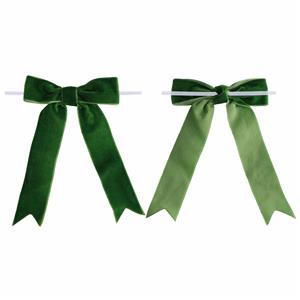
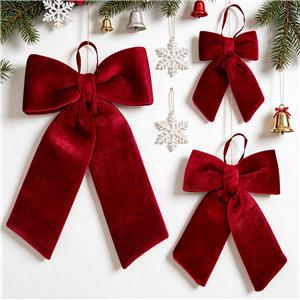
Velvet ribbon (custom color):
1,000–3,000 meters per color. Velvet requires a separate cut-pile finishing step, adding to production complexity. Some factories produce plain velvet only in stock colors, with custom dyeing available but at higher MOQ.
Why MOQs Vary Between Factories
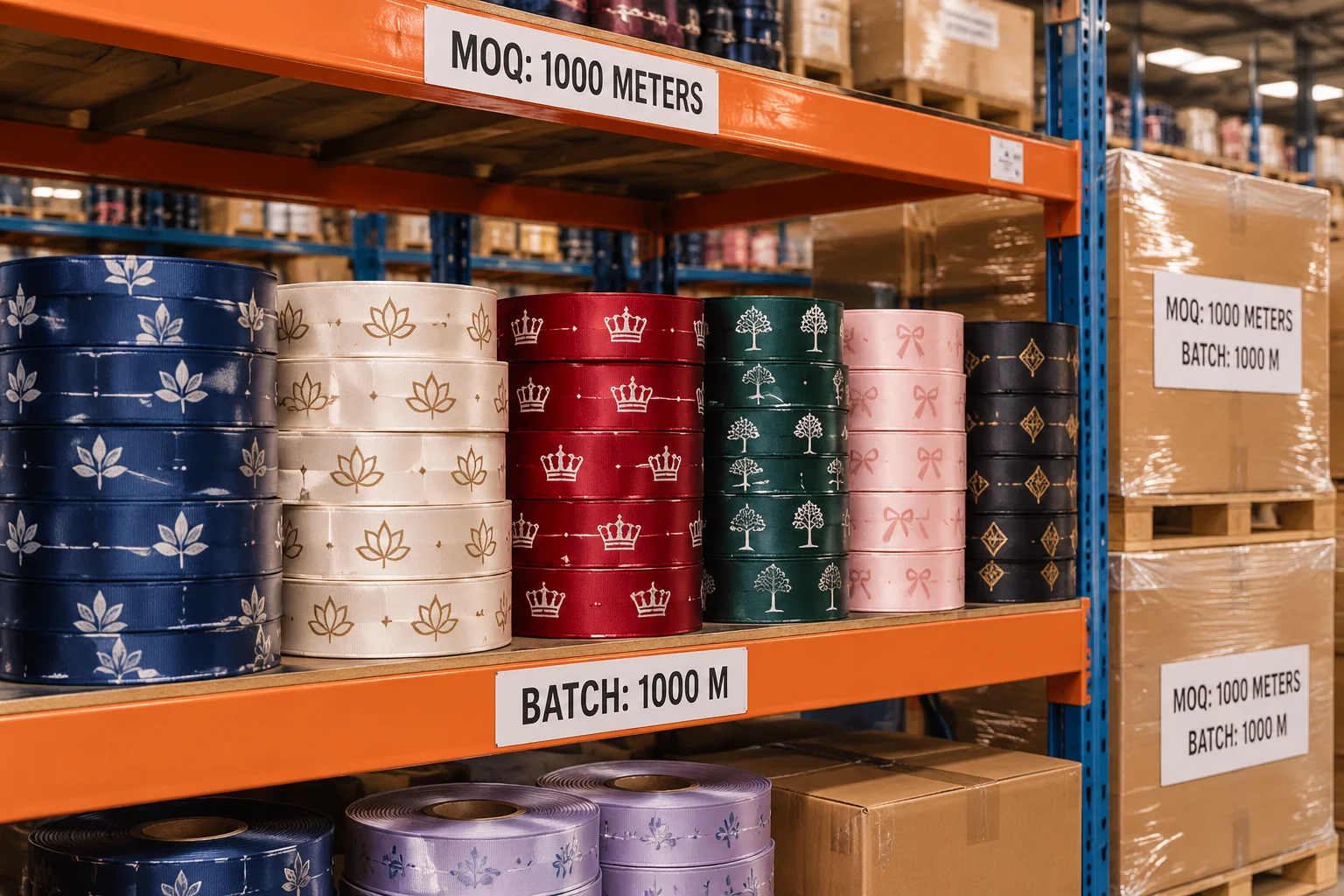
When you get different MOQ answers from different suppliers, it is not random — there are real reasons behind the variation:
Equipment setup time: Every color change requires a setup run to flush and reclean the dye equipment. If a factory's machines take 2 hours to set up per color run, the minimum quantity they need to make it economical is higher than a factory with faster changeover equipment.
Loom capacity: For woven ribbon, each loom must be warped (threaded) for each design or color. Warping can take 4–8 hours; at the typical production speed, a factory needs several hundred meters minimum just to break even on setup labor.
Inventory strategy: Some factories pre-stock popular base ribbon colors and only need to apply print — lower MOQ. Factories that dye to order for every base color need higher MOQ to justify the dye run.
Factory size: Larger factories with higher fixed costs and production minimums tend to have higher MOQs. Smaller factories often accept lower volumes to stay competitive, but may have longer lead times if they batch small orders together.
Strategies for Small and Medium Buyers
Four approaches that work in practice:
Use stock ribbon as base, customize only the print. Custom-dyed ribbon requires both a dye minimum and print minimum. Choosing a factory's stock color then printing your logo cuts one MOQ requirement entirely.
Consolidate your color range. If you planned 5 ribbon colors, consider 2–3 for the initial order. Each additional color is a separate MOQ commitment.
Negotiate a trial order with surcharge. Frame it as: "I want to place a 300-meter trial order to verify quality before committing to a 2,000-meter annual requirement." Most factories will accept this at 20–30% above standard price.
Ask about production batch sharing. Some factories will add your small order to a larger existing run of the same spec, reducing your effective setup cost — worth asking for standard base colors.
Total Cost at Different MOQ Levels
For 38mm screen-printed satin ribbon with single-color logo:
200m: $150 setup + $0.35/m × 200 = $220 total ($1.10/m effective)
500m: $150 setup + $0.28/m × 500 = $290 total ($0.58/m)
1,000m: $150 setup + $0.24/m × 1000 = $390 total ($0.39/m)
3,000m: $150 setup + $0.21/m × 3000 = $780 total ($0.26/m)
Setup cost dilutes across volume. For buyers doing 1,000+m per season the setup becomes minor; for 200m orders it can double the effective cost.
Frequently Asked Questions
What is the typical MOQ for custom printed ribbon from China?
500–1,000 meters per design for screen-printed ribbon. 2,000–5,000 meters for woven jacquard. 50–200 meters for digital print (at higher per-meter cost). These ranges vary by factory and specification.
Can I order less than 500 meters of custom ribbon from China?
Yes, but expect a surcharge. Some factories accept 200–300 meter minimums for simple print on stock ribbon. Digital printing goes lower (50–100m) but at higher per-meter cost. Always worth asking directly — many factories will negotiate for new customers.
Does MOQ apply per color or per design?
For plain ribbon: usually per fabric color (each color is a separate dye run). For printed ribbon: per design per base color combination. For woven jacquard: per loom card design — different colorways sometimes share a card at reduced cost.
What happens if I order below the stated MOQ?
Most factories charge a small order surcharge (20–50% above standard price) rather than refusing outright. Some hard-refuse below a threshold (usually 200m). Framing the under-MOQ order as a trial run before a larger commitment often gets better results.
How can a small buyer get better MOQ terms?
Three strategies: (1) Use stock base ribbon + printed logo instead of custom-dyed + printed; (2) Consolidate to fewer colors; (3) Negotiate a trial order with surcharge as a step toward a larger commitment. Communicating your planned annual volume upfront also motivates factories to offer flexibility on the initial order.