How a Japanese Gift Brand Upgraded 200,000 Holiday Boxes Using Two-Tone Double-Faced Satin Ribbon — Sourcing Case Study
How a Japanese Gift Brand Upgraded 200,000 Holiday Boxes Using Two-Tone Double-Faced Satin Ribbon — Sourcing Case Study
A Japan-based seasonal gift brand had been using single-color burgundy ribbon for its holiday gift box range for three consecutive years. The packaging looked fine, but their retail buyers were noting that the boxes looked increasingly similar to competitor products at the same price point. The packaging team's brief for 2025 was to elevate the visual without significantly raising material cost — a constraint that ruled out custom-printed ribbon (high setup cost, long lead time) and foil ribbon (premium cost, fragile handling).
Their sourcing manager found a third path: two-tone double-faced satin ribbon, which achieves a color contrast effect in a single ribbon without requiring two separate ribbons or more complex decoration. This is the story of how that decision played out — the sourcing process, the numbers, and the outcome.
The Starting Point: Why Single-Color Wasn't Working Anymore
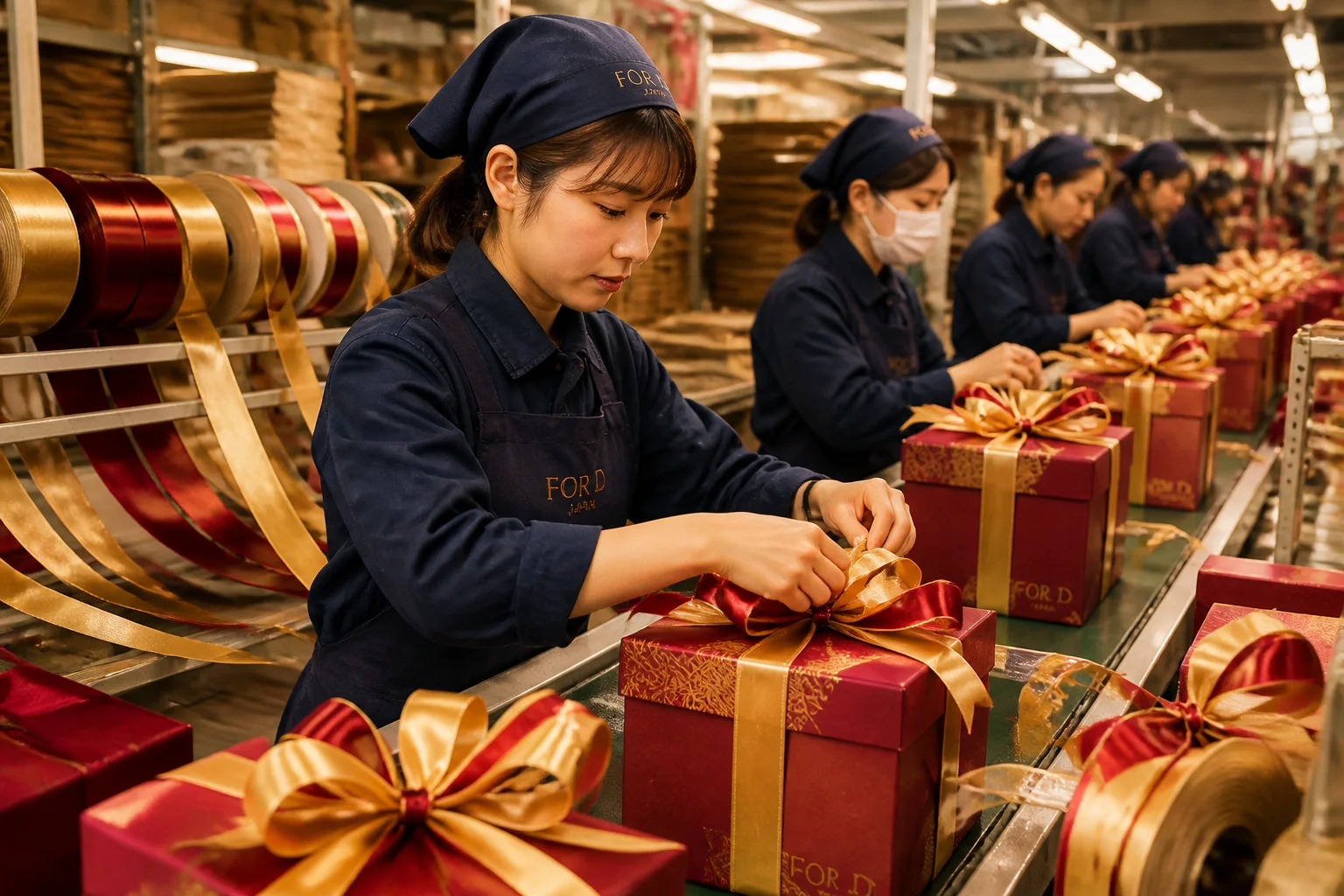
The brand's gift box range spans 12 SKUs at retail prices from ¥2,800 to ¥12,000. All boxes used the same 38mm burgundy single-faced satin ribbon, which their domestic distributor had been supplying at ¥38/meter for three years. The packaging quality was acceptable — the ribbon color was consistent, delivery was reliable — but the boxes had no visual differentiation between SKUs, and the same ribbon was showing up on competitor products at lower price points.
The brief from the retail buyers was specific: the top four SKUs (priced above ¥6,000) needed to look meaningfully different from the entry-level boxes. Options considered:
Custom printed ribbon with logo or pattern: setup cost ¥35,000–80,000 depending on design complexity; lead time 8–12 weeks; minimum order 3,000 meters per design
Velvet ribbon in place of satin: ¥65–90/meter vs ¥38 — cost increase of 71–137% for a category that uses 50cm per box
Double ribbon (two ribbons layered): doubles ribbon cost and assembly labor time
Two-tone double-faced satin ribbon: ¥52–58/meter target; same assembly method as current ribbon; distinctive visual without custom print setup cost
The two-tone option won on cost and simplicity. The question was whether a factory could produce the specific color combination — deep burgundy facing with champagne gold facing — in the volume required (200,000 meters across four SKU color combinations) within the available 11-week window.
The Sourcing Process: From Inquiry to Approved Sample
Five Chinese ribbon manufacturers were contacted. Three declined at the requested volume (minimum 10,000m per combination). Two confirmed 2,000m MOQ per combination.
Sample evaluation covered four color combinations: burgundy/champagne, burgundy/ivory, deep navy/gold, and forest green/champagne. Each sample was 10 meters and evaluated on three criteria:
Color balance: Zone boundary within 1mm of centerline across full length. All four passed.
Color independence: Damp rubbing test on white cloth — no bleed between color zones. All four passed.
Bow formation: Compatibility with existing auto bow-tying machines confirmed with minor tension adjustment.
Burgundy/champagne and navy/gold approved. Burgundy/ivory rejected — ivory tone read too similar to packaging paper at retail viewing distance. Forest green/champagne held for the following season.
The Numbers: Cost and Volume
Final negotiated pricing for the confirmed order:
38mm two-tone double-faced satin, burgundy/champagne: ¥54/meter for 120,000 meters
38mm two-tone double-faced satin, navy/gold: ¥54/meter for 80,000 meters
Total: 200,000 meters at ¥54 average = ¥10,800,000 ribbon cost
Previous year's equivalent (single-color): 200,000 meters at ¥38 = ¥7,600,000
Ribbon cost increase: ¥3,200,000 / ¥16,000 per 1,000 boxes
The retail buyer's response to the new packaging was positive enough to justify a ¥300 shelf price increase on the top-tier SKUs. At 40,000 units sold in that tier, that is ¥12,000,000 in additional revenue from a ¥3,200,000 input cost increase in ribbon alone. The sourcing manager's view: "It's one of the more straightforward ROI calculations we've made."
Logistics and Lead Time
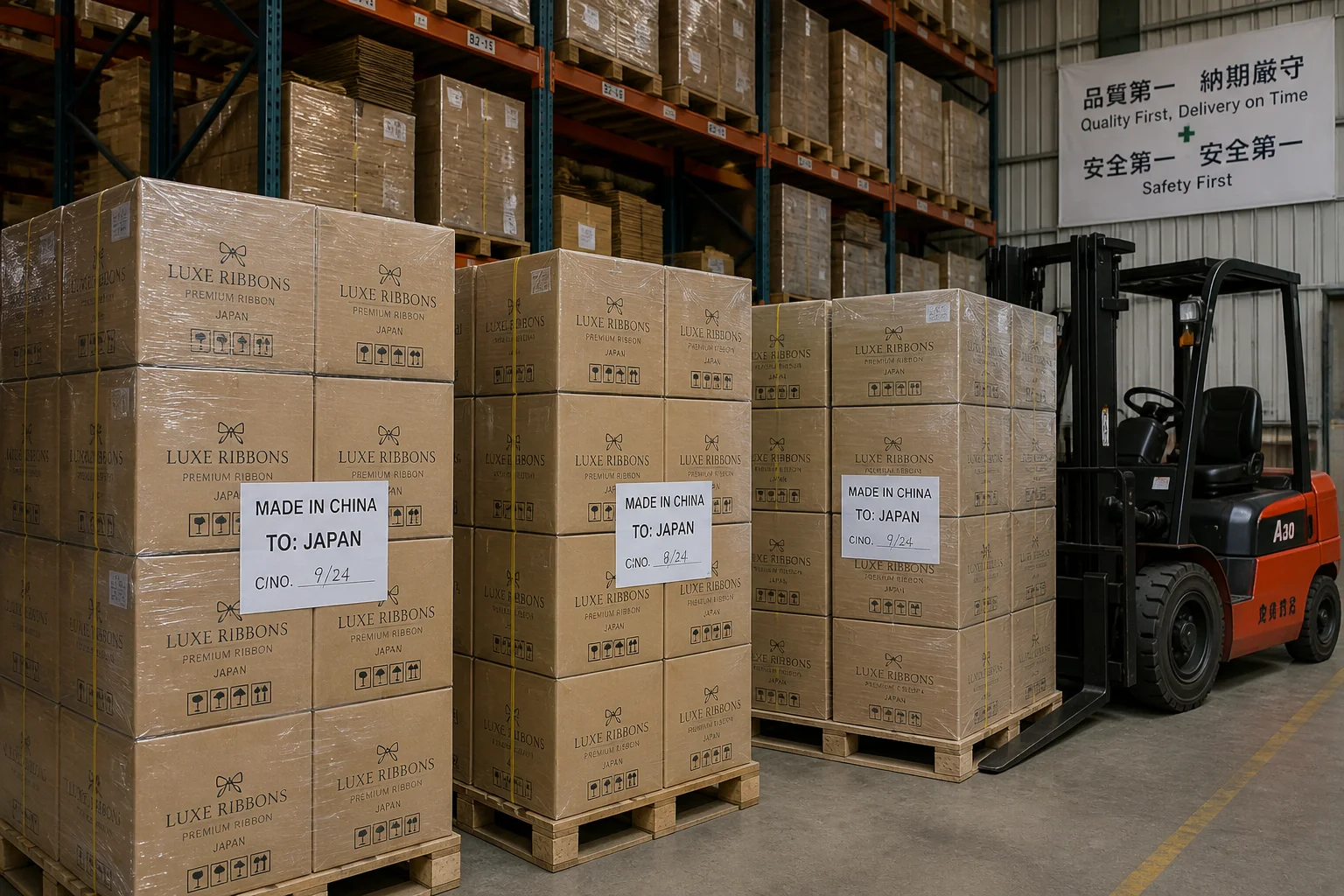
Production was confirmed in early August for mid-November first delivery. Timeline:
Week 1–2: Yarn procurement and loom setup
Week 3–6: Production of 200,000 meters
Week 7: Factory QC and shipping documentation
Week 8–9: Sea freight Xiamen to Osaka via Shanghai
Week 10: Customs clearance and domestic delivery
Week 11: Arrival at packaging line
Total: 10.5 weeks actual (11 weeks planned). No air freight required. Preparing shipping documentation in advance (packing list, invoice, certificate of origin, OEKO-TEX certificate copy) reduced customs clearance from 3 days to 1.5 days.
What Would Have Made It Harder
Three factors that could have derailed this sourcing project:
Starting sample evaluation too late: The team began supplier conversations 14 weeks before delivery. At 10 weeks, airfreighting samples would have added cost and urgency pressure during evaluation.
Requiring exact Pantone match for both colors: Accepting "near match" for the champagne tone saved 1–2 weeks of additional dye trials.
Not testing auto bow-tying machine compatibility: A 5% feed tension adjustment was needed for two-tone ribbon. Finding this only post-production would have caused recalibration delays during peak packaging season.
Frequently Asked Questions
What is two-tone double-faced satin ribbon?
A single ribbon with two different colors woven into the fabric — one color per face — both with smooth satin sheen. The colors are integral to the weave structure, not printed or laminated, so they don't fade or peel independently.
What is the minimum order quantity for custom two-tone satin ribbon?
Typically 2,000–5,000 meters per color combination. Some factories offer 1,000-meter MOQ for standard color combinations from existing yarn inventory. Pre-booking before peak season can reduce MOQ requirements.
How does two-tone ribbon compare in cost to standard single-color ribbon?
30–50% more per meter due to complex loom setup and yarn management. Per finished gift box, the cost difference is typically small — ¥0.07–0.15 per box for 50cm at 38mm width — while the visual upgrade can support meaningful retail price premiums.
What quality checks matter most when sourcing two-tone satin ribbon?
Color balance consistency across width, colorfastness independence of each color zone, and cut edge quality at the boundary between the two color zones. Test all three before approving production.
How long does it take to get custom two-tone ribbon from factory to warehouse?
25–35 days production, plus 15–30 days sea freight. Total 6–10 weeks minimum. Place orders 12–14 weeks before first delivery date to avoid air freight premium.