How to Read a Ribbon Specification Sheet — What the Numbers Actually Mean for Your Order
How to Read a Ribbon Specification Sheet — What the Numbers Actually Mean for Your Order
Ribbon suppliers hand out specification sheets routinely, but many buyers either skip them entirely or treat them as formalities without knowing what the numbers actually mean. That can cause problems: delivering a purchase order that doesn't specify weight or width tolerance is essentially ordering on faith, and disputes about whether the delivered goods match the sample are very hard to resolve without documented specs.
This guide walks through the key parameters on a ribbon specification sheet — what each one measures, what values are normal, and what to watch out for when comparing specs between suppliers or between sample and production runs.

Fiber Composition
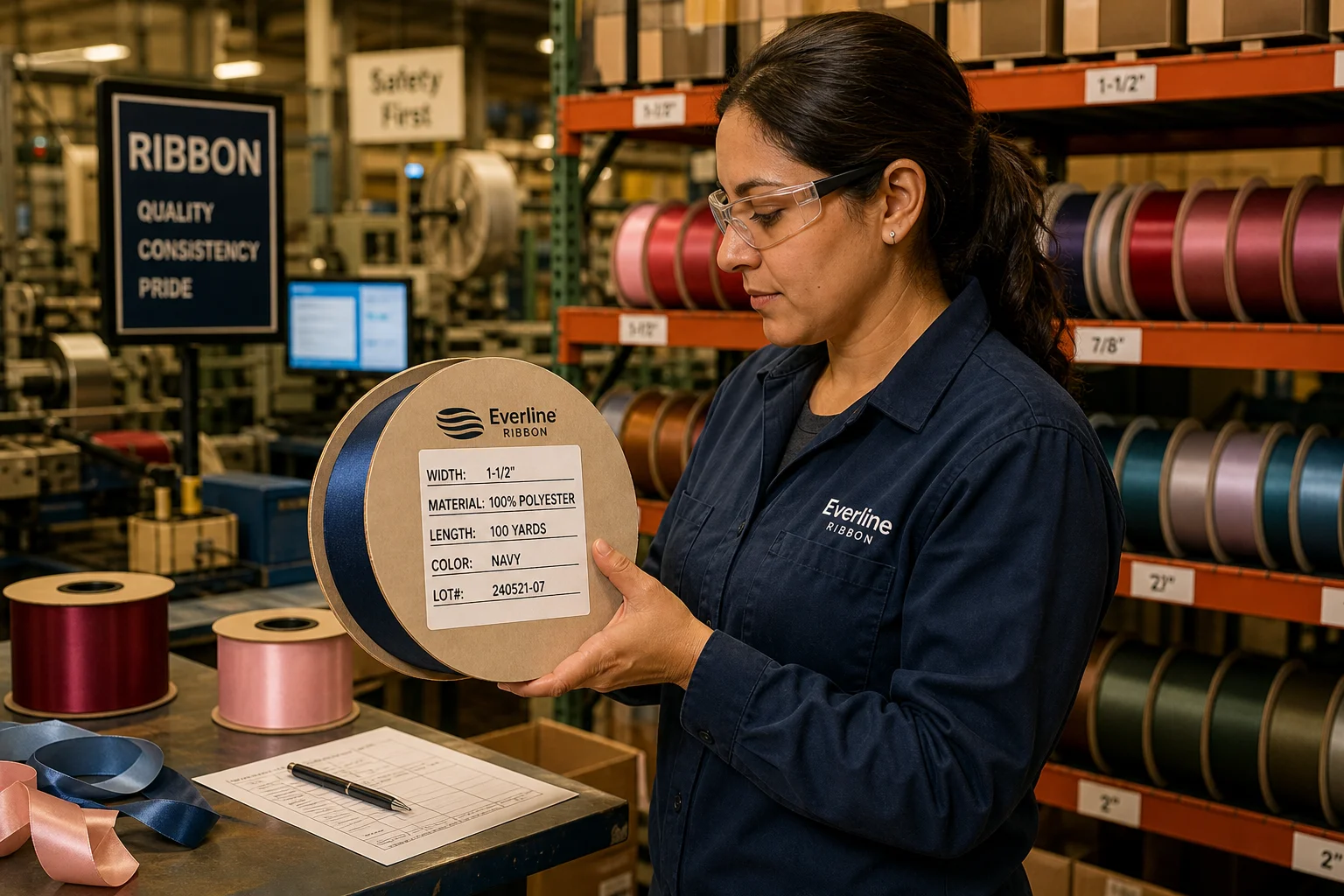
The composition line tells you what the ribbon is made of, usually expressed as a percentage: "100% Polyester," "100% Nylon," "80% Polyester / 20% Nylon," or "100% Organic Cotton." This is the most fundamental specification because fiber type determines the ribbon's basic properties — how it dyes, how it handles, what certifications apply, and what recycled-content claims are possible.
What to verify: the composition on the spec sheet should match the composition on the product label attached to the spool. Mismatches occasionally occur when a supplier substitutes a fiber to manage costs — polyester sold as nylon is a common example, since they look similar but nylon carries a price premium. If the certification matters (organic cotton, recycled polyester), request documentation that confirms the fiber origin, not just the label claim.
Width and Width Tolerance
Width is listed as a nominal value with a tolerance range, for example "38mm ±1mm." The nominal value is the target; the tolerance is the acceptable production range. A ribbon produced within spec can deliver anywhere from 37mm to 39mm in that example.
Width tolerance matters most for applications involving machinery. Automated ribbon bow-making equipment, packaging machines, and label-printing fixtures are calibrated to specific ribbon widths. If the ribbon runs consistently at the tolerance edge — always at 37mm when your machine is calibrated for 38mm — you will see alignment issues and potentially machine stoppages. For manual applications, ±1mm is not visible to the human eye at typical viewing distances, so it's less critical.
What to ask: request the actual width range from recent production runs, not just the stated tolerance. A supplier that tracks production data can tell you whether their typical width variation is ±0.3mm or ±0.9mm. That difference matters for machinery applications even though both are within the nominal ±1mm tolerance.
Weight: g/m² and g/m
Ribbon weight can appear in two units on spec sheets:
g/m² (grams per square meter): The standard textile measure. Independent of ribbon width. A fabric that consistently weighs 100 g/m² is the same fabric regardless of whether it's cut into a 16mm or 63mm ribbon width.
g/m (grams per linear meter): More practical for cost calculations because it directly reflects what you're paying per unit length. A 38mm ribbon at 100 g/m² weighs approximately 3.8g per meter. At 120 g/m², it weighs 4.56g per meter.
Weight is the most reliable indicator of whether the production goods match the sample. If the sample was 110 g/m² and the delivered goods test at 85 g/m², they are not the same fabric — the supplier substituted a lighter construction, which will feel cheaper and perform differently.
Colorfastness Grades
Colorfastness grades appear as numbers from 1 to 5. Three test standards appear most often:
ISO 105-B02 (Light fastness): How much color fades under UV or simulated sunlight exposure. Grade 4 is commercial standard for most indoor applications. If the ribbon will be used in window displays or point-of-sale settings with prolonged light exposure, request Grade 5.
ISO 105-C06 (Wash fastness): How much color is lost under washing conditions. Relevant for ribbon that will be laundered — garment labels, hair accessories, clothing trim. For pure decorative packaging ribbon, wash fastness grades are largely irrelevant.
ISO 105-X12 (Rubbing fastness): How much dye transfers when the ribbon is rubbed against white fabric. Tested both dry and wet. Wet rubbing is always lower than dry rubbing. Grade 3 wet rubbing is borderline for applications involving skin contact or light-colored substrates.
Roll Length and Packaging
Standard roll lengths are 25 meters, 50 meters, and 100 meters per spool. Some factories also produce 500m or 1000m bulk rolls for industrial customers. The spec sheet should state the nominal roll length and the packaging: how many spools per polybag, how many polybags per inner carton, how many inner cartons per outer carton, and the outer carton dimensions and gross weight.
This information matters for logistics planning — a buyer who hasn't checked carton dimensions and weight before shipping 10,000 spools has an unpleasant surprise when the pallets don't match their warehouse racking system or the freight quote comes in higher than expected because carton weight exceeds standard thresholds.
Frequently Asked Questions
What information should a ribbon specification sheet include?
At minimum: fiber composition, nominal width and tolerance, weight (g/m² or g/m), colorfastness grades for relevant tests, shrinkage rate, roll length and packaging, and certification references. Missing weight or width tolerance is a quality management concern.
What does width tolerance mean on a ribbon spec sheet?
How much actual width can vary from nominal. 38mm ±1mm means 37–39mm is acceptable. For manual applications this is negligible; for packaging machinery, ask for actual production width range from recent runs, not just the stated tolerance.
How do you interpret colorfastness grades on a ribbon spec sheet?
Scale of 1–5, higher is better. Grade 4 is commercial standard. Light fastness (ISO 105-B02) matters for display applications; wash fastness (ISO 105-C06) only matters for ribbon that will be laundered; rubbing fastness (ISO 105-X12) matters for skin contact or light-colored substrates.
What does the weight specification on a ribbon spec sheet mean?
g/m² is fabric density (independent of width); g/m is per-linear-meter weight. A 38mm ribbon at 100 g/m² = ~3.8g/m. Weight is the most reliable way to verify that delivered goods match the sample — different g/m² means a different fabric.
What certifications are worth asking for on a ribbon spec sheet?
OEKO-TEX Standard 100 (chemical safety), GRS (recycled content traceability), and REACH compliance declaration (EU market mandatory). These address different things: OEKO-TEX and REACH cover harmful substances; GRS covers supply chain origin for recycled fiber claims.