How to Prevent Ribbon from Fraying When Cutting — 4 Methods That Actually Work
How a German Wedding Planning Agency Secured Consistent Custom Ribbon Across 200+ Events Per Year — A B2B Sourcing Case Study
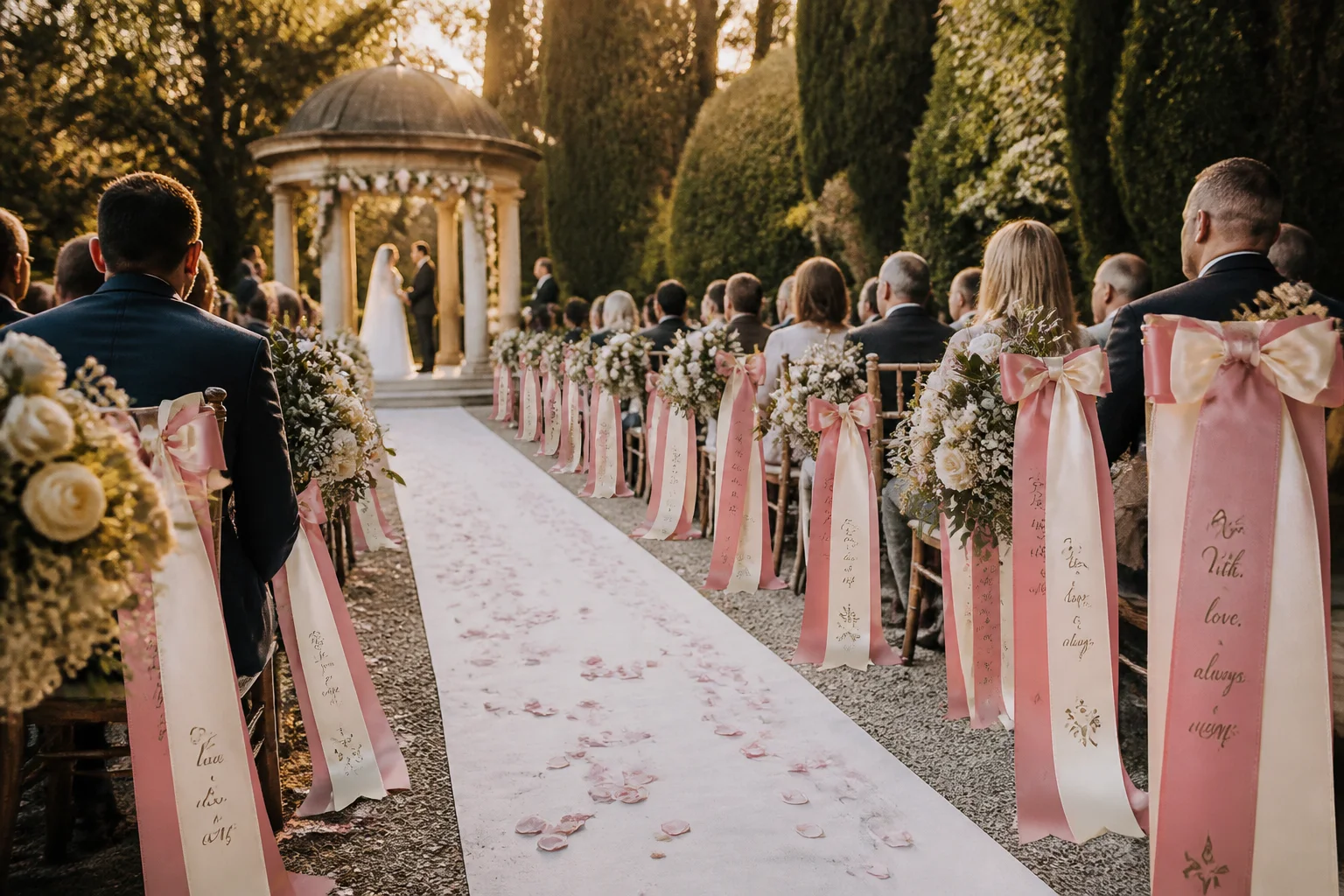
For most event businesses, custom ribbon is a one-time experiment. For Marlene Hoffmann's team at a Berlin-based wedding planning agency, it was a supply chain commitment. They needed the same dusty rose and ivory printed satin ribbon — with the agency's floral motif — across every wedding they styled. Not approximately the same. Exactly the same.
What started as a sourcing problem in late 2023 became a repeatable procurement process.
The Problem: Three Suppliers, Three Different "Dusty Rose"
Marlene's agency handles 200–240 weddings per year across Germany, Austria, and Switzerland. Ribbon is part of their standard styling package: chair back ties, aisle draping, gift table decoration, and bridal party details. In 2022 and 2023, she sourced from three different suppliers, rotating based on availability and price.
The results were predictable in hindsight: each supplier's "dusty rose" was a slightly different shade. The agency's signature floral print motif varied in scale between suppliers. Ribbon widths listed as 38mm measured anywhere from 36.5mm to 39mm under a caliper.
At the 2023 autumn peak — September through November — two separate events had visibly mismatched ribbon between the chair backs and the gift table because a reorder came from a different supplier than the initial order. One bride noticed. Marlene's team spent three hours sourcing replacement ribbon locally at retail prices. That was the end of the rotating-supplier approach.
What the Brief Required
In December 2023, Marlene's team documented their requirements precisely:
Custom printed satin ribbon with agency floral motif, two colorways: dusty rose (Pantone reference) and ivory
Width: 38mm, tolerance ±0.5mm
Annual volume: ~2,400 meters per colorway (200 events × 12 meters average)
Reorder cycle: twice yearly — spring season (March) and autumn season (August)
Color consistency: ΔE ≤1.5 between seasons, measured against retained standard
MOQ: 300 meters per colorway; 100 meters for reorders from existing design files
Lead time: 25 business days standard; 15 business days for reorders from retained files
How Supplier Qualification Worked
The team shortlisted four suppliers. Four qualification questions separated genuine manufacturers from trading companies:
Can you provide samples from three different production runs of the same specification?
How do you manage dye lot records for annual reorders?
What is your printed ribbon MOQ and reorder minimum for retained design files?
Can we see the printing line via factory video call?
Two suppliers dropped out at the dye lot question. One could not provide multi-run samples. Smith Ribbon & Bow provided three production run samples, a written dye lot procedure, and scheduled a factory video call within 24 hours.
What the First Order Established
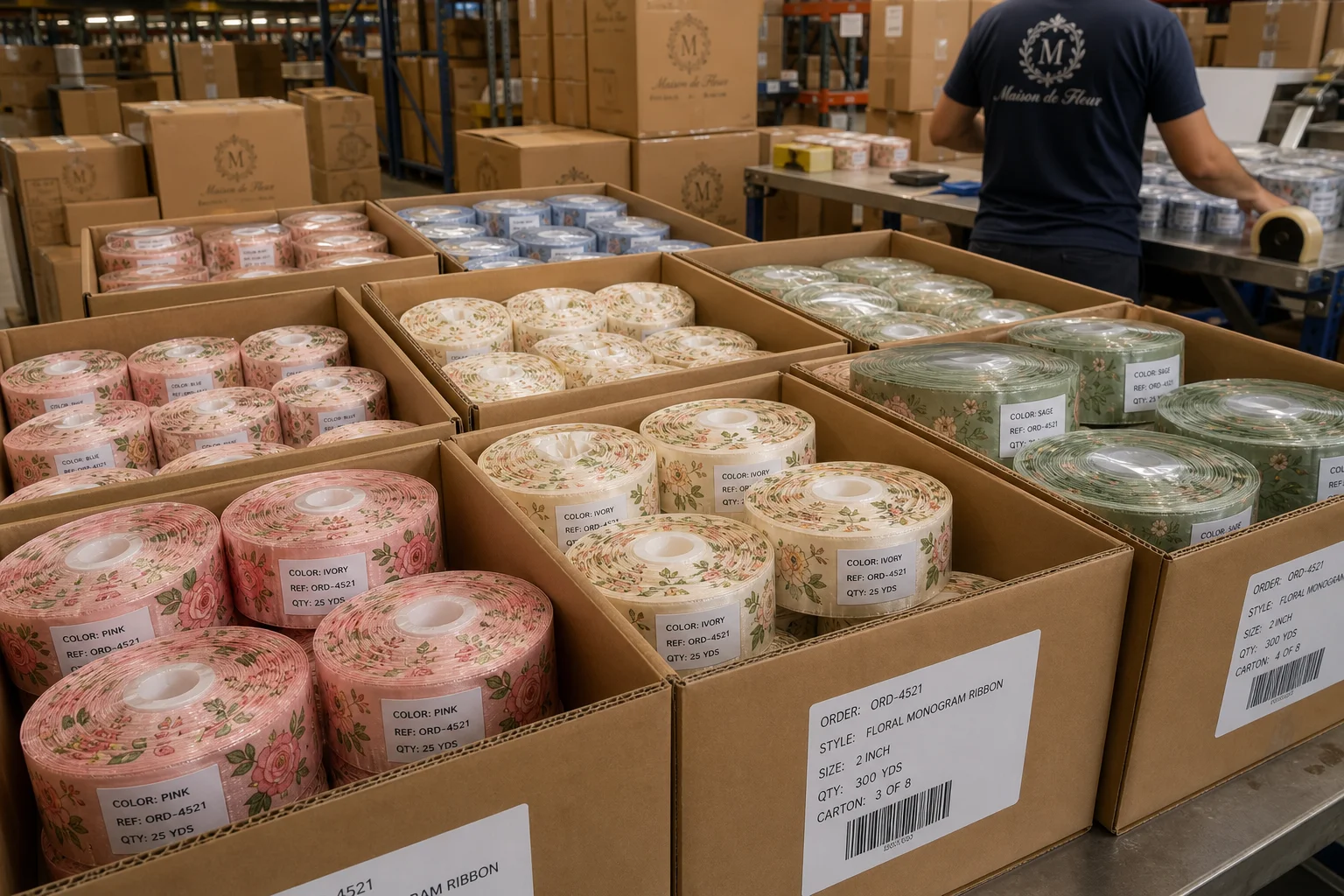
Initial order, February 2024: 600 meters dusty rose + 600 meters ivory, 38mm double-faced satin with floral motif. Delivered in 22 business days. Incoming inspection on 10 random rolls: average width 38.1mm, max deviation 0.3mm, color delta ΔE 1.1 against Pantone standard.
Autumn 2024 reorder (500 meters per colorway): used retained design file and dye formula. Lead time 14 business days. Color delta of reorder against retained physical standard: ΔE 0.8. Marlene's quality manager measured the rolls blind and noted no visible color difference.
The Economics: What Consistent Sourcing Costs vs Saves
Marlene's team compared 2024 costs against the rotating-supplier approach of 2023:
Per-meter cost: Custom printed satin at volume: €0.31/meter. Previous mixed-supplier approach: €0.27–0.45/meter depending on availability.
2023 rejection and replacement cost: Two order rejections (replacement sourcing + express shipping) plus one on-site retail replacement: approximately €580 total.
2023 color-checking overhead: ~45 min per delivery × 24 deliveries at €60/hour coordinator rate: ~€1,080.
2024 spot-check overhead: ~10 min per delivery × 8 deliveries: ~€80.
The higher custom ribbon price was recovered through elimination of rejections and reduction in quality-checking time. Consistent sourcing cost less in total than variable sourcing, even at a higher per-meter price.
Key Takeaways for High-Volume Event Buyers
Document the color standard before the first order, not after. Pantone references and physical retained samples prevent the "we matched last time" ambiguity that causes seasonal color drift.
Reorder minimums matter more than initial MOQ. A supplier with a 300-meter initial MOQ but a 300-meter reorder minimum is less useful than one with the same initial MOQ and a 100-meter reorder minimum from a retained design file.
Dye lot management is a qualifier, not a feature. Any supplier without a dye lot tracking system cannot guarantee season-to-season consistency regardless of their stated capabilities.
Build the annual volume picture before the first order. Sharing a 12-month volume forecast at onboarding secures better lead times and pricing than treating each order as a one-off.
Measure color delta numerically. ΔE ≤1.5 is the visible threshold — colors above this delta are perceived as different in typical viewing conditions.
Frequently Asked Questions
What is the minimum order quantity for custom printed ribbon from a factory supplier?
Most ribbon factories require 300–500 meters per color for custom printed ribbon. At Smith Ribbon & Bow, the standard MOQ is 300 meters per color, with 100-meter reorder minimums for retained design files from previous runs.
How do I ensure ribbon color stays consistent when I reorder each year?
Consistent reorder color requires dye lot management and a retained lab color reference at the factory. Specify that reorders must match the retained standard with ΔE ≤1.5. Factories with proper dye lot controls can achieve this reliably across seasons.
Can I get custom printed ribbon in small quantities for a single event?
Under 100 meters is typically not viable from direct manufacturers — printing setup costs make small runs uneconomical. Custom printing becomes cost-efficient at 300+ meters. For single events, stock ribbon in a close color match is more practical.
How long does it take to produce custom printed ribbon from a factory?
Standard lead time is 20–30 business days from design approval and deposit. Rush orders (15 business days) are available for existing design files. New color development adds 5–7 business days for sampling.
What file format should I send for custom ribbon printing?
Vector files (AI or EPS) are preferred for clean edge definition. Include Pantone color codes. The design repeat width must fit within the ribbon width. PNG at 300+ DPI is acceptable for simple patterns but not fine-line designs.