How to Choose the Right Ribbon Width for Your Packaging — A Buyer's Size Guide
How to Choose the Right Ribbon Width for Your Packaging — A Buyer's Size Guide
Ribbon width is one of those decisions that seems minor until you get it wrong. Too narrow on a large gift box and the ribbon looks like an afterthought. Too wide on a small jewelry box and the packaging looks clumsy. Getting the width right takes about two minutes of thinking — once you know the framework.
This guide covers the standard widths available from factories, how to match width to package size, what to expect for MOQ at different widths, and how width constraints affect custom printing and weaving options.
Standard Ribbon Widths and What They're Used For
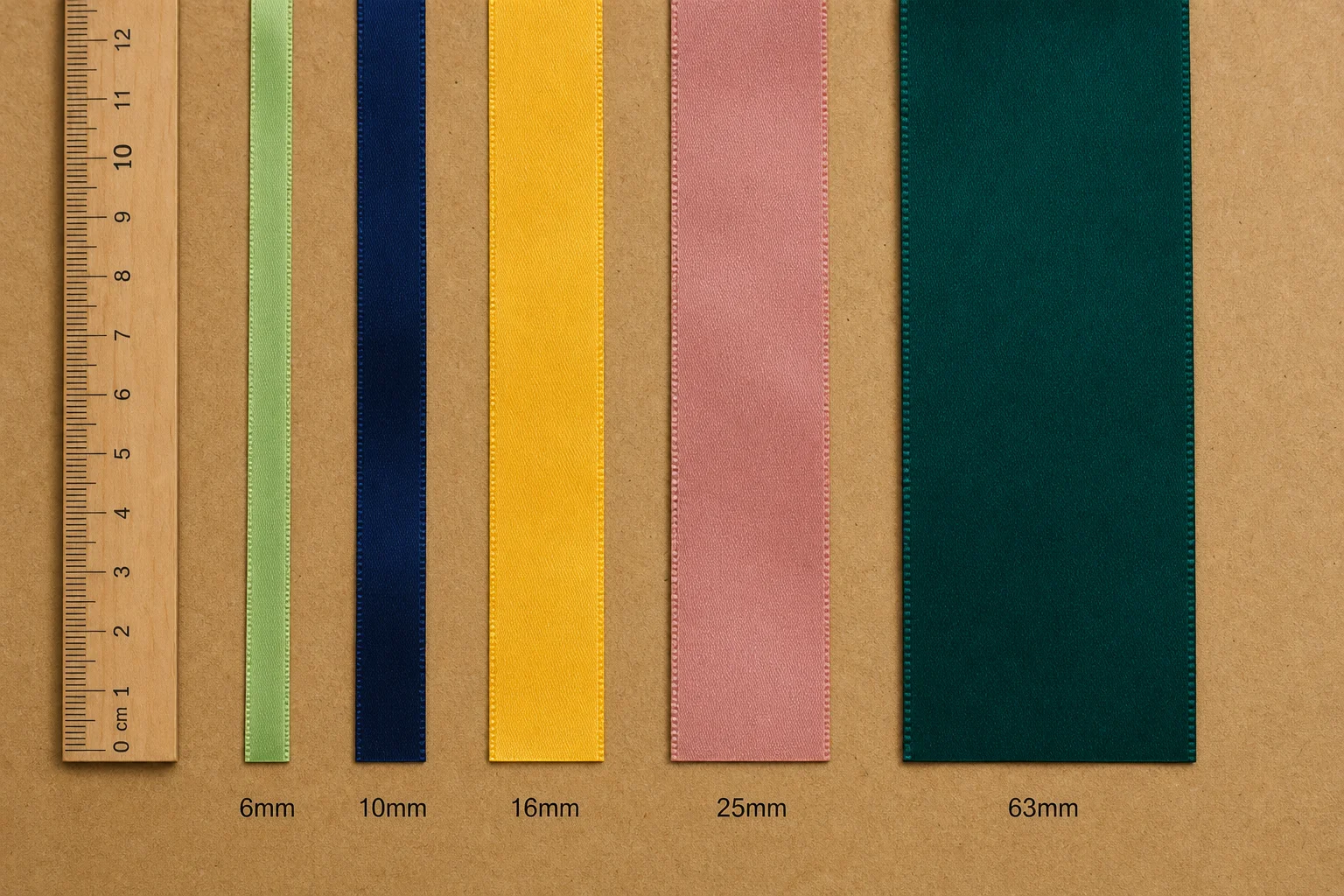
Ribbon manufacturers work in millimeter increments. Here are the widths you'll actually encounter from Chinese factories, and what each is typically used for:
3–6mm: Trim and accent work. Too narrow for standalone gift wrapping; used for layering over wider ribbon, corsage trim, and fine detail work on small packages.
9–12mm (3/8"): Small gift wrapping, wine bottle neck bows, jewelry pouches, envelope seals. The most common narrow-width tier for retail accessories.
16mm (5/8"): Standard narrow ribbon for gift bags, small boxes, and florist arrangements. Versatile across satin, grosgrain, and velvet.
25mm (1"): The workhorse width. Fits most standard retail gift boxes (150mm × 200mm and smaller). Works for both wrapped and tied-bow applications. Most factories carry the deepest stock in this width.
38mm (1.5"): Premium gift boxes, corporate gifts, mid-size hampers. Wide enough to carry custom woven logos legibly. Makes a visible statement bow without looking heavy.
50–63mm (2–2.5"): Oversized gift wrapping, luxury hampers, decorative display ribbons. Bows in this width are showpiece elements, not functional ties.
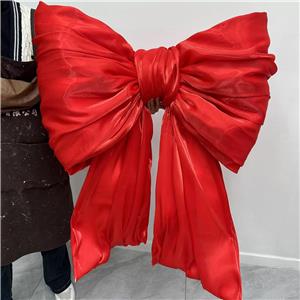
75–100mm (3–4"): Display-only. Used for retail store displays, trade show decoration, and oversized prop bows. Rarely used in actual gift packaging due to the bulk when tied.
Matching Width to Package Size: The Practical Rule
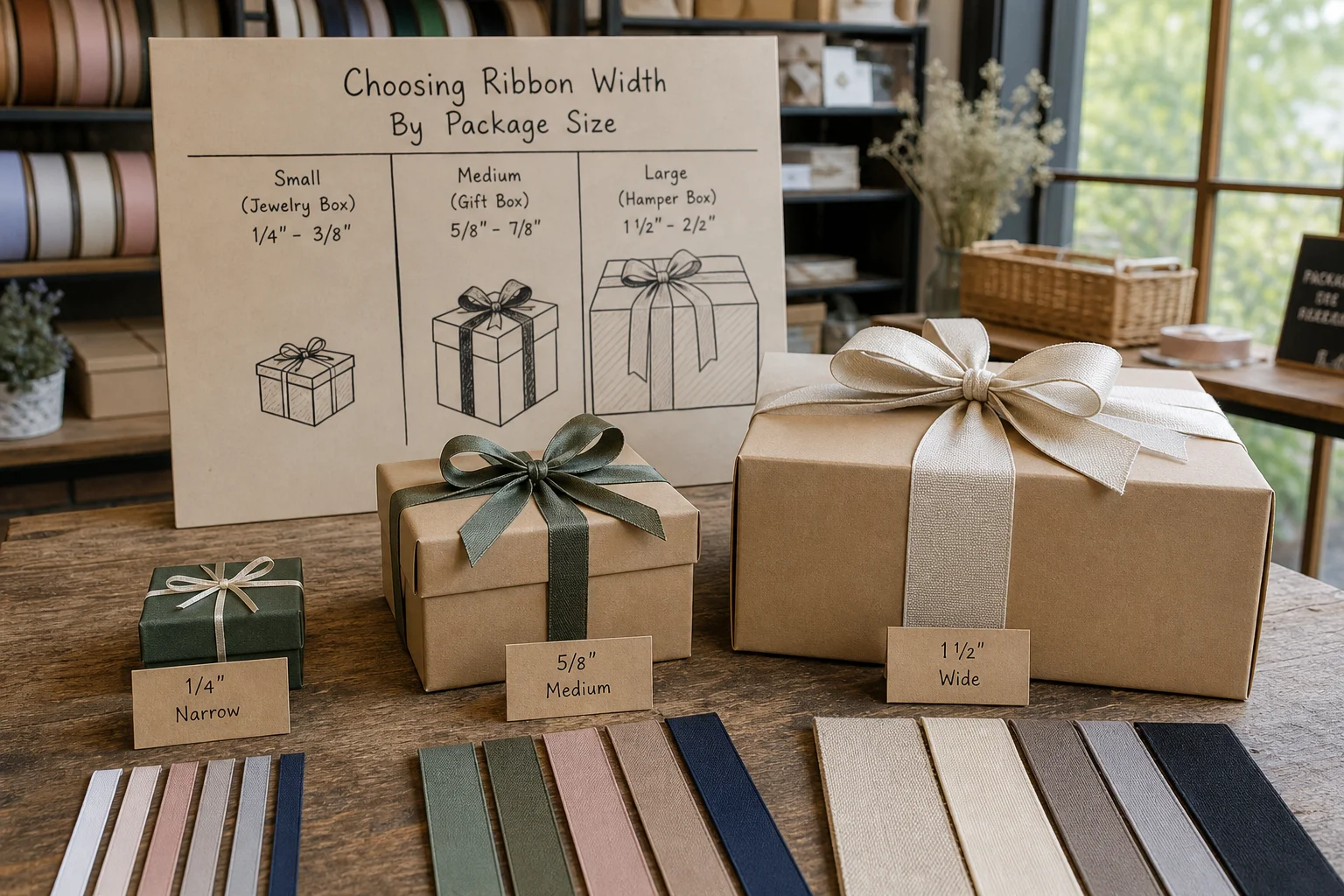
There's a simple proportioning principle that works across virtually all packaging applications: ribbon width should be approximately 1/8 to 1/6 of the box's shortest face dimension.
Examples of this in practice:
Small jewelry box (80mm × 100mm): 1/8 of 80mm = 10mm → use 9–12mm ribbon
Standard gift box (150mm × 200mm): 1/8 of 150mm = 19mm → use 16–25mm ribbon
Premium gift box (250mm × 300mm): 1/8 of 250mm = 31mm → use 25–38mm ribbon
Large hamper (350mm × 450mm): 1/8 of 350mm = 44mm → use 38–50mm ribbon
The 1/8 rule gives proportional correctness. If you want a more prominent bow — one that becomes a focal point rather than an accent — go toward 1/6 instead. If you want understated elegance, stay closer to 1/8.
For bows specifically: the bow's loop length (from knot to tip of loop) should be roughly equal to the face width of the box. A bow with 75mm loops on a 75mm-wide box face looks proportional. The same bow on a 250mm box face looks like a small decorative element rather than gift packaging.
Width and MOQ: What Changes at Different Sizes
Ribbon width affects factory economics in specific ways that buyers should understand before placing orders:
Wider ribbon uses more material per meter. A factory producing 50mm ribbon from the same loom setup as 25mm ribbon uses twice the yarn per meter of output. This is reflected in pricing (wider = higher per-meter cost) but not always in MOQ meter counts.
Standard widths have shorter lead times. Widths of 16, 25, 38, and 63mm are produced continuously by most satin and grosgrain ribbon factories. Standard widths often have semi-stocked inventory, reducing lead time by 5–10 business days versus non-standard widths.
Non-standard widths require loom reconfiguration. A width like 30mm or 45mm requires a custom reed and warp setup, typically adding $150–300 to setup cost and requiring higher MOQs (3,000–5,000 meters).
Narrower ribbon generally requires higher meter-count MOQs. Factories prefer to run longer passes of narrow ribbon to amortize setup. 9mm ribbon MOQ is commonly 2,000–3,000 meters; 38mm MOQ is often 500–1,000 meters for the same factory.
Width Constraints for Custom Branding
If you're adding a logo — either woven or printed — the minimum usable width depends on the complexity of your design:
Logo mark only (no text), woven: 16mm minimum; 25mm recommended for clean rendering
Brand name text, woven: 38mm minimum for text that's legible without magnification
Logo mark, screen printed: 12mm minimum; 16mm recommended
Brand name text, screen printed: 25mm minimum for text below 6 characters; 38mm for longer names
Full design with text + graphics: 38mm minimum regardless of printing method
The physical limit for jacquard weaving is that each individual warp thread is approximately 0.3–0.5mm wide. A 16mm ribbon has roughly 32–50 warp threads across its width — enough for simple geometric logos or very short text, but not for fine detail or small font sizes.
Frequently Asked Questions
What is the most common ribbon width for gift packaging?
25mm (1 inch) for standard retail gift boxes; 38mm (1.5 inch) for premium gift boxes. These two widths cover approximately 80% of gift packaging applications. For small items, 9–16mm; for oversized gifts, 50–63mm.
How do I match ribbon width to box size?
Use the 1/8 rule: ribbon width should be roughly 1/8 of the box's shortest face dimension. A 200mm box calls for 25mm ribbon; a 300mm box calls for 38mm. For a more prominent bow, use 1/6 of the face dimension instead.
What ribbon widths are available from Chinese factories?
Standard stocked widths: 6, 9, 12, 16, 25, 38, 50, 63mm. These have the shortest lead times. Non-standard widths (e.g. 30mm, 45mm) are possible but require custom loom setup and higher MOQs.
Does ribbon width affect MOQ when ordering from a factory?
Yes. Narrower ribbon typically requires higher meter-count MOQs (9mm: 2,000–3,000m; 38mm: 500–1,500m). Non-standard widths add $150–300 setup cost and require 3,000–5,000 meter minimums.
What ribbon width works best for logo printing or weaving?
Woven logo only: 16mm minimum, 25mm recommended. Woven text: 38mm minimum. Screen-printed logo: 12mm minimum. Screen-printed text: 25mm minimum. Any design combining text and graphics needs 38mm regardless of method.