What Types of Ribbon Are Food-Safe and Suitable for Direct Contact with Edibles?
What Types of Ribbon Are Food-Safe and Suitable for Direct Contact with Edibles?
As food gift packaging has grown into a significant category — hampers, bakery boxes, confectionery, artisan food brands — buyers increasingly need to know whether the ribbon they use is safe for food-adjacent applications. The answer depends on the level of contact, the certification the ribbon carries, and the specific dyes and finishes used. This guide sets out the practical requirements for B2B buyers sourcing ribbon for food gift packaging programmes.

Direct Contact vs Indirect Contact — The Key Distinction
No woven decorative ribbon is certified for direct food contact in the same regulatory sense as food-grade packaging film or paper. The relevant framework for ribbon in food contexts is textile safety, not food packaging law. The distinction that matters for buyers is:
Indirect contact: Ribbon tied around a sealed box, bag, or container that holds food. The ribbon touches the outside of the packaging, not the food. This is the most common application in food gift packaging and is appropriate for OEKO-TEX certified ribbon.
Close indirect contact: Ribbon tied around a lightly wrapped or tissue-covered food item where some contact with the outer wrapping layer is possible. Still considered indirect, but the certification requirement is higher — OEKO-TEX Class I.
Direct contact: Ribbon tied directly around an unwrapped food item (e.g. a tied bunch of vegetables, a decorated edible). This is rare in commercial packaging and requires natural fibre ribbon with water-based, food-grade-safe dyes. Standard decorative ribbon is not appropriate for this application.
For the vast majority of food gift packaging applications — bakery boxes, hampers, confectionery, tea and coffee gifts — the ribbon is in indirect contact with sealed packaging, and OEKO-TEX Standard 100 certification is the relevant standard.
OEKO-TEX Standard 100: What It Tests and What It Means
OEKO-TEX Standard 100 is an independent certification from the OEKO-TEX Association, tested by accredited institutes including Hohenstein. It tests for over 100 harmful substances across four product classes. For food gift packaging ribbon, Product Class I applies — this is the strictest class, originally developed for baby products, and appropriate for any application where close human contact is possible.
Class I limits relevant to food packaging ribbon include:
Formaldehyde: ≤20mg/kg (not detectable above trace level)
Heavy metals (chromium, lead, cadmium, etc.): below defined thresholds per metal
Azo dyes that release carcinogenic aromatic amines: not detectable
Pesticide residues: below Class I limits
pH value: 4.0–7.5
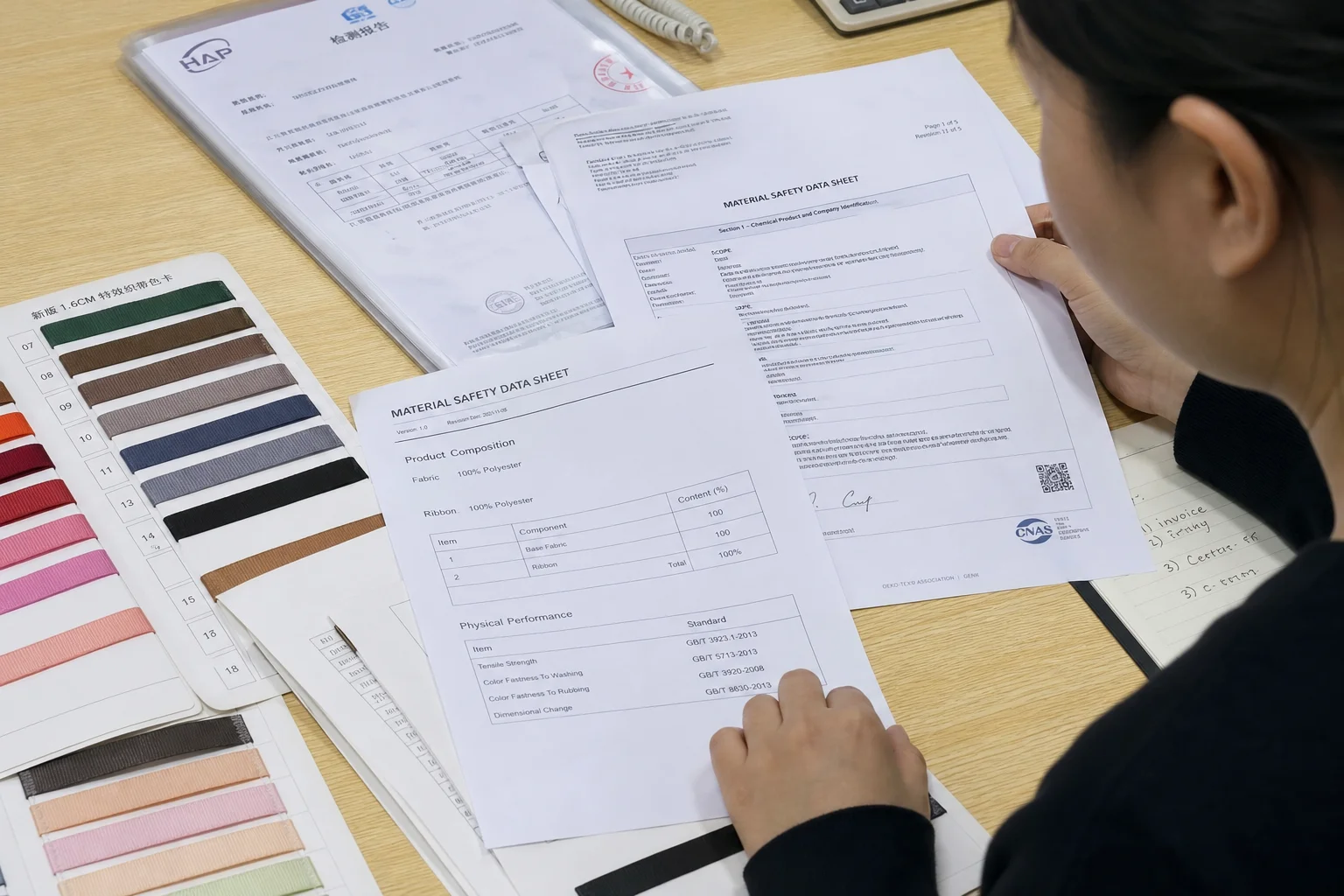
Certificates are issued per product range per factory and expire after 12 months. Each certificate carries a unique number that can be verified at the OEKO-TEX certificate database online.
Dye Migration Risk — The Practical Concern
Beyond formal certification, buyers should understand dye migration. Dye can transfer from ribbon to adjacent surfaces when:
The ribbon is damp or the environment is humid
The ribbon is in prolonged contact with absorbent materials (tissue paper, kraft paper, cotton fabric)
The ribbon is exposed to heat (warehouse storage in summer conditions)
Dark saturated colours — deep red, navy, black, dark green — carry higher migration risk than pastels or neutrals, because darker colours require higher dye concentrations. OEKO-TEX certification requires colour fastness testing (perspiration and rubbing, ISO 105 E04 and ISO 105 X12), which addresses migration risk. Specify minimum Grade 4 colour fastness in your purchase order for food packaging applications.
How to Specify Food-Safe Ribbon in a Purchase Order
Include these fields in your PO for food gift packaging ribbon:
Certification: OEKO-TEX Standard 100, Product Class I. Supplier to provide current certificate number for verification.
Azo dyes: No azo dyes releasing carcinogenic aromatic amines (per OEKO-TEX Class I requirements).
Formaldehyde: Below 20mg/kg.
Colour fastness: Minimum Grade 4 to perspiration (ISO 105 E04) and rubbing (ISO 105 X12).
pH: 4.0–7.5.
At goods receipt, verify the certificate number at oeko-tex.com. The certificate lookup will confirm the issuing factory, the product range covered, the product class, and the expiry date. A certificate that covers yarn but not finished ribbon is not sufficient — the finished product must be certified.
Frequently Asked Questions
What ribbon is safe for direct contact with food?
OEKO-TEX Standard 100 Class I certified ribbon is appropriate for indirect food contact (tied around sealed packaging). For direct contact with unwrapped food, use natural fibre ribbon with water-based dyes only — standard decorative ribbon is not appropriate for direct food contact.
What does OEKO-TEX certification mean?
Independent testing for 100+ harmful substances including heavy metals, formaldehyde, azo dyes, and pesticides. Class I is the strictest level. Verified via the OEKO-TEX certificate database. Certificates expire after 12 months — always verify currency before accepting a shipment.
Can ribbon dye transfer to food packaging?
Yes, especially dark colours in humid conditions. OEKO-TEX certified ribbon passes colour fastness testing (perspiration and rubbing) which addresses migration risk. Specify minimum Grade 4 colour fastness in your PO for food packaging applications.
Is polyester ribbon safe for food gift packaging?
Yes, when OEKO-TEX Standard 100 Class I certified. Standard uncertified polyester ribbon may contain residual processing chemicals or unfixed dye. Certified polyester ribbon is appropriate for indirect food contact (tied around sealed boxes and bags).
How do I specify food-safe ribbon in a PO?
Include: OEKO-TEX Standard 100 Class I; no carcinogenic azo dyes; formaldehyde ≤20mg/kg; colour fastness Grade 4 minimum (ISO 105 E04 and X12); pH 4.0–7.5. Verify certificate number at oeko-tex.com before accepting shipment.