How Recycled Polyester Ribbon Is Made — From Plastic Bottle to Finished Ribbon
How Recycled Polyester Ribbon Is Made — From Plastic Bottle to Finished Ribbon
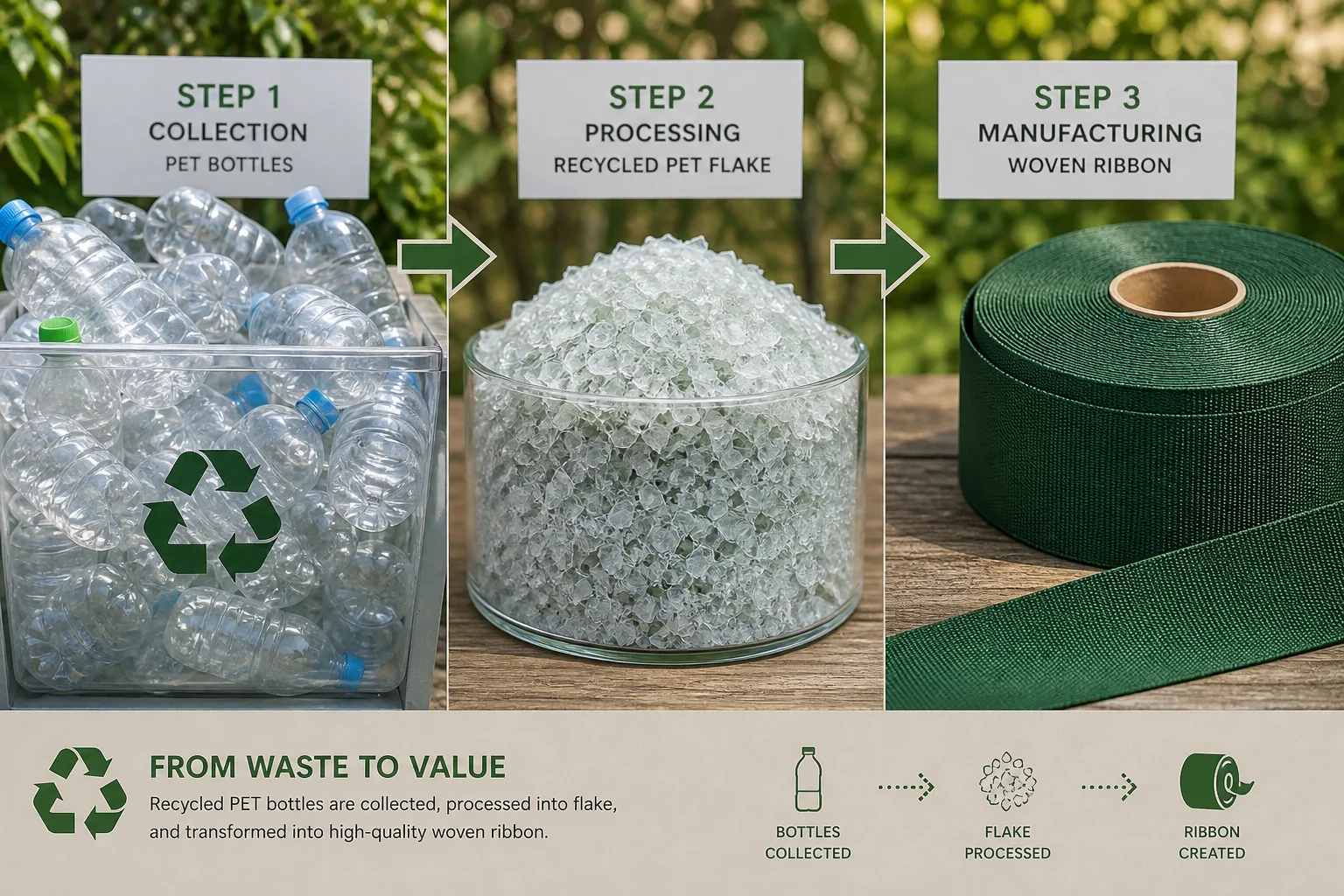
When buyers choose GRS-certified recycled polyester ribbon, they are choosing a product with a specific and verifiable material history. The ribbon starts as post-consumer plastic — primarily clear PET bottles from household recycling — and passes through a defined series of processing steps before becoming the finished ribbon on the spool. Understanding this process helps explain why recycled ribbon looks and performs like standard ribbon, and why GRS certification matters as a verification mechanism rather than just a label.
Stage 1: Collection and Sorting
The process begins with post-consumer PET collection — primarily clear PET beverage bottles from municipal and commercial recycling programmes. Clear bottles are preferred because they produce the cleanest rPET with the least colour contamination. Coloured bottles (green, brown) and non-PET plastics are sorted out at this stage.
The sorted bottles are compressed into bales and transported to rPET processing facilities. The quality of the input material — specifically the proportion of non-PET contaminants and the mix of bottle types — directly affects the quality of the recycled yarn produced downstream. GRS certification requires verification of the input material source, which is why certified rPET commands a higher price than uncertified recycled plastic.
Stage 2: Washing, Shredding, and Flaking
At the processing facility, the bottles are washed to remove labels, adhesive, and contamination, then shredded into small flakes approximately 10–15mm in size. The flakes are washed again (hot wash with caustic and detergent) to remove remaining contaminants, rinsed, dried, and inspected for colour and purity.
The resulting clean rPET flake is the first stage at which GRS certification documentation is created. The flake processor issues a GRS scope certificate covering this stage of the supply chain.
Stage 3: Melting and Yarn Extrusion
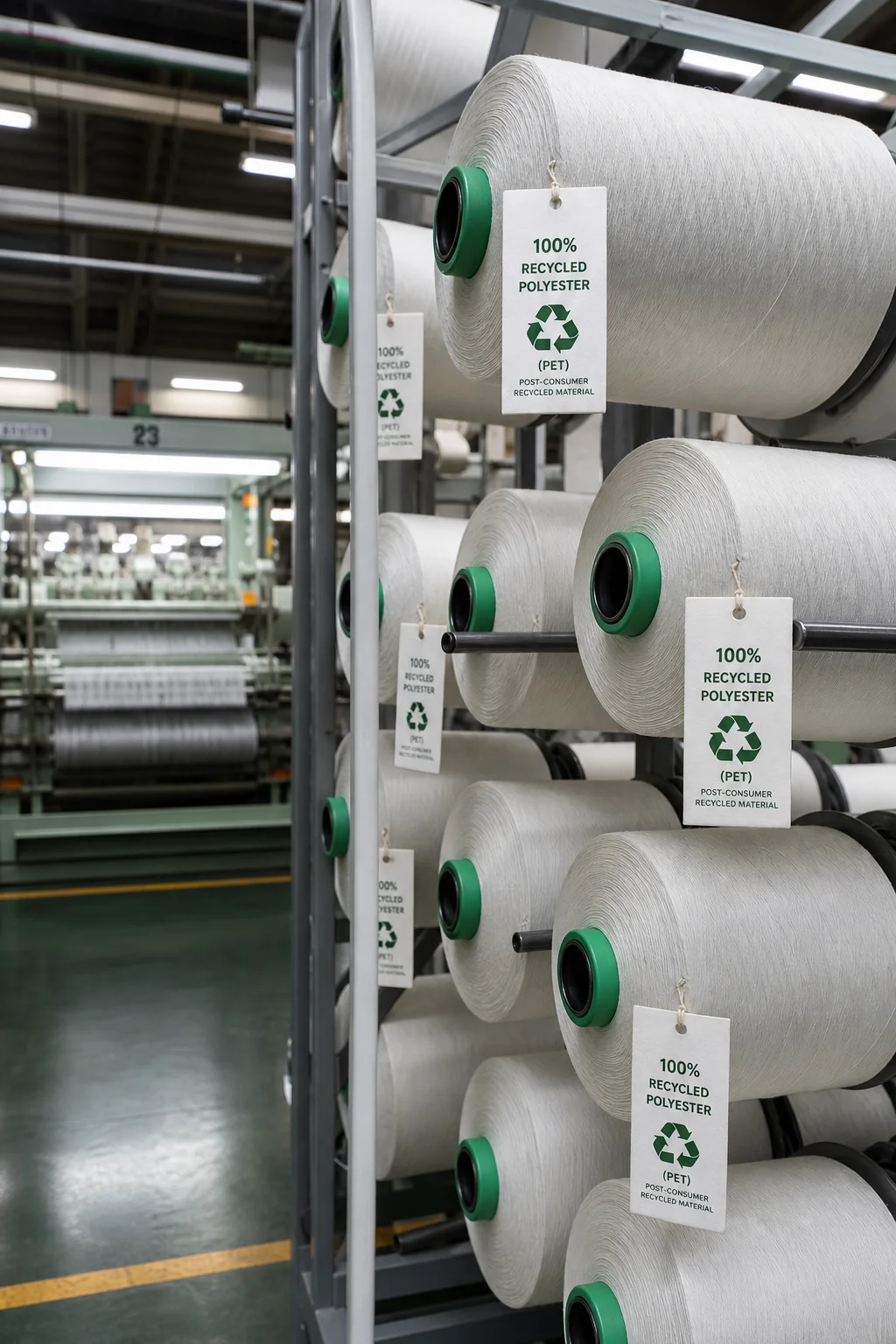
The rPET flake is melted in an extruder and forced through spinnerets — small precision nozzles with multiple holes — to produce continuous filament yarn. The extruded filaments are cooled, drawn (stretched to align the polymer chains and develop tensile strength), and wound onto yarn packages.
The intrinsic viscosity (IV) of the polymer — a measure of molecular chain length that determines the yarn's strength — is controlled during extrusion by adjusting temperature, draw ratio, and throughput speed. Quality-controlled rPET yarn manufacturers blend input flake to achieve consistent IV levels, producing yarn with properties equivalent to virgin polyester yarn of the same count.
Disperse dyes used to colour polyester ribbon adhere to the polymer structure of the fibre — they work the same way on rPET as on virgin PET. This is why recycled polyester ribbon can be produced in the same colour range as standard ribbon, with the same colour fastness and appearance.
Stage 4: Weaving
The rPET yarn is warped and woven on ribbon looms in exactly the same way as virgin polyester yarn. The weave structure — satin, grosgrain, organza — is determined by the loom setup, not the yarn type. A 38mm single-face satin ribbon made from rPET yarn uses the same weave structure and the same loom as a 38mm single-face satin ribbon made from virgin polyester.
At this stage, the ribbon manufacturer must hold a GRS scope certificate covering the weaving operation. Without this certificate, ribbon woven from GRS-certified yarn cannot be marketed as GRS-certified ribbon. The GRS chain of custody requirement means that every facility handling the certified material must be independently audited and certified.
Stage 5: Dyeing and Finishing
After weaving, the grey (undyed) ribbon fabric is dyed in piece form or in yarn form (if dyed yarn is used). Meisida uses a disperse dye process with spectrophotometric colour management to achieve consistent, verifiable colour results. The same colour management process is used for rPET ribbon as for standard ribbon — the recycled base fibre behaves identically in the dye bath.
After dyeing, the ribbon is heat-set to fix dimensions and appearance, then wound to specified lengths, labelled, and packed. GRS Transaction Certificates are issued per production batch, covering the specific quantity of certified ribbon in each order.
What This Means for Quality
The process described above produces ribbon that is chemically identical to virgin polyester ribbon at the finished product stage. The physical and performance properties — tensile strength, colour fastness, surface appearance, dimensional stability — are determined by the weave structure and the dye process, both of which are identical between rPET and virgin polyester ribbon production. Buyers can specify GRS-certified ribbon without compromising on quality or performance. Contact mystyleribbon.com for GRS ribbon samples and certification documentation.
Frequently Asked Questions
What is recycled polyester ribbon made from?
Primarily post-consumer recycled PET from clear plastic bottles. Bottles are cleaned, shredded into flake, extruded into rPET filament yarn, and woven into ribbon using the same process as virgin polyester ribbon.
How many plastic bottles does it take to make a roll of recycled ribbon?
Approximately 3–4 standard 500ml PET bottles per 25-metre roll of 38mm ribbon. For 10,000 rolls, this represents 30,000–40,000 bottles diverted from waste.
Is recycled polyester ribbon as strong as virgin polyester ribbon?
Yes — rPET yarn has comparable tensile strength and elongation to virgin polyester. Colour fastness, abrasion resistance, and handling are indistinguishable in normal packaging and decorative use.
Why does recycled ribbon sometimes look different between batches?
From unverified sources with inconsistent input material quality. GRS-certified ribbon from controlled supply chains shows no surface appearance difference from virgin polyester ribbon. Inconsistency is a quality control issue, not an inherent property of recycled ribbon.
Can recycled polyester ribbon be recycled again?
Technically yes, but rarely captured in practice due to size and mixed packaging. The primary sustainability benefit is upstream: diverting post-consumer plastic from waste and reducing demand for virgin petroleum-derived polyester.