How Ribbon Tension Is Controlled During Weaving — What It Means for Consistency in Bulk Orders
How Ribbon Tension Is Controlled During Weaving — What It Means for Consistency in Bulk Orders
When buyers compare two ribbon samples and ask why one looks more even and professional than the other, the answer is often tension control. Tension during weaving is one of those production variables that does not appear on a specification sheet — but its effects show up clearly in the finished ribbon. For buyers placing large orders that need to perform consistently across thousands of metres and multiple delivery batches, understanding what tension control means in practice helps you ask the right questions and choose suppliers who can deliver consistent results.
What Tension Means in Ribbon Weaving
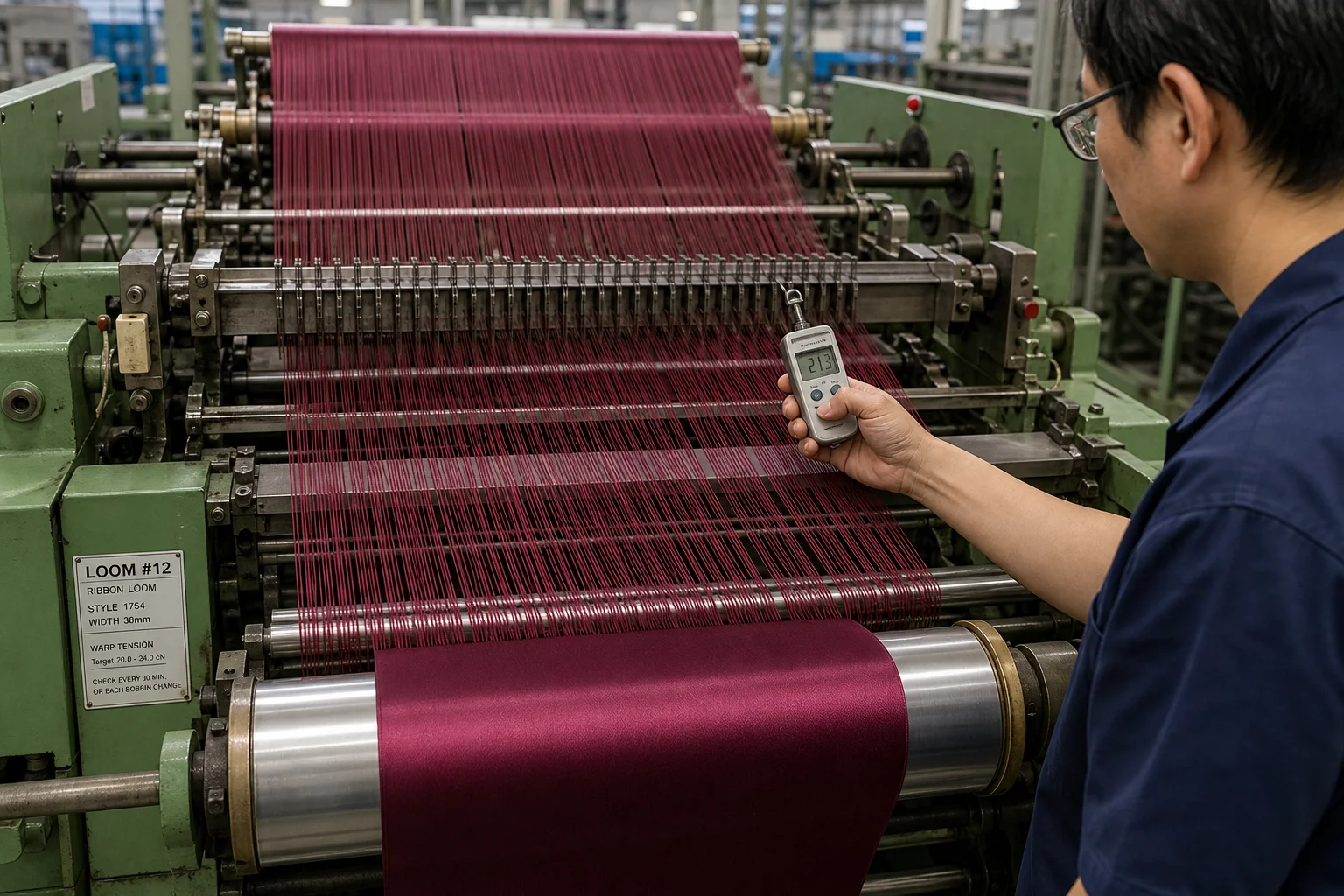
Every woven ribbon starts with warp threads — the threads that run along the length of the ribbon, unwinding from a back beam as the loom operates. These warp threads must be kept under consistent tension throughout the production run. If the tension is too high, the weave pulls tight and the ribbon narrows slightly and becomes stiff. If the tension is too low, the weave loosens, the ribbon widens slightly, and the surface looks uneven.
The challenge is that tension naturally changes as the warp beam unwinds. A full beam has a large diameter; as yarn is consumed, the diameter decreases and the beam rotates faster for the same yarn delivery rate. Without compensation, this would cause tension to gradually increase through a production run. Professional ribbon looms use automatic let-off mechanisms — either mechanical spring systems or electronic servo-controlled systems — that continuously adjust the beam rotation rate to maintain constant yarn delivery tension.
The Three Visible Effects of Tension Variation
When tension control is inadequate, buyers can identify the effects by inspection:
Width variation: Measure ribbon width at multiple points along a 25-metre roll. A well-controlled production run should show variation no greater than ±0.5mm for premium grades and ±1mm for standard commercial grades. Variation above ±1.5mm indicates a tension control problem. Width variation is the most measurable indicator and the one most relevant to machine-applied ribbon programmes where consistent width is required for reliable feeding.
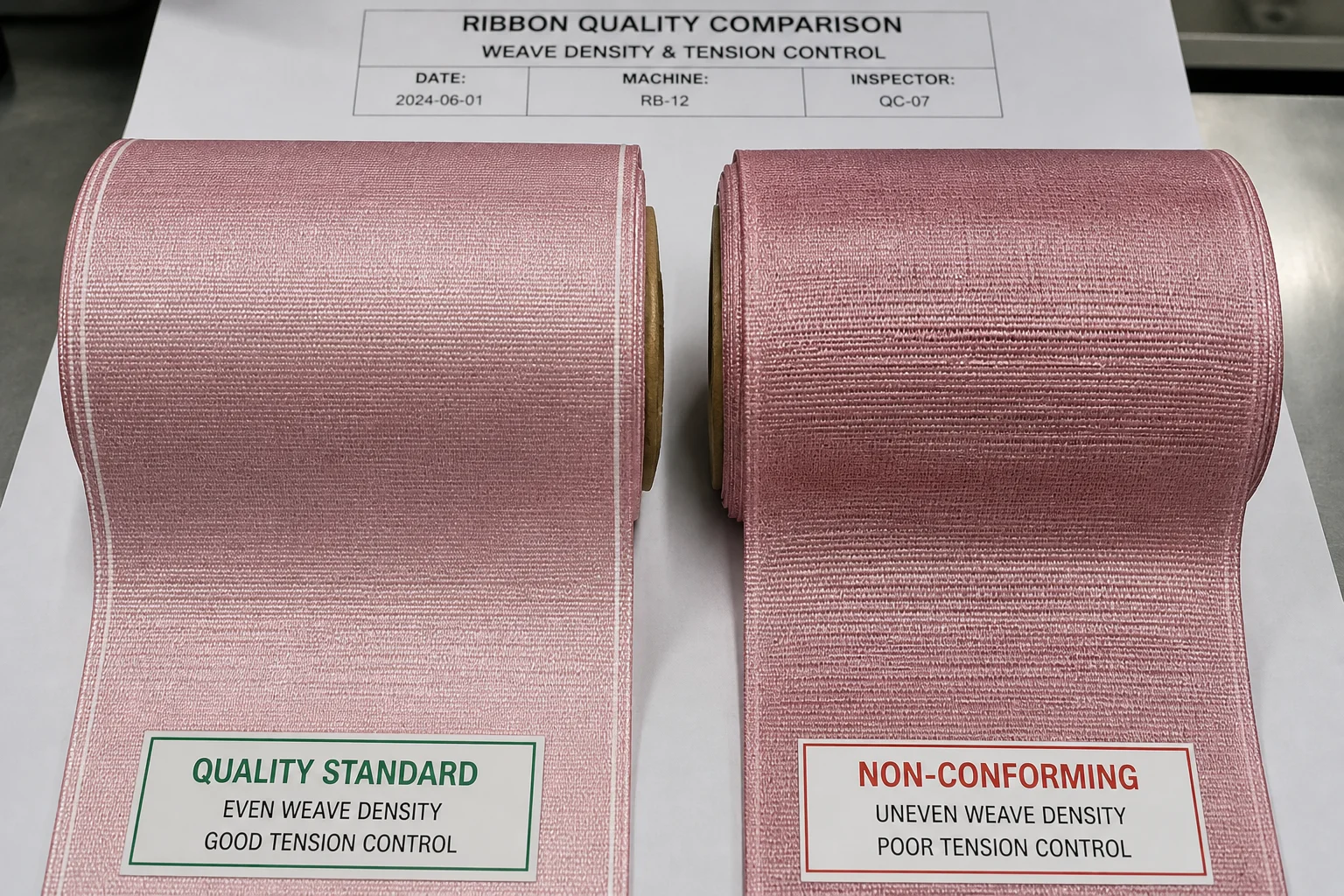
Density variation: Hold the ribbon up to a light source. Consistent tension produces even weave density throughout — the light transmission should be uniform across the ribbon length. Poor tension control produces alternating areas of denser and looser weave, visible as lighter and darker patches when backlit.
Surface texture variation: In satin ribbon, tension variation shows as areas where the surface appears slightly different in sheen level — sections woven at higher tension have slightly more compressed floats, which can appear marginally less lustrous. In grosgrain ribbon, tension variation shows as inconsistent rib definition along the ribbon length.
How Professional Manufacturers Control Tension
At Meisida, tension control operates at two levels. The mechanical level uses precision back-beam braking systems that maintain consistent let-off resistance as the warp beam diameter changes. The electronic level uses real-time tension monitoring sensors positioned between the warp beam and the heddles — these sensors feed tension data continuously to the loom controller, which adjusts the let-off rate to compensate for any deviation from the target tension value.
The result is warp tension maintained within ±5% of the target value throughout a production run — including across the transition from a full beam to a near-empty beam, which is where the most significant tension changes occur on less well-controlled equipment. This level of control is what allows Meisida to guarantee width consistency to ±0.5mm across large production runs.
What This Means for Multi-Batch Programmes
The relevance for bulk buyers goes beyond individual roll quality. When a programme requires multiple delivery batches from the same order — perhaps a July delivery and an October delivery from the same production commitment — tension control determines whether the ribbon from the second batch looks and performs identically to the first. If tension varies between production runs, width and density will vary, and the two batches will be subtly different even if the colour is matched.
Professional manufacturers document the tension settings used for each production run and can reproduce them for repeat orders. This is one of the reasons Meisida maintains detailed production records for every order — it allows consistent repeat production for ongoing programmes. Contact mystyleribbon.com to discuss documentation standards for your specific programme requirements.
Frequently Asked Questions
Why does ribbon tension matter for bulk orders?
Tension determines width consistency, weave density, and surface uniformity across a production run. Variation causes measurable width shifts and visible density differences that affect machine performance and appearance. For bulk programmes requiring consistent results across multiple batches, tension control is fundamental.
How do ribbon manufacturers control tension during weaving?
Through mechanical back-beam braking and electronic real-time tension sensing. Modern looms maintain tension within ±5% of target throughout the full production run by continuously adjusting the warp let-off rate.
How can I tell if a ribbon supplier has good tension control?
Request mid-run samples and measure width at 10 points on a 25m roll. Variation above ±1mm indicates a problem. Ask for their stated width tolerance specification — professional manufacturers guarantee ±0.5mm to ±1mm.
Does tension control affect ribbon colour consistency?
Yes, indirectly. Density variation from inconsistent tension causes subtle dye absorption differences, resulting in within-roll colour variation. This is most visible under consistent lighting and in photography.
What should I specify in a purchase order to ensure tension consistency?
Specify a width tolerance (±0.5mm premium, ±1mm standard) applying across the full run. Request a production certificate with width measurements from beginning, middle, and end of run. Meisida provides this as standard. Contact mystyleribbon.com for documentation samples.