What Is the Difference Between Polyester and Nylon Ribbon — Which Should You Use?
What Is the Difference Between Polyester and Nylon Ribbon — Which Should You Use?
Polyester and nylon ribbon look almost identical on the roll. Both are synthetic fibres, both produce smooth satin surfaces, both come in the same widths and colour ranges, and both are widely available at similar price points. The difference only becomes meaningful when you know what each material does slightly differently — and for some applications, those differences matter.
The Material Difference
Polyester (PET) and nylon (PA6 or PA66) are both synthetic polymer fibres, but they have different molecular structures that produce different physical properties in the finished ribbon:
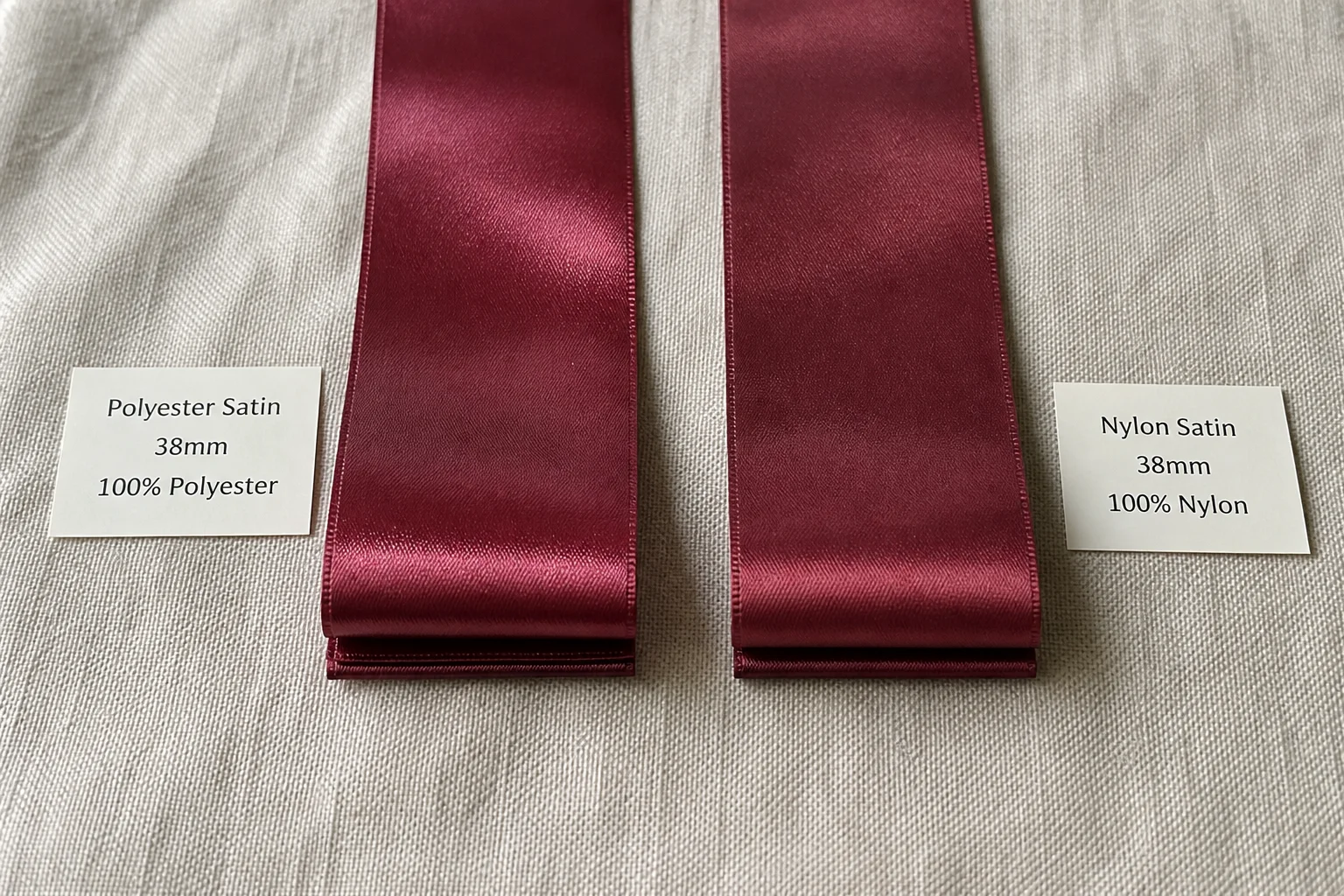
Lustre: Polyester produces a brighter, more reflective sheen — sometimes described as slightly "plastic" or "hard" in appearance. Nylon produces a softer, warmer lustre that is slightly less intense but often described as more luxurious or silk-like. For premium gift packaging targeting a luxury market, nylon's softer sheen is often preferred.
Hand (feel): Nylon ribbon feels softer and more pliable than polyester of equivalent construction. Polyester has a slightly stiffer, crisper hand. For applications where the ribbon is handled — bows tied by hand, ribbon that passes through fingers in a packaging operation — nylon feels notably more pleasant.
Colour depth: Nylon accepts certain dye classes differently from polyester. Acid dyes on nylon can produce very deep, rich colour depths that are harder to achieve on polyester with equivalent dye methods. For very dark or saturated colours — deep navy, rich burgundy, forest green — nylon can produce more intense colour.
Moisture absorption: Nylon absorbs approximately 4% moisture by weight; polyester absorbs less than 0.4%. In practice, this means nylon ribbon can absorb slight humidity from the environment, which can marginally affect feel in very humid conditions. It is not a significant issue for standard gift packaging, but matters for outdoor event or floral applications in wet weather.
UV resistance: Polyester has better UV resistance than nylon. Ribbon displayed in shop windows or outdoor settings for extended periods will fade less on polyester. For point-of-sale display ribbon that will be in direct light for months, polyester is the better specification.
Price Difference
Nylon ribbon typically costs 10–20% more than equivalent polyester ribbon. The price difference reflects nylon's higher raw material cost — nylon polymer is more expensive to produce than polyester — and the slightly more complex dyeing requirements for some colour families. For most B2B gift packaging programmes, this cost differential is manageable. For very large volume programmes where per-metre cost is tightly controlled, the premium should be evaluated against the performance benefit.

When to Choose Polyester
High-volume programmes where per-metre cost is the primary driver
Ribbon that will be in direct sunlight or UV exposure for extended periods
Applications where a bright, clean sheen is the visual goal (modern, graphic gift presentation)
Standard retail gift packaging programmes where the material difference is not perceptible to the end customer
When to Choose Nylon
Premium or luxury gift programmes where the ribbon is a significant brand touchpoint
Ribbon that will be tied by hand extensively — the softer hand reduces operator fatigue and produces better-looking hand-tied bows
Very dark or saturated colour requirements where nylon's deeper dye take is needed
Wedding and event decoration where tactile quality is visible in close-up photography
Frequently Asked Questions
Can I mix polyester and nylon ribbon in the same packaging programme?
You can, but the lustre difference will be visible if both constructions are used side by side in the same packaging context. If both are the same colour and width but different materials, they will not appear identical — the polyester will look slightly brighter and the nylon slightly softer. For most programmes, it is better to standardise on one material throughout. Contact mystyleribbon.com to discuss material specifications for your programme.
Is nylon ribbon significantly more expensive than polyester?
Typically 10–20% more per metre at equivalent widths and constructions. For a programme using 10,000m of 38mm satin ribbon annually, the material difference might represent £200–400 in cost — meaningful but manageable for most buyers. Whether the quality improvement justifies the cost depends on the application and the value of the packaging programme. Contact mystyleribbon.com for current pricing on polyester and nylon satin in your target specification.
Does the material affect how the ribbon ties — polyester vs nylon?
Yes, noticeably. Nylon satin ribbon ties more easily by hand — it is more pliable, holds shape at the bow centre without the slight stiffness that polyester can introduce, and the softer surface slides more smoothly when pulling the knot. Polyester's slightly stiffer hand means the bow loops hold their shape well but the tying process requires slightly more tension. For packing lines where bows are tied quickly by operators, nylon often reduces re-tie rates and increases throughput. Contact mystyleribbon.com to request tying samples for line trials.
Which material is more sustainable?
Both polyester and nylon are synthetic fibres derived from petrochemical feedstocks, and both are recyclable in principle but rarely recycled in practice when used as decorative ribbon. Recycled polyester (rPET) ribbon is available — produced from post-consumer PET bottle material — and carries GRS certification. Recycled nylon from post-industrial sources is available but less common and carries a higher premium. For programmes with sustainability commitments, rPET ribbon is currently the more accessible and cost-effective option. Contact mystyleribbon.com to discuss GRS-certified rPET ribbon availability for your programme.
Does nylon ribbon behave differently in storage or transit?
Nylon's slightly higher moisture absorption means it can absorb ambient humidity in storage, which may cause very minor changes in feel if ribbon is stored in a very humid environment for extended periods. In standard warehouse storage conditions (temperature-controlled, dry), this is not a practical concern. Polyester is completely unaffected by humidity in storage. For ribbon stored in genuinely challenging conditions (tropical humidity, outdoor warehousing), polyester is the more stable specification. Contact mystyleribbon.com for guidance on storage and transit for your specific materials.