How to Prevent Ribbon From Fraying — Everything Buyers Need to Know About Ribbon Edge Finishing
How to Prevent Ribbon From Fraying — Everything Buyers Need to Know About Ribbon Edge Finishing
Ribbon fraying at cut edges is one of the most common quality complaints in gift packaging and decoration — and almost entirely avoidable when the ribbon is specified and handled correctly. The fray is not random. It happens for specific, identifiable reasons, and each one has a practical solution.
This guide covers what causes ribbon to fray, what edge finishing methods prevent it, and how to specify ribbon to eliminate fraying in your packaging programme.
Why Ribbon Frays
All woven ribbons can fray at a cut edge if the edge is not treated or the ribbon is not cut correctly. Fraying happens because woven fabric is, structurally, a grid of interlaced threads. At a cut edge, the threads that ran perpendicular to the cut are no longer locked in by the weave — they can slide and separate if nothing holds them in place.
Whether fraying occurs depends on three factors:
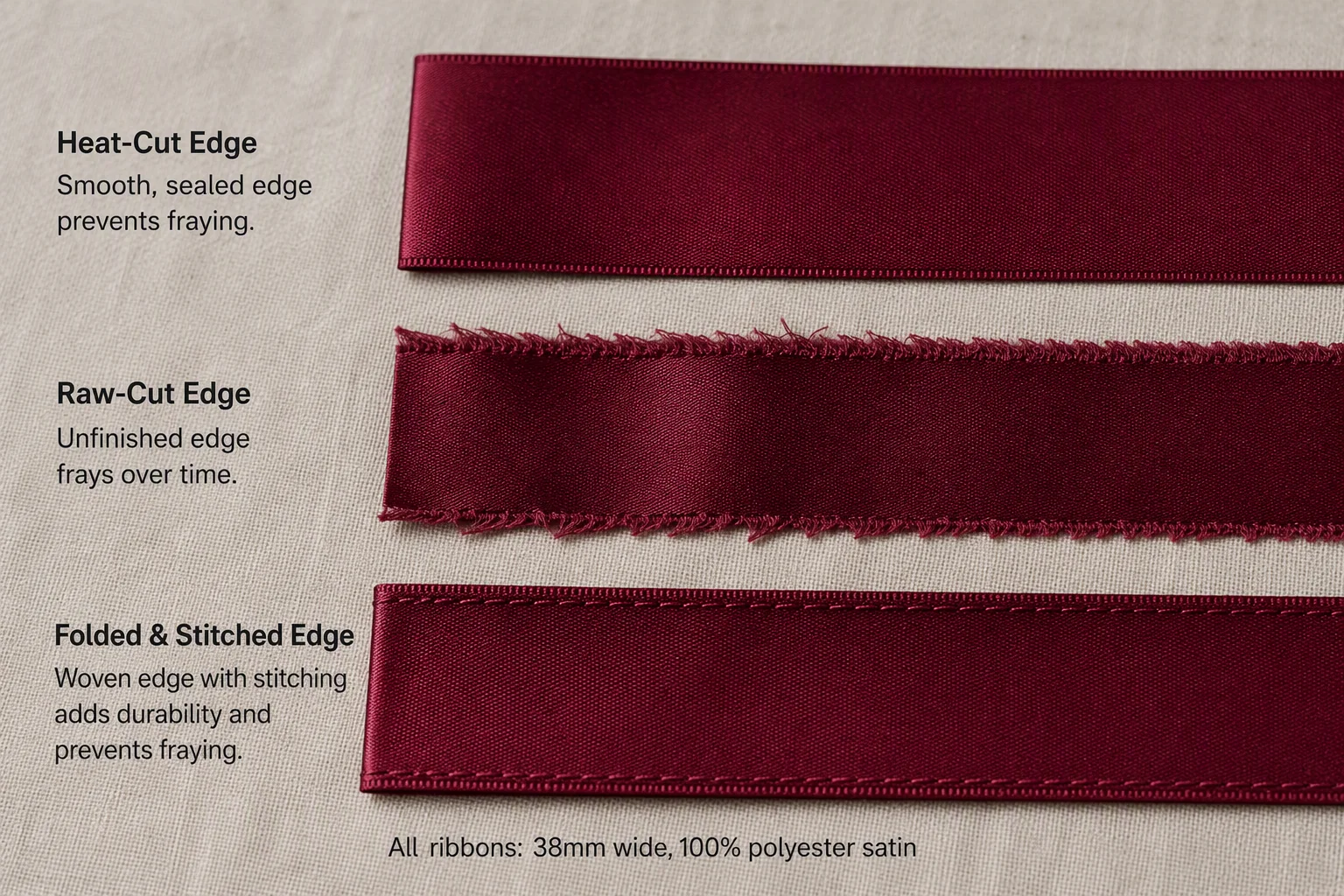
Material: Polyester ribbon does not fray in the same way as natural fibre ribbon when heat-cut — the polyester melts and fuses at the cut edge, sealing the fibres. Silk, cotton, and linen ribbons cannot be heat-sealed and will fray unless the edge is finished by another method.
Cut method: A hot or laser cut on polyester ribbon seals the edge as it cuts. A cold cut (scissors, knife, rotary cutter) on any ribbon leaves an open edge that may fray. The cut method is the single most controllable factor in edge fraying.
Weave density: Loosely woven ribbons — organza, open-weave grosgrain — have more space between threads for the cut edge to open up. Tightly woven ribbons are more resistant to fraying even on a cold cut, but will still fray eventually under handling stress.
Edge Finishing Methods and When to Use Each
Ribbon manufacturers use several edge finishing methods depending on the ribbon material and the application:
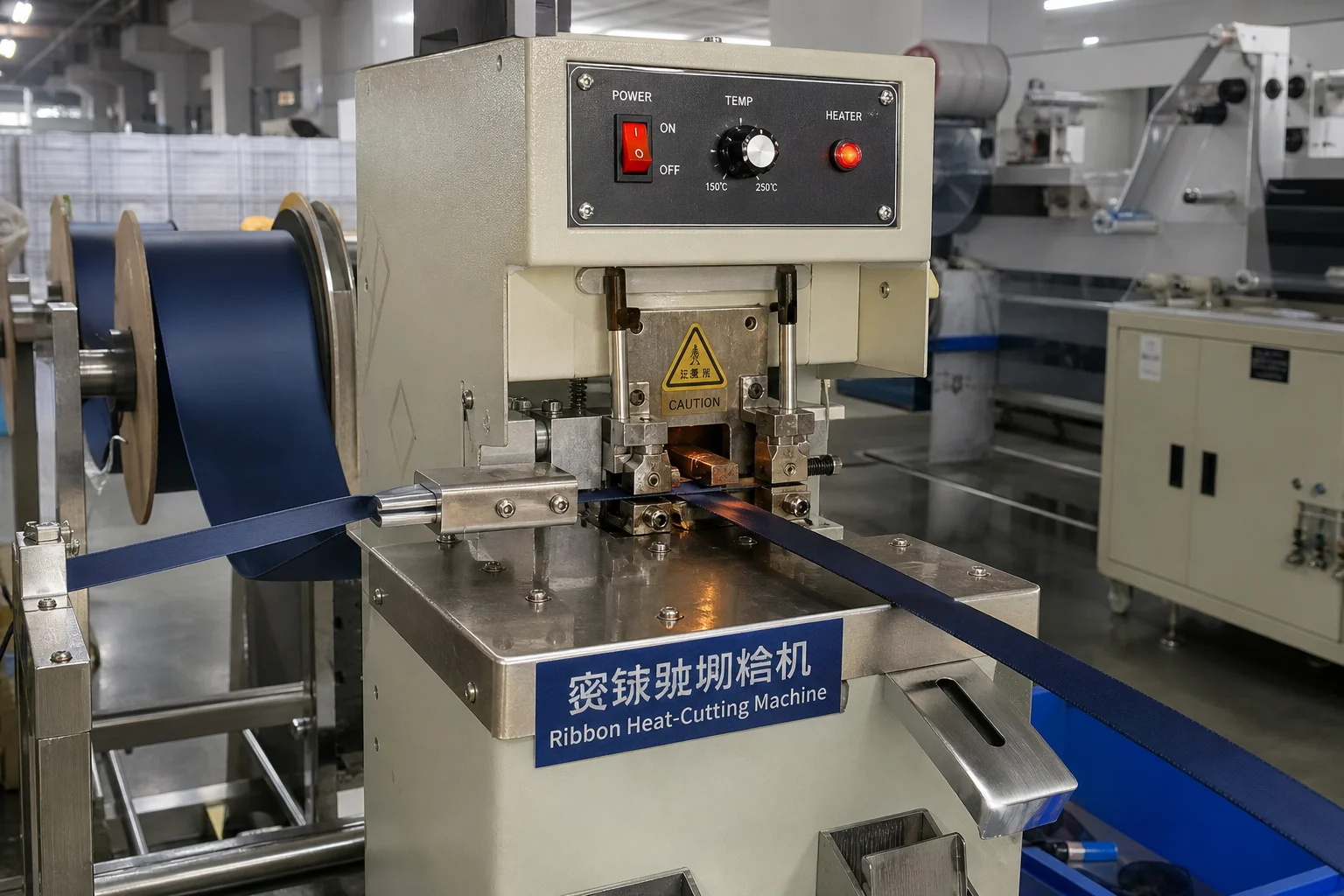
Heat cutting (standard for polyester): A heated blade cuts and seals the polyester edge in one pass. The heat fuses the synthetic fibres into a clean, hard line. This is the standard method for polyester satin, grosgrain, and organza. It is fast, inexpensive, and produces a clean edge that will not fray under normal handling. When buying polyester ribbon, heat-cut edges should be the default expectation.
Ultrasonic cutting: High-frequency vibration melts and fuses the polyester edge simultaneously with cutting. The result is similar to heat cutting but often produces a slightly cleaner, harder seal and is used for precision cutting of narrow widths. Functionally equivalent to heat cutting for most buyers.
Folded and sewn selvedge (for woven-edge ribbon): Some ribbon constructions include a woven selvedge edge — where the weft thread turns back at the ribbon edge rather than being cut. The edge is structurally complete without any cutting treatment. This is the construction of grosgrain ribbon, which does not rely on heat sealing for its edge integrity.
Liquid edge sealant (for cut ends in application): A clear liquid applied to the cut end of a ribbon length that dries to a flexible seal. Used by end users (florists, gift wrappers) to treat cut lengths rather than by manufacturers on production runs. Fray Check and similar products are available through craft suppliers.
What Buyers Should Specify and Check
When ordering polyester ribbon for a packaging programme, specify heat-cut edges as a requirement. This is standard practice for most ribbon manufacturers, but making it explicit in the purchase order ensures it is not omitted from production instructions. For ribbon that will be cut to length in your packaging operation, specify the cutting equipment your team uses and confirm that it is appropriate for the ribbon construction.
A quick practical test: cut a short length with scissors (cold cut) and observe whether the edge holds over 10–15 minutes of handling. A well heat-sealed polyester ribbon will not fray from a subsequent cold cut in normal use. A ribbon that frays immediately may have been improperly sealed, or may be a natural fibre construction requiring different treatment.
Frequently Asked Questions
Does polyester ribbon always have heat-cut edges from the manufacturer?
Standard production polyester ribbon from reputable manufacturers is heat-cut as part of the finishing process. However, ribbon cut to non-standard lengths at distribution, or produced by smaller operations without heat-cutting equipment, may have cold-cut edges. If fray resistance is critical, specify heat-cut edges in your purchase order. Contact mystyleribbon.com to confirm our standard edge finishing for your construction.
Can silk ribbon be heat-cut to prevent fraying?
No. Heat cutting works by melting synthetic fibres — the fused edge is the seal. Silk and other protein fibres do not melt cleanly; they scorch and discolour. Natural fibre ribbon requires alternative edge finishing: a woven selvedge, a folded hem, a liquid sealant applied to cut ends, or Z-folding and stitching. Most silk ribbon available to B2B buyers has a woven selvedge edge that does not require cutting treatment at production. Contact mystyleribbon.com to discuss edge finishing options for natural fibre ribbon orders.
My ribbon is fraying after being cut to length in our packing line. What is the cause?
If the ribbon was correctly heat-cut by the manufacturer and frays when you cut it to length, the issue is your cutting method. Cold scissors and rotary cutters leave open edges on any woven fabric. Use a hot cutter or heated scissors, or apply a liquid edge sealant (Fray Check or equivalent) to each cut end. Contact mystyleribbon.com for advice on cutting equipment suitable for your line speed.
Does grosgrain ribbon fray differently from satin ribbon?
Grosgrain typically has a woven selvedge edge — the weft turns back at each edge rather than being cut — so the long edges do not fray in normal use. A cross-width cut on grosgrain leaves a raw end that can fray like any woven fabric; heat-seal that cut end or apply sealant. Satin ribbon's edges are cut edges and rely on heat sealing. Contact mystyleribbon.com for edge construction details for your specific grosgrain.
Is there a fray-resistant ribbon that does not require any edge treatment?
Grosgrain with a true woven selvedge edge, as described above, is the closest widely available option — the long edges do not require treatment. For cut ends, no woven ribbon is naturally fray-proof without some form of treatment or construction feature. Polyester ribbon with correct heat-cut edges is the most practical fray-resistant specification for the majority of B2B gift packaging applications — it is widely available, cost-competitive, and requires no additional end-user treatment under normal handling conditions. Contact mystyleribbon.com to discuss the best fray-resistant specification for your programme.