How to Choose Ribbon for Automated Packaging Lines — Speed, Width, and Tension Specifications That Prevent Jams
How to Choose Ribbon for Automated Packaging Lines — Speed, Width, and Tension Specifications That Prevent Jams
Ribbon that works perfectly for hand-tied bows will jam an automated packaging line within the first hour of a production run. Automated bow machines are less forgiving than human hands: they cannot compensate for ribbon that is 1.5mm wider than specified, or for a roll wound with inconsistent tension, or for a surface friction coefficient that is 20% higher than the machine's guide settings expect. This guide covers the four specifications that matter most for automated lines, based on our experience supplying ribbon to B2B buyers running bow machines at 600–2,400 bows per hour.
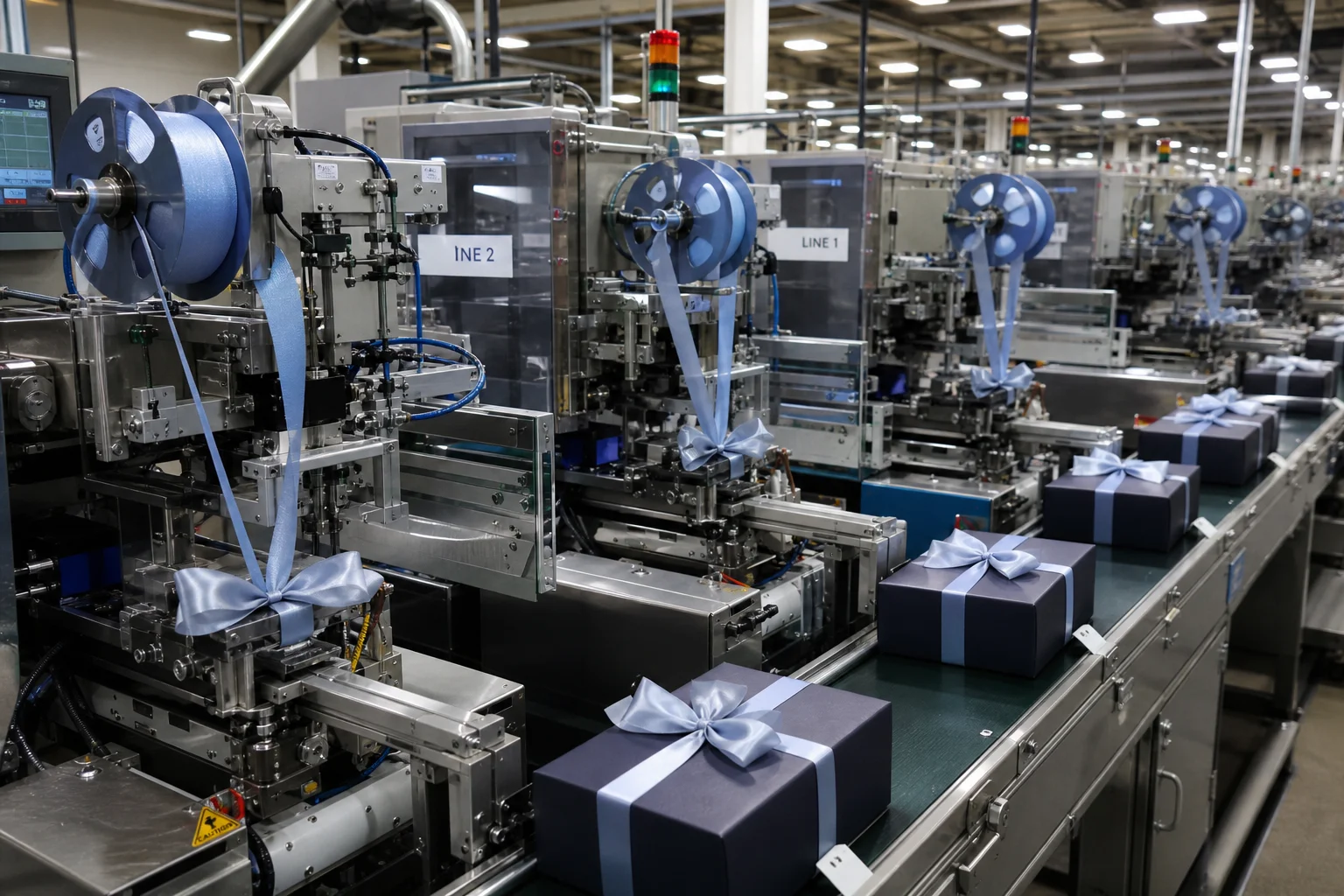
The Four Specifications That Matter
1. Width Tolerance
Width tolerance is the most common cause of ribbon-related machine downtime. Automated bow machines have fixed-width tension guides calibrated for a specific ribbon width. When ribbon is wider than specified, it catches on the edges of the guides. When it is narrower, it slides laterally, producing bows with loops of uneven size.
For automated lines, specify ±1mm maximum width variation — tighter than the standard ±5% typically used for hand-tied ribbon. For 25mm ribbon, ±5% allows a range of 23.75mm–26.25mm. For a machine calibrated to 25mm, anything above 26mm is a jam risk. Specify ±1mm (24mm–26mm) explicitly in your purchase order for machine-use ribbon.
In our production, we verify width at five points along a 100m sample from each batch before shipment for machine-use orders: both selvedge edges and the centre. A roll that passes at the outer wraps and fails at the core wraps — which happens with worn-loom production — will jam a machine mid-run.
2. Surface Friction
Surface friction determines how easily ribbon slides through the machine's tension guides and forming mechanisms. Ribbon with too-high friction feeds inconsistently; ribbon with too-low friction feeds too fast.
Surface friction varies significantly by ribbon type:
Single-face satin: Lowest friction on the satin face. Feeds most consistently on standard machines. Recommended default for new machine setups.
Double-face satin: Slightly higher friction than single-face but still within standard machine parameters. No recalibration needed when switching from single-face satin of the same width.
Grosgrain: 15–25% higher friction than satin. Machines need tension guide recalibration when switching to grosgrain. Run a calibration test before committing to production.
Velvet and textured ribbon: High friction, typically requires specialist machine settings. Consult your equipment supplier before specifying.
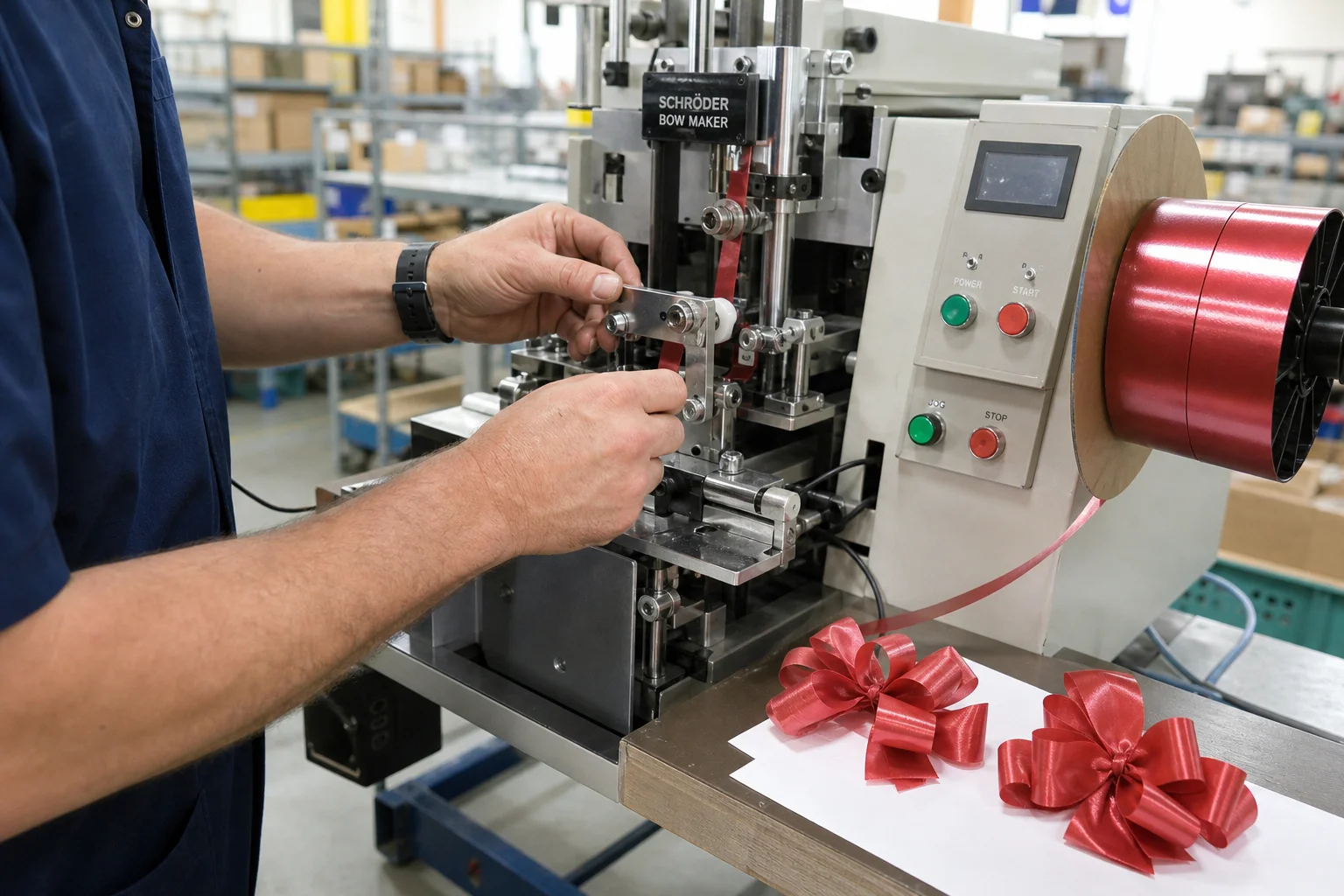
3. Roll Winding Tension
Roll winding tension is the pressure applied as ribbon is wound onto the cardboard core during production. A consistently wound roll has the same layer density from core to outer edge. As the machine unwinds the roll, the feed speed remains constant regardless of remaining roll diameter.
An inconsistently wound roll — common in production where winding equipment is not calibrated — produces bows that start correctly but become larger or smaller as the roll unwinds. The symptom is bow size variation that appears gradually through a production run rather than immediately.
To specify consistent winding: ask your supplier to confirm their winding equipment is servo-controlled (tension-compensated), not fixed-speed. Servo-controlled winding maintains constant tension as roll diameter increases; fixed-speed winding produces tighter inner layers and looser outer layers.
4. Edge Finish
Ribbon for automated machines must have heat-sealed edges — the standard edge finish produced by a hot-wire cutter that simultaneously cuts and seals the selvedge. Heat-sealed edges do not fray under tension guide pressure.
Ribbon with woven selvedge edges (no heat-seal) is acceptable for hand-tied applications but can produce loose fibres under the repeated friction of a machine's tension guides. These fibres accumulate inside the machine and eventually cause jams or contaminate the bow surface. When ordering machine-use ribbon, explicitly specify heat-sealed edges, not woven selvedge.
Specification Template for Machine-Use Ribbon Orders
Add these fields to your standard ribbon purchase order when ordering for automated lines:
Width tolerance: ±1mm (not ±5%)
Surface type: single-face satin (or specify grosgrain with note: machine recalibration required)
Roll winding: servo-controlled winding, consistent tension inner-to-outer
Edge finish: heat-sealed, not woven selvedge
Core diameter: [specify your machine's core size — typically 38mm or 76mm]
Roll length: [calculated for 50–60 bows per roll — see our ribbon quantity calculation guide]
Frequently Asked Questions
What ribbon specifications matter most for automated bow machines?
Width tolerance (±1mm), surface friction (satin preferred), consistent roll winding tension (servo-controlled), and heat-sealed edges. These four factors account for over 90% of ribbon-related machine downtime.
Can grosgrain ribbon be used in automated bow machines?
Yes, but grosgrain's 15–25% higher friction vs satin requires tension guide recalibration. Always run a calibration test before committing to a grosgrain production run.
What roll length works best for automated lines?
Target 50–60 bows per roll. Calculate your bow length, add 3% safety margin, set roll length accordingly. Too-short rolls mean frequent stops; too-long rolls risk winding tension inconsistency near the core.
What is roll winding tension and why does it matter?
Consistent winding tension (servo-controlled) produces the same layer density from core to outer edge, so the machine feeds at a constant speed through the whole roll. Inconsistent winding causes bow size to drift during a run.
Should I use wired or unwired ribbon in automated bow machines?
Unwired ribbon is standard for automated machines. Wire along the selvedge edges of wired ribbon can catch on tension guides and cause jams on most standard equipment.