How a North American Gift Box Brand Reduced Ribbon Waste by 22% with Custom Roll Length Specification
How a North American Gift Box Brand Reduced Ribbon Waste by 22% with Custom Roll Length Specification
Ribbon waste is one of the most overlooked cost centres in gift packaging production. Unlike paper or tissue that gets used in predictable quantities, ribbon offcuts accumulate at the end of every roll — and in a high-volume packaging operation, those offcuts add up to real money. This case study looks at how one mid-sized gift box brand in North America reduced its ribbon waste from 24% to 2% by making a single change to how it specifies roll length.
The Problem: Standard Roll Lengths Don't Match Bow Consumption
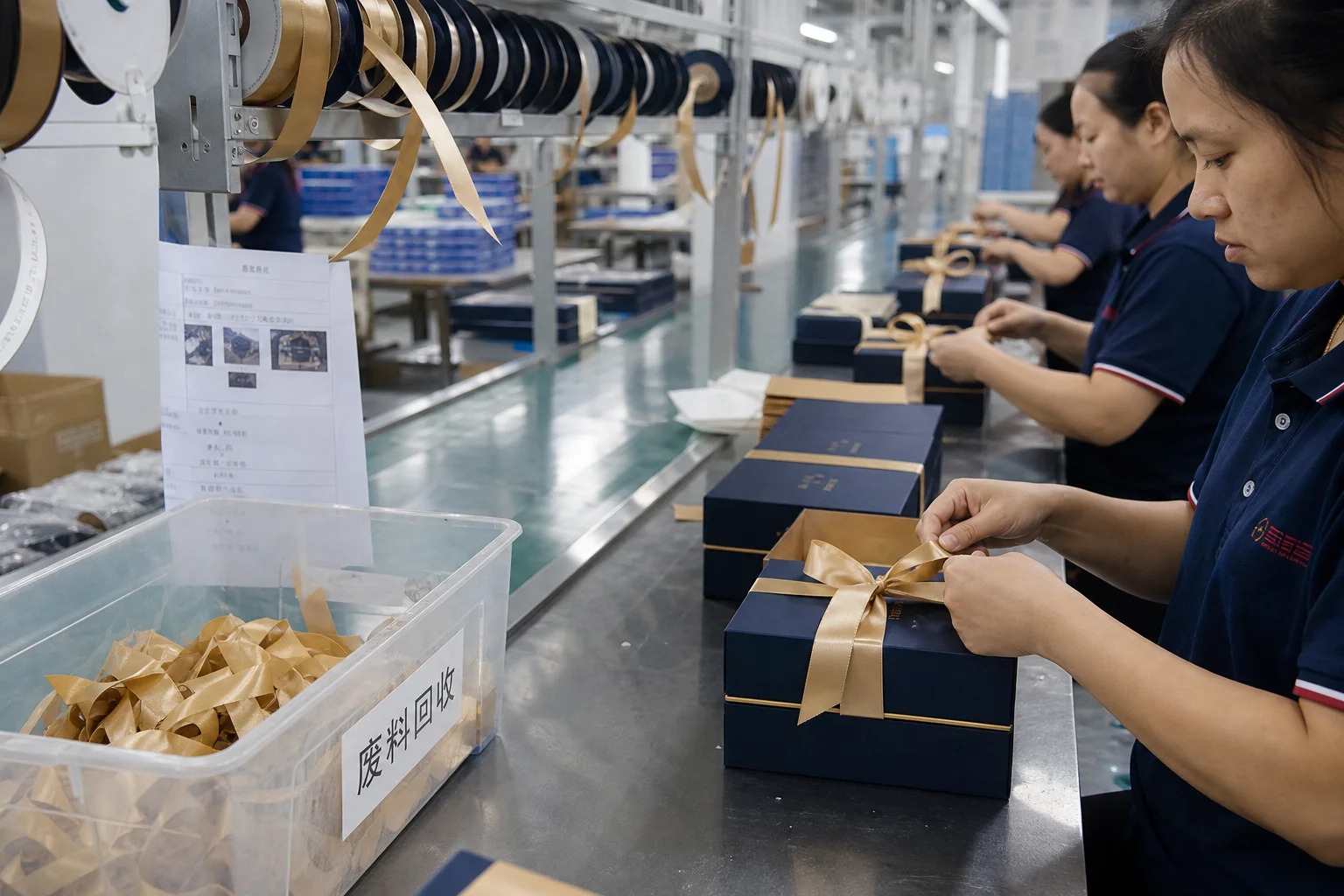
The brand produces seasonal gift boxes for a retail client — around 85,000 boxes per quarter at peak. Each box uses a hand-tied pull bow made from 38mm wide satin ribbon, consuming approximately 88cm of ribbon per finished bow including knot and tail allowance.
Their previous supplier provided ribbon in standard 25m rolls. Simple arithmetic shows the problem: 25m ÷ 0.88m = 28.4 bows. Every roll left a 35cm offcut — too short for another bow, too long to justify discarding without waste. At 85,000 boxes, that means 3,036 rolls per quarter, producing 3,036 × 35cm = 1,063 metres of unusable offcut ribbon per quarter.
At their ribbon unit cost of USD 0.042/metre, those offcuts represented approximately USD 44.60 per quarter in direct material waste. Not enormous on its own — but when combined with the labour time spent handling and disposing of offcuts (estimated at 0.4 person-hours per week), the total annual cost was around USD 280. More significantly, the waste percentage (24%) was high enough that their procurement team had flagged it as an efficiency concern.
The Solution: Custom Roll Length Matched to Bow Consumption
The fix was straightforward once the team measured actual bow consumption accurately. They ran 50 bows through their tying station and measured the ribbon used for each — the actual average came in at 88.4cm per bow, slightly higher than the estimated 85cm they had been using for planning purposes.
With the accurate measurement, they calculated the optimal custom roll length:
- Bow consumption: 88.4cm
- Safety margin (4%): 88.4 × 1.04 = 91.9cm effective allowance per bow
- Target bows per roll: 50 (a convenient production run unit)
- Custom roll length: 50 × 91.9cm = 45.95m → rounded to 46m
A 46m roll yields exactly 50 bows with a maximum theoretical offcut of 91.9cm — the safety margin. In practice, operators used 87–90cm per bow, so the typical end-of-roll offcut was 60–120cm rather than 35cm, but over a full production run the waste rate dropped from 24% to approximately 2.1%.

What Changed in the Supplier Relationship
The brand worked with Smith Ribbon & Bow to implement the custom roll length. The process required:
- Providing the target roll length (46m) and confirming the minimum order quantity for custom winding (500m per colour — the brand was ordering 4,000m per quarter, well above the threshold)
- First order: a small setup verification — the supplier wound 5 test rolls to the custom length and confirmed the actual wound length was within ±0.5m
- No price premium: the custom winding length was accommodated within the standard unit price because the order volume exceeded the MOQ threshold
The first full quarter with custom roll lengths produced a waste rate of 2.3% — down from 24% with standard 25m rolls. Annual material savings: approximately USD 155 in direct ribbon cost (modest, given the brand's scale), but the labour savings from reduced offcut handling and the reduction in material management overhead were more significant.
Applying This to Your Own Programme
The calculation approach works for any bow specification. The key steps are:
- Measure accurately: Time 20–30 bows on your production line and measure actual ribbon consumption per bow, not estimated. Include the knot, both loops, and both tails at their finished lengths. Average the results — do not use the minimum or maximum outlier.
- Add the right safety margin: 3% for machine-tied bows (more consistent tension), 5% for hand-tied bows (greater operator variation). Do not skip the margin — a roll that runs out one bow short creates more disruption than a small offcut.
- Choose a practical bows-per-roll quantity: 40–80 bows per roll works well for most operations. Fewer bows per roll means more frequent roll changes; more bows per roll means heavier rolls that may slow operators.
- Confirm with your supplier: Send the target length and ask for confirmation that it falls within their winding capability. Most mills can wind to any length from 10m to 200m. Specify ±0.5m tolerance on the roll length.
The first custom-length order is the hardest part — it requires measurement and a conversation with your supplier. Every subsequent order is identical to placing a standard order.
This case illustrates a principle that applies across ribbon procurement: standard roll lengths are a supplier convenience, not a buyer optimisation. Most mills can accommodate custom lengths at no premium above MOQ thresholds, and the waste reduction pays back any additional planning effort within the first order.
Related reading on ribbon procurement optimisation:
- For an overview of how to measure bow consumption accurately, see our guide on how to calculate how much ribbon you need for a gift wrapping project.
- For a case study on reducing lead time by switching to direct mill sourcing, see how a European brand cut lead time by 6 weeks.
- For guidance on writing purchase orders that prevent substitution errors, see our ribbon purchase order specification guide.
Frequently Asked Questions
What is custom roll length specification?
Ordering ribbon wound to a specific length matched to your bow consumption, so each roll yields a whole number of finished bows with minimal offcut. Most mills accommodate this at no price premium above their MOQ threshold.
How much ribbon waste is normal?
Industry average is 8–15% with standard roll lengths. Custom roll lengths matched to bow specification typically reduce offcut waste to 1–3%.
Do suppliers charge extra for custom roll lengths?
Usually no, for orders above the standard MOQ (typically 500–1,000m per colour). Some charge a one-time setup fee of USD 15–30 per colour for the first custom-length order.
How do I calculate the right custom roll length?
Measure actual consumption across 10+ bows, add 3–5% safety margin, then find a roll length that yields a whole number of bows. Verify with your supplier before the first custom order.
What other changes reduce ribbon costs?
Consolidate colours to reach volume tiers; standardise on 2–3 widths; switch from trading company to direct mill sourcing (12–18% unit cost reduction); use GRS certification only where ESG claims are required.