How Ribbon Width Tolerances Are Controlled in Production — What B2B Buyers Need to Specify
How Ribbon Width Tolerances Are Controlled in Production — What B2B Buyers Need to Specify
Width is one of those ribbon specifications that buyers often list without thinking too carefully about what they are actually asking for. A purchase order that says "25mm satin ribbon" has technically specified a width — but it has not specified a tolerance, a measurement method, or an inspection standard. In practice, what gets shipped can range from 23.5mm to 26.5mm depending on the supplier's default tolerance and production variability. For most manual gifting applications this does not matter much. For automated packaging lines or programmes where visual consistency across a large batch is essential, it matters a great deal.
What Width Tolerances Mean in Practice
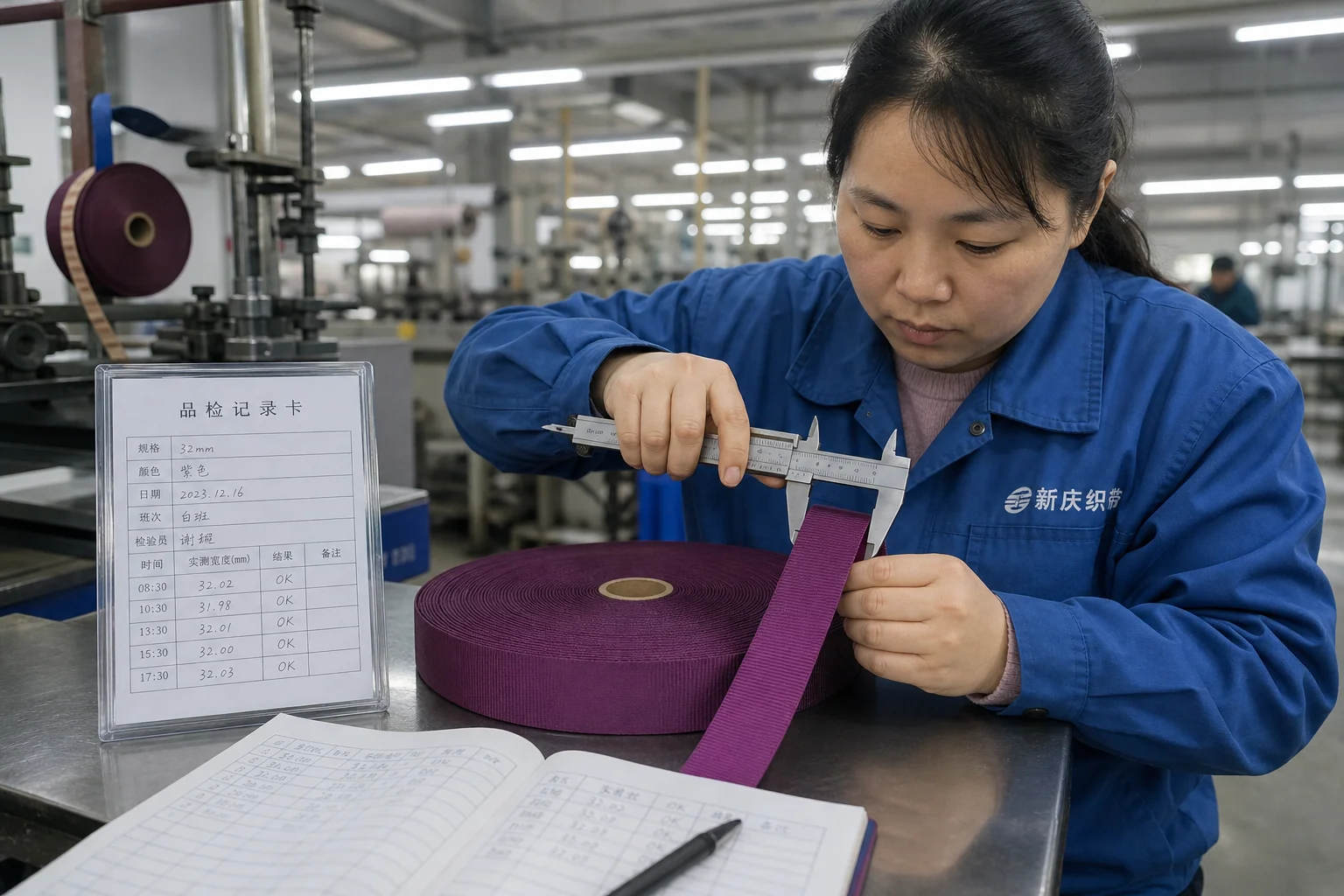
Tolerance is the accepted range of variation around a nominal specification. When a supplier states their ribbon is 25mm, they mean the finished ribbon will measure 25mm plus or minus their standard tolerance. Standard industry tolerance for woven polyester ribbon is typically ±1mm for widths up to 25mm, and ±1.5mm for wider ribbons. This means a nominally 25mm ribbon could legitimately measure anywhere between 24mm and 26mm — a full 2mm range — and still be within standard tolerance.
That range sounds small, but its significance depends entirely on how the ribbon is being used:
Manual gifting programmes: ±1mm is essentially invisible in a finished bow or wrapping. Human hands compensate intuitively for small width variations. Standard tolerance is completely adequate.
Printed label ribbons flush-mounted on box lids: A 2mm width variation on a ribbon intended to sit precisely within a recessed channel or alongside a printed edge becomes immediately visible. Tight tolerance (±0.5mm) is worth specifying and paying for.
Automated bow machines: These are calibrated to a specific ribbon width for feed guide clearance. A ribbon wider than the guide opening causes jamming; narrower causes slippage and inconsistent loop sizes. For automated lines, ±0.5mm is not optional — it is a machine reliability requirement.
Wired ribbon for floral and wreath applications: The wire is inserted at or near the selvedge edge. Width variation affects where the wire sits relative to the edge, which affects the ribbon's structural behaviour when bent. Consistent width matters for consistent product performance.
The Three Production Factors That Cause Width Variation
Understanding what drives width variation helps buyers evaluate whether a supplier's quality system is actually addressing the root causes.
Warp tension. During weaving, the warp threads are held under tension across the loom width. If tension is set too high, the warp threads pull inward during interlacing, causing the ribbon to narrow. If tension drops as the warp beam empties (a common issue on looms without automatic tension compensation), the ribbon can widen slightly toward the end of a warp. Good operators check width at regular intervals — every 50–100m — and adjust tension before deviation exceeds tolerance.
Yarn count variation. Yarn is supplied in batches, and polyester yarn diameter can vary slightly between batches even from the same supplier. A slightly heavier weft yarn packs more densely, which can increase width by 0.3–0.5mm. Suppliers who test incoming yarn for count and reject out-of-spec material will have tighter width consistency than those who do not.
Heat-setting shrinkage. Most woven ribbon goes through a heat-setting process after weaving — passing through a heated chamber at controlled temperature to fix the dye, stabilise the weave structure, and give the ribbon its final hand. Heat causes polyester to shrink slightly. The amount of shrinkage depends on temperature, dwell time, and the specific yarn used. A ribbon woven at 26mm may finish at 25mm after heat-setting if the process is calibrated correctly — or at 24.5mm if the heat-setting temperature is higher than specified. Suppliers should have documented heat-setting parameters and monitor finished width post-setting.
What to Include in a Width Specification
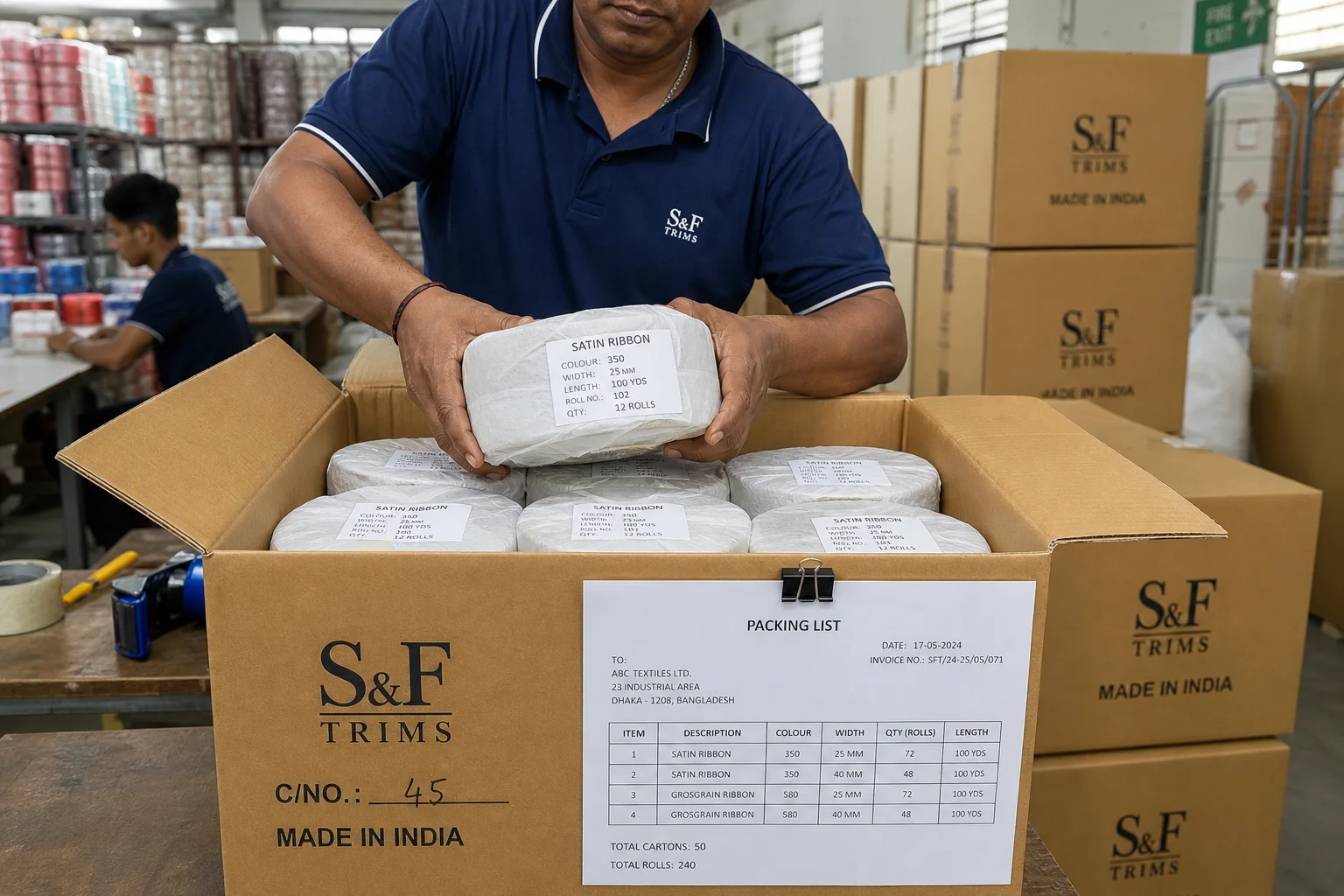
A complete width specification for a ribbon purchase order should include four elements:
Nominal width: The target dimension in millimetres (e.g. 25mm).
Tolerance: The acceptable deviation stated explicitly (e.g. ±0.5mm, ±1mm). Do not leave this unstated — the supplier will apply their default, which may be wider than you need.
Measurement method: Measured flat, under no tension, at room temperature (approximately 20°C). Width measured under tension or at elevated temperature will read differently from the same ribbon measured at rest.
Inspection standard: Per roll (every roll measured), per batch (a sample from each production batch), or by statistical sampling (AQL-based incoming inspection). For critical applications, per-batch measurement with a width verification report accompanying each shipment is a reasonable requirement.
Frequently Asked Questions
What is normal width tolerance for woven ribbon?
±1mm for widths up to 25mm; ±1.5mm for 25–63mm. For automated packaging or precision applications, specify ±0.5mm explicitly — it is not the default.
Why does ribbon width vary in production?
Three main causes: warp tension variation during weaving, yarn count differences between batches, and heat-setting shrinkage. Good suppliers monitor all three; ask how.
How to specify width tolerances in a purchase order?
State nominal width, explicit tolerance (±Xmm), measurement method (flat, no tension, room temperature), and inspection frequency (per roll / per batch / AQL). All four elements, not just the nominal dimension.
What happens if width is inconsistent on an automated packaging line?
Jamming (ribbon too wide for feed guide), slippage and inconsistent loop sizes (too narrow), or machine stoppages. For automated lines, ±0.5mm is a machine reliability requirement, not a preference.
Can I request a pre-production width sample?
Yes — strongly recommended for new suppliers or new widths. Request 10–20m, measure at five points along the length. A supplier who cannot provide this cannot guarantee their tolerance.