What Is the Minimum Order Quantity for Custom Printed Ribbon, and How Do Suppliers Calculate It?
What Is the Minimum Order Quantity for Custom Printed Ribbon, and How Do Suppliers Calculate It?
Custom printed ribbon is one of those purchases where the MOQ question comes up in almost every initial enquiry. Buyers who are used to ordering stock ribbon by the roll are often surprised to find that custom printing involves a different pricing logic — one built around setup costs rather than material costs. Understanding how suppliers calculate MOQ makes it much easier to plan orders, compare quotes, and avoid the scenarios that add unnecessary cost to what should be a straightforward sourcing decision.
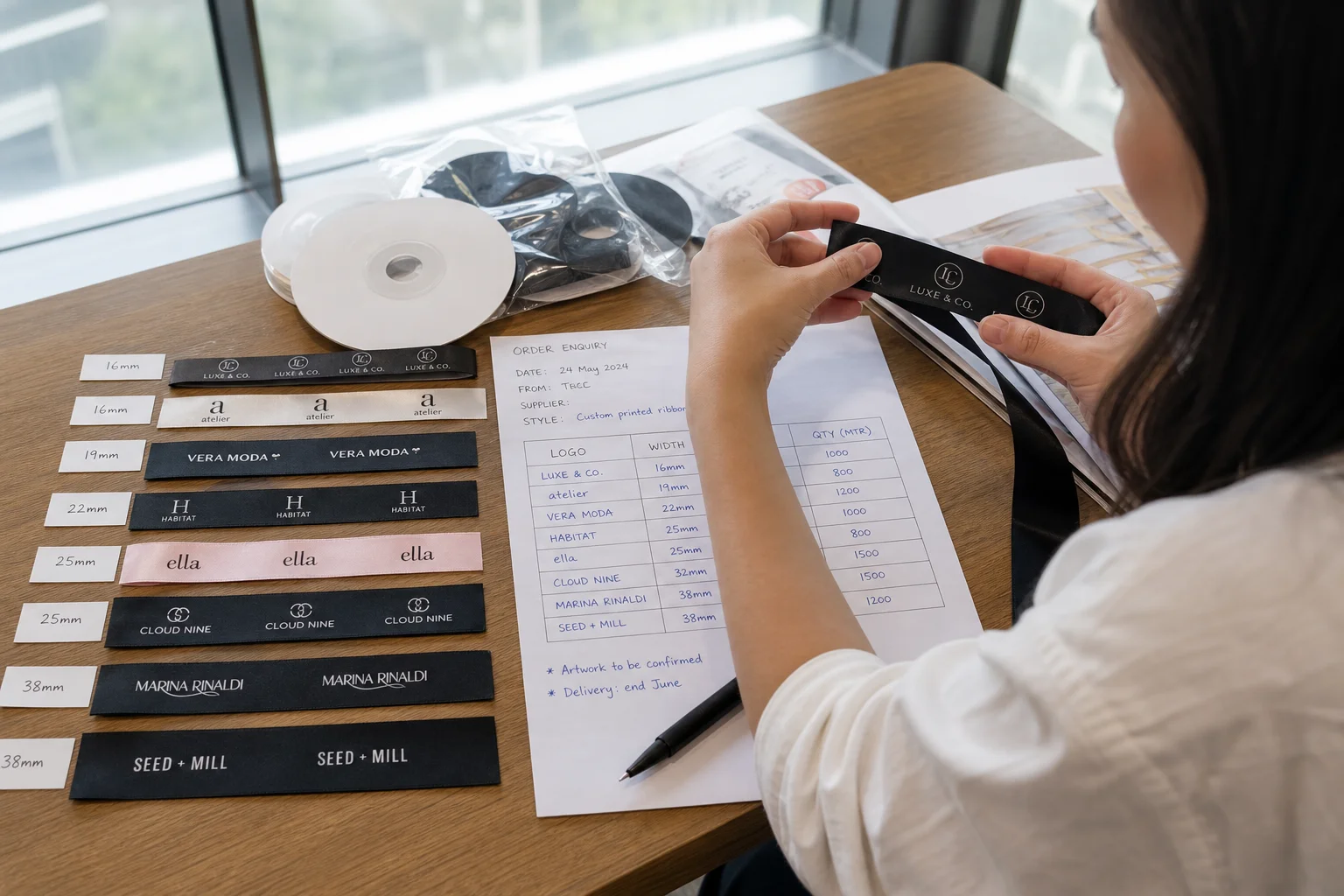
The Two Types of Custom Ribbon and Their Different MOQ Logic
Before getting to numbers, it helps to understand that "custom printed ribbon" covers two fundamentally different production methods, each with its own MOQ structure.
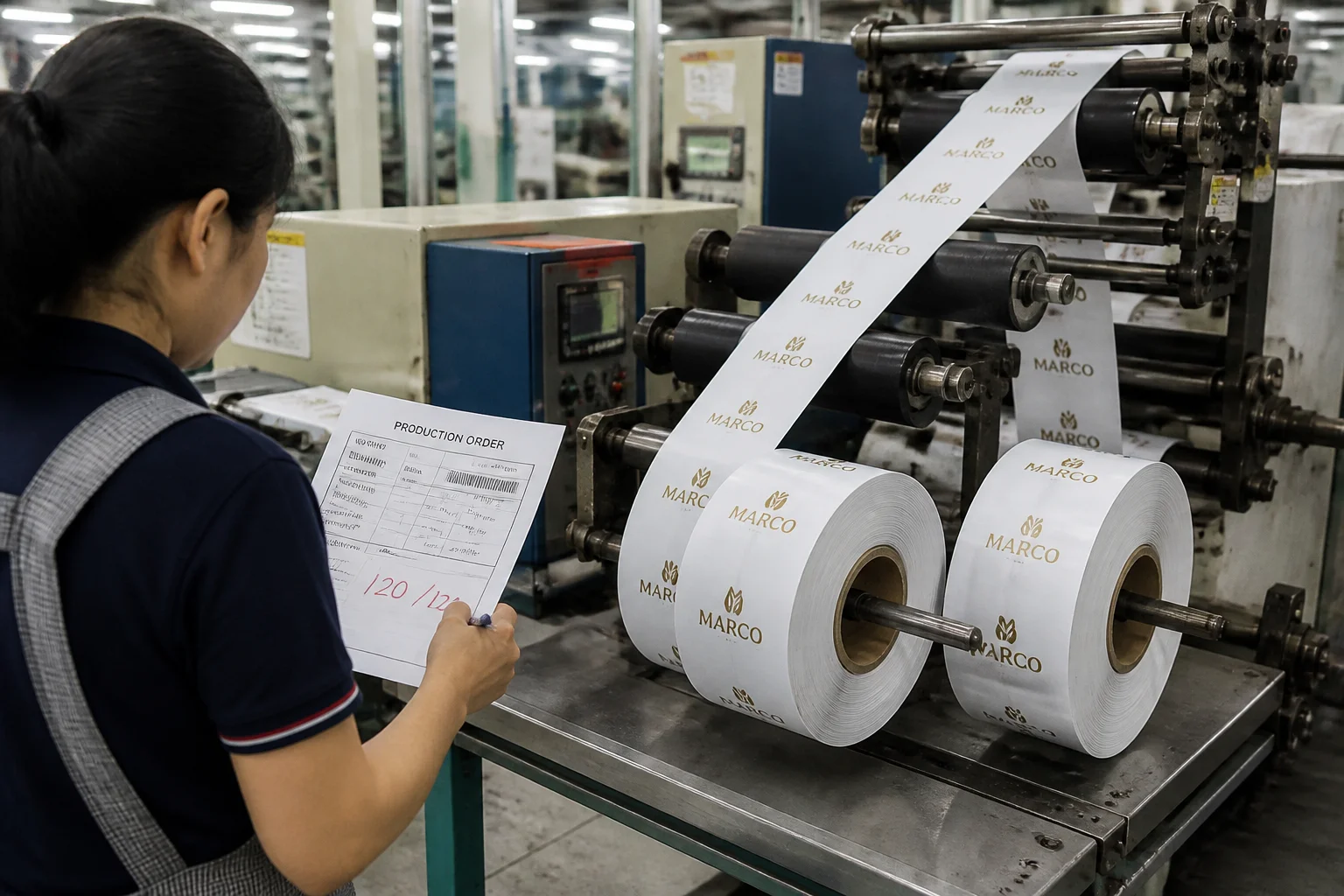
Printed ribbon starts as standard woven ribbon (satin, grosgrain, or other construction) and has a design applied to the surface after weaving, using heat transfer printing or screen printing. The ribbon and the printing are separate production stages. MOQ is driven primarily by printing setup cost — preparing the screen or transfer film, mixing ink to the correct colour match, and running the press through alignment calibration.
Woven jacquard ribbon integrates the design into the ribbon structure during weaving itself. The pattern is created by programming which warp threads are raised for each weft pass, allowing the logo or design to appear as a textured or colour variation in the fabric. MOQ is driven by loom programming and heddle setup, which is more expensive and time-consuming than printing setup.
Typical MOQ ranges:
Heat transfer printed ribbon: 200–500m per colour per width
Screen printed ribbon: 300–500m per colour per width
Woven jacquard ribbon: 500–1,000m per design
How Setup Cost Drives the MOQ Calculation
The arithmetic behind MOQ is straightforward once you understand what the supplier is trying to recover. Every custom order involves two cost categories: setup costs (fixed, paid once regardless of volume) and production costs (variable, paid per metre). MOQ is the volume at which the amortised setup cost per metre drops to an acceptable level relative to total order value.
A practical example for printed ribbon:
Screen preparation and ink mixing: USD 100 (fixed)
Standard production cost: USD 0.50 per metre
At 100m: setup cost adds USD 1.00/m → total effective cost USD 1.50/m (200% premium on setup alone)
At 300m: setup cost adds USD 0.33/m → total effective cost USD 0.83/m (66% premium)
At 500m: setup cost adds USD 0.20/m → total effective cost USD 0.70/m (40% premium)
The supplier sets MOQ at the volume where the effective cost is close enough to standard production cost to price the order competitively. Below that threshold, the supplier either declines the order or applies a small-order surcharge to recover setup costs from a lower volume.
Width and Its Effect on MOQ
Ribbon width affects MOQ in ways that are not always intuitive. Narrower ribbon (10–16mm) typically has a higher MOQ in absolute metres than wider ribbon (38–63mm) at the same print complexity. The reason: setup costs are the same regardless of ribbon width, but narrower ribbon yields less total print area per metre. The supplier needs more metres of narrow ribbon to recover the same setup cost at a reasonable per-metre price.
For procurement teams managing multi-width programmes (for example, 16mm for seal ribbons and 38mm for bow-tie ribbons in the same brand colour), it is usually more cost-efficient to order each width separately at or above MOQ than to try to consolidate the order.
Practical Strategies for Managing MOQ
Order to MOQ and hold inventory: For recurring programmes, ordering to the MOQ and warehousing surplus is almost always more cost-effective than repeatedly paying small-order surcharges. Calculate your annual consumption first; if it exceeds the MOQ over the year, ordering the full MOQ once is the right approach.
Consolidate colourways: If you need the same design in multiple ribbon colours, confirm with your supplier whether all colourways can be counted toward a single MOQ threshold. Some suppliers allow this; others treat each colour as a separate MOQ.
Trial run before full production: For new designs, order a 50–100m trial run with a separate setup fee before committing to the full MOQ. The per-metre cost will be higher, but catching a colour or registration problem at 100m is far less costly than discovering it at 500m.
Negotiate repeat-order terms upfront: Many suppliers waive or reduce setup fees on repeat orders of confirmed designs. Getting this in writing as part of the initial agreement can meaningfully reduce the effective cost of subsequent orders.
Frequently Asked Questions
What is the typical MOQ for custom printed ribbon?
Heat transfer / screen print: 200–500m per colour per width. Woven jacquard: 500–1,000m per design. Narrower widths often require higher MOQ in metres due to lower area per metre.
Why do suppliers set MOQs?
Fixed setup costs (screen prep, ink mixing, loom programming: USD 50–400 per design) must be amortised across a minimum volume. Below MOQ, setup cost per metre makes pricing uneconomical.
Can I order below MOQ for testing?
Yes — trial runs of 50–100m available with a one-time setup fee (USD 80–200). Per-metre cost 3–5x higher than production rate. Worth it to validate colour and registration before committing.
How does colour count affect MOQ?
Each additional screen-print colour adds setup cost and a printing pass. Two-colour designs typically require 50–100% more volume than single-colour at the same price point. Jacquard is less affected by colour count.
What if my volume is below the MOQ?
Two options: pay a small-order surcharge (20–40% premium) or round up to MOQ and hold surplus. For recurring programmes, ordering to MOQ and warehousing surplus is almost always more cost-effective.