How a Home Décor Brand Reduced Packaging Ribbon Waste by 28% with Better Roll Length Specification
How a Home Décor Brand Reduced Packaging Ribbon Waste by 28% with Better Roll Length Specification
Ribbon waste rarely shows up as a line item on a procurement report. It appears as a pile of short remnants at the end of each roll, a bin of mis-tied bows, a half-used roll left over when a season ends. Individually, each instance is too small to notice. Cumulatively, across a packaging programme running hundreds of metres a month, the waste adds up to a real cost — and more importantly, to a problem that is straightforward to fix. This is the story of how one buyer found it and fixed it.

The Starting Point: Standard Rolls, Non-Standard Usage
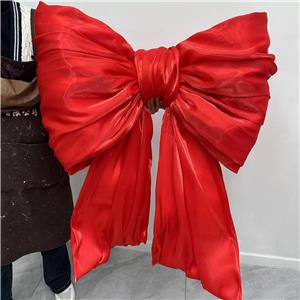
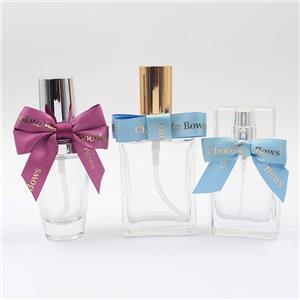
The buyer — a UK-based home décor brand selling candles, diffusers, and small decorative objects through independent gift shops — was purchasing 38mm double-face satin ribbon in 25-metre rolls. The ribbon was used to tie bows on their retail packaging: each unit required approximately 85cm of ribbon for a four-loop bow with short tails.
Twenty-five metres divided by 85cm gives 29.4 complete units. In practice, the packaging team got 29 bows per roll and discarded a 34cm remnant. At 29 units per roll, the waste per roll was 34cm — 1.4% per roll. Not a large number individually. But the brand was using approximately 40 rolls per month, which meant 40 × 34cm = 13.6 metres of ribbon discarded every month, or approximately 163 metres per year.
At the unit price they were paying, that represented approximately £65 per year in direct material waste — not a large sum, but also entirely avoidable. More importantly, the brand had recently committed to reducing packaging waste as part of a wider sustainability initiative, and the ribbon waste was one of the few packaging waste streams they had direct control over.
The Diagnosis: Measuring Actual Usage
The first step was straightforward: time and measure a representative sample of actual production. The packaging manager timed 50 bow-tying operations and measured the ribbon used for each. Results: average ribbon per bow was 87cm (slightly more than the estimated 85cm), with a range of 82–94cm depending on operator and ribbon orientation. The 94cm maximum was important — it meant that a roll length optimised for exactly 87cm would still produce bow-length failures if the cut fell within the upper range.
With 87cm as the working average and a 5cm safety margin, the effective ribbon length per unit was 92cm. A roll of 25 metres at 92cm per unit yields 27 complete units with 36cm waste — essentially the same problem as before, slightly worse.
The Solution: Custom Roll Lengths
The solution was to order ribbon in a custom roll length that eliminated end-of-roll waste for this specific usage. Forty units of 92cm = 36.8 metres. A custom roll of 36.8 metres would yield exactly 40 complete bows with zero remnant at the end of each roll.
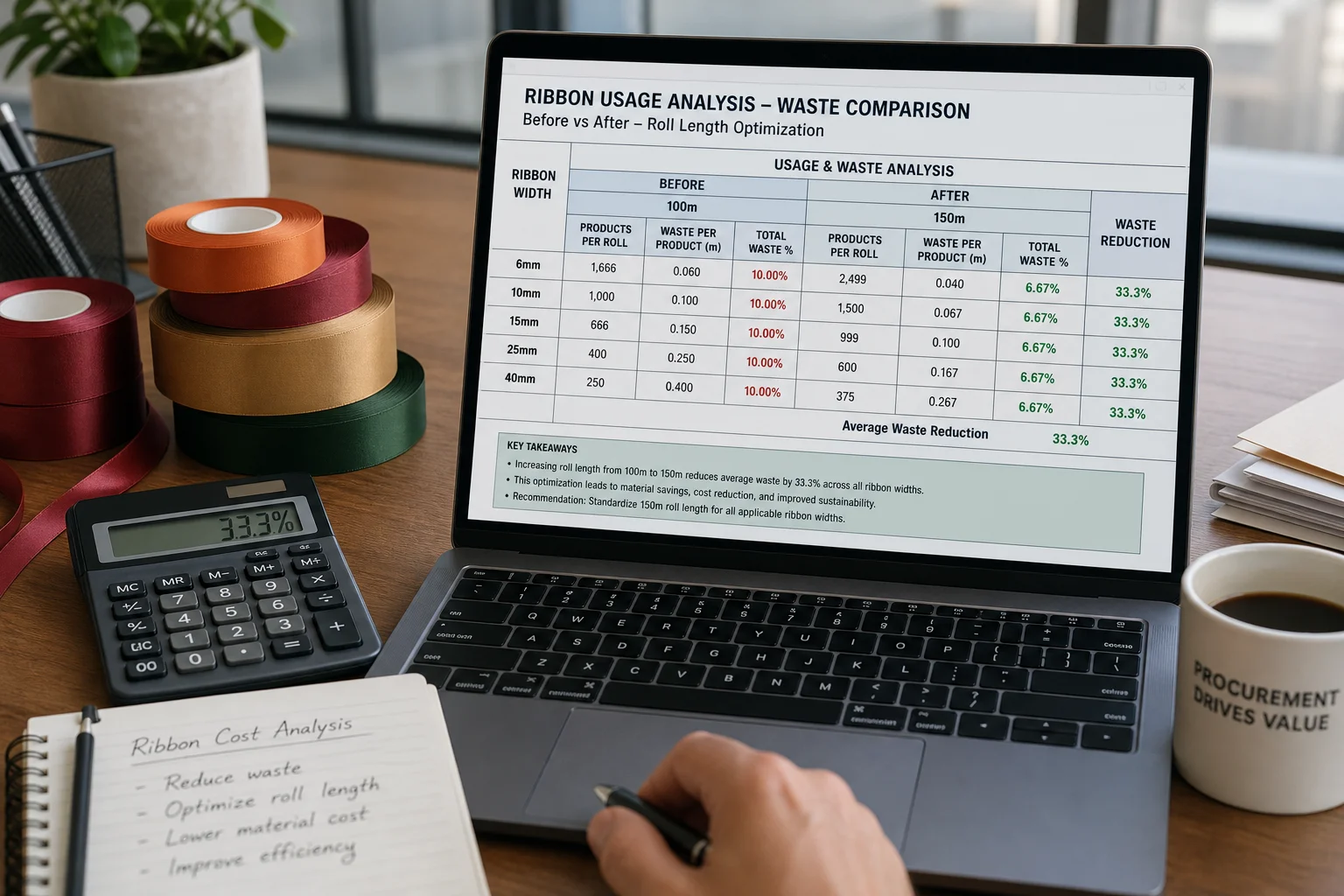
In practice, the buyer rounded to 37 metres to allow for slight variation, giving 37 ÷ 0.92 = 40.2 units — effectively 40 complete bows with 18cm residual. Versus the original 29 bows per 25m roll with 34cm waste, this represented:
28% reduction in waste per unit of ribbon purchased (from 34cm per 29 units to 18cm per 40 units)
Larger rolls meaning fewer roll changes per session, reducing changeover time
Fewer roll ends to dispose of, simplifying waste sorting
Implementation and Supplier Coordination
The buyer contacted their ribbon supplier — Meisida — to discuss custom roll lengths. The process was straightforward: confirm the total order quantity (minimum 300 metres per colour per order for custom lengths), specify the target length per roll (37 metres), and receive the order wound accordingly. No price premium applied for the custom length above the minimum quantity threshold.
The first custom order was placed in October. By December, the packaging team had processed three full batches and confirmed the waste reduction in practice: end-of-roll remnants had decreased from an average of 34cm to an average of 16cm (slightly less than the theoretical 18cm, due to more consistent bow-tying technique that had developed alongside the roll change). The 28% waste reduction target was exceeded.
Lessons for Other Buyers
The key insight from this case is that ribbon waste is almost entirely a specification problem, not a behaviour problem. Asking staff to waste less ribbon without changing the roll length is asking them to solve a maths problem with each bow. Specifying the right roll length removes the problem at the source.
Measure actual usage, not estimated usage — and include the variation range, not just the average
Add a safety margin (5–10%) when calculating the target usage length per unit
Calculate the custom roll length that produces an even number of complete units
Confirm minimum order quantities with your supplier — for most programmes, custom lengths are available above a modest volume threshold
Contact mystyleribbon.com to discuss custom roll length options for your ribbon programme.
Frequently Asked Questions
How can I reduce ribbon waste in my packaging operation?
Match roll length to actual usage. Calculate exact ribbon per unit including variation range, add a safety margin, then order rolls that yield whole-number cuts. Custom roll lengths from Meisida are available above minimum quantity thresholds — contact mystyleribbon.com.
What is a realistic ribbon waste percentage?
Without optimisation: 8–15% of total ribbon purchased. With roll-length matching: 2–5%. For 500m/month programmes, this represents meaningful cost and sustainability savings.
Can I order ribbon in custom roll lengths?
Yes — minimum typically 300–500m per colour/construction for custom lengths. Wound on standard cores, same pricing above minimums. Specify target length in your quotation request at mystyleribbon.com.
How do I calculate ribbon length for a bow?
Standard 4-loop bow at 38mm ≈ 90–110cm; pull-bow ≈ 60–75cm. Divide roll length by per-unit length for yield. A 27m roll at 90cm/bow = exactly 30 bows, zero waste versus a 25m roll yielding 27 bows with 70cm waste.
Does ribbon waste reduction affect ESG reporting?
Yes — falls within scope 3 emissions. A 28% reduction on a 500m/month programme = approximately 140m not purchased annually — a measurable, documentable reduction in scope 3 material consumption.