How a Seasonal Gift Retailer Solved a Lead-Time Crisis with Ribbon Pre-Production Planning
How a Seasonal Gift Retailer Solved a Lead-Time Crisis with Ribbon Pre-Production Planning
Most ribbon procurement problems do not start as emergencies. They start as reasonable decisions that look sensible until one variable changes — and then, six weeks before Christmas, everything urgent arrives at once. This is the story of one buyer who found a better way.
The Problem: Ordering on Instinct
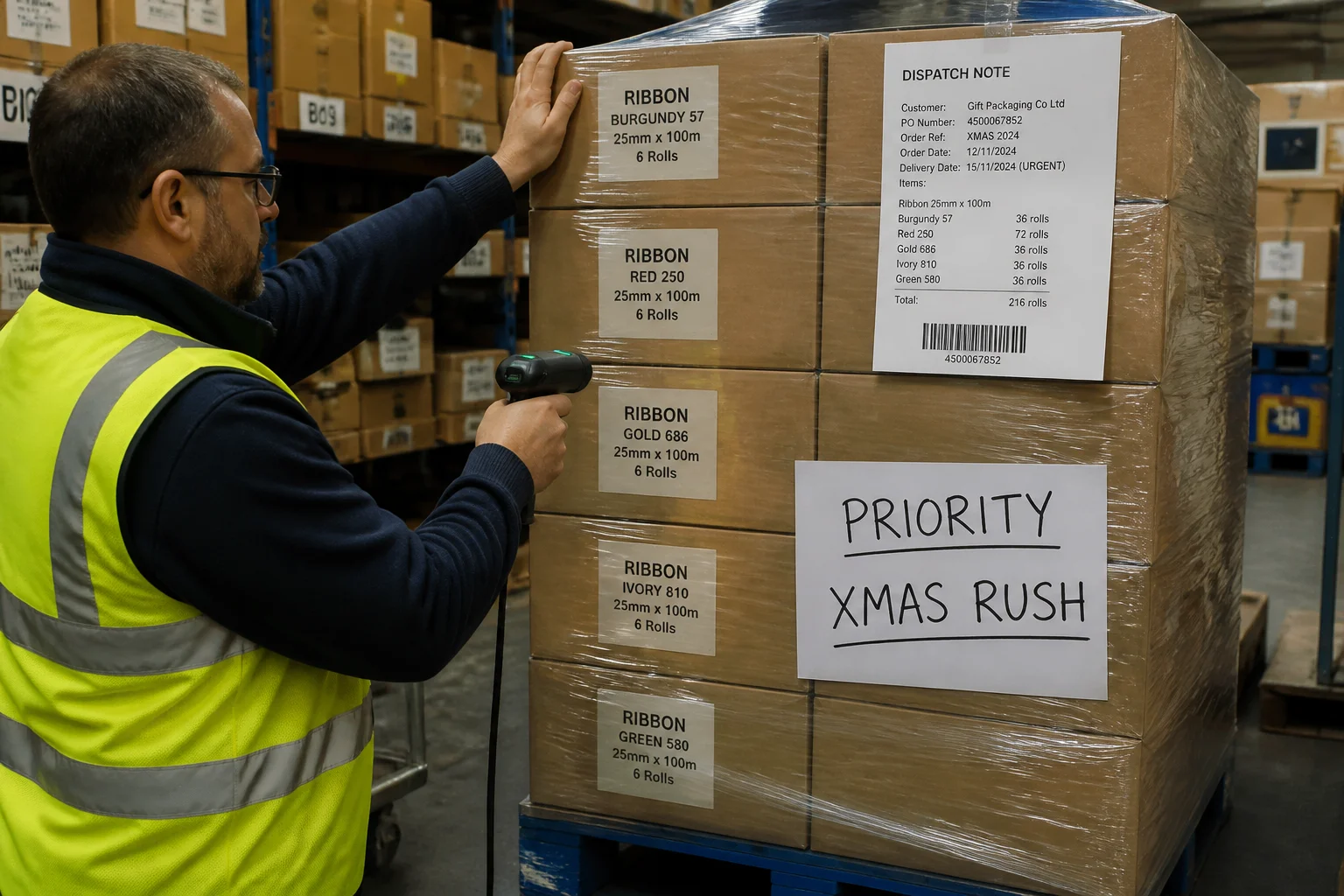
Claire runs a gift and stationery shop in the North of England. Her business is seasonal — roughly 55% of annual ribbon spend happens in the ten weeks between mid-October and Christmas Eve. She had been ordering ribbon the same way for years: wait until October, assess remaining stock, place an order with her usual supplier, and hope it arrived before the rush hit.
For most years, this worked well enough. Then, in the year before she found Meisida, two things happened at the same time. Her previous supplier had a production delay due to raw material shortages. And her sales in October ran hotter than expected — two corporate gifting contracts came in that she had not anticipated. By the time she placed her emergency top-up order, the supplier's December production slots were fully committed. She finished the Christmas season with improvised alternatives, mismatched colour across her signature lines, and a promise to herself that this would never happen again.
The Solution: A Forward Production Commitment
When Claire approached Meisida in January the following year, the first conversation was not about price. It was about production planning. The Meisida account manager asked her to share her previous season's sales data — not the order data, but the actual sales-out figures by week. From this, they built a simple forecast: expected ribbon consumption by colour group and width for the following Christmas season, with a 20% buffer built in for the corporate gifting scenario that had caught her out.
Based on this forecast, Meisida proposed a forward production commitment: they would produce Claire's specified ribbon in July and August — well before the seasonal rush — and hold the finished goods at the factory against a scheduled dispatch in three tranches: one in late September, one in late October, and one in late November for any top-up.
The cost structure was straightforward:
Unit price: Identical to spot pricing — no premium for forward commitment at this volume.
Payment terms: 30% deposit at order confirmation in January; 70% net 30 days from each dispatch date.
Flexibility buffer: 15% of total order volume held as optional — Claire could call off or cancel this portion up to 60 days before the scheduled dispatch date without penalty.
Storage: No storage charge for goods held at Meisida for up to 90 days post-production.
What Changed
The first season under this arrangement, Claire received her September tranche in the first week of October — well before the corporate gifting enquiries arrived. When two new accounts came in for branded gift wrapping with specific colour requirements, she had sufficient stock to accommodate both without a supplemental order. Her October top-up tranche arrived as scheduled. She used approximately 60% of the November top-up option and cancelled the remainder within the 60-day window.
The practical outcomes were measurable:
Zero out-of-stock events during the Christmas season for the first time in three years.
No expedited shipping costs — all three tranches arrived by standard sea freight, saving approximately £800 versus the prior year's air freight emergency.
Consistent colour matching across all Christmas packaging — all ribbon from the same dye batch, eliminating shade variance from multiple split orders.
No supplier substitution — the branded silk-finish crimson ribbon was available throughout because it had been reserved in July.
How to Set Up a Forward Production Commitment
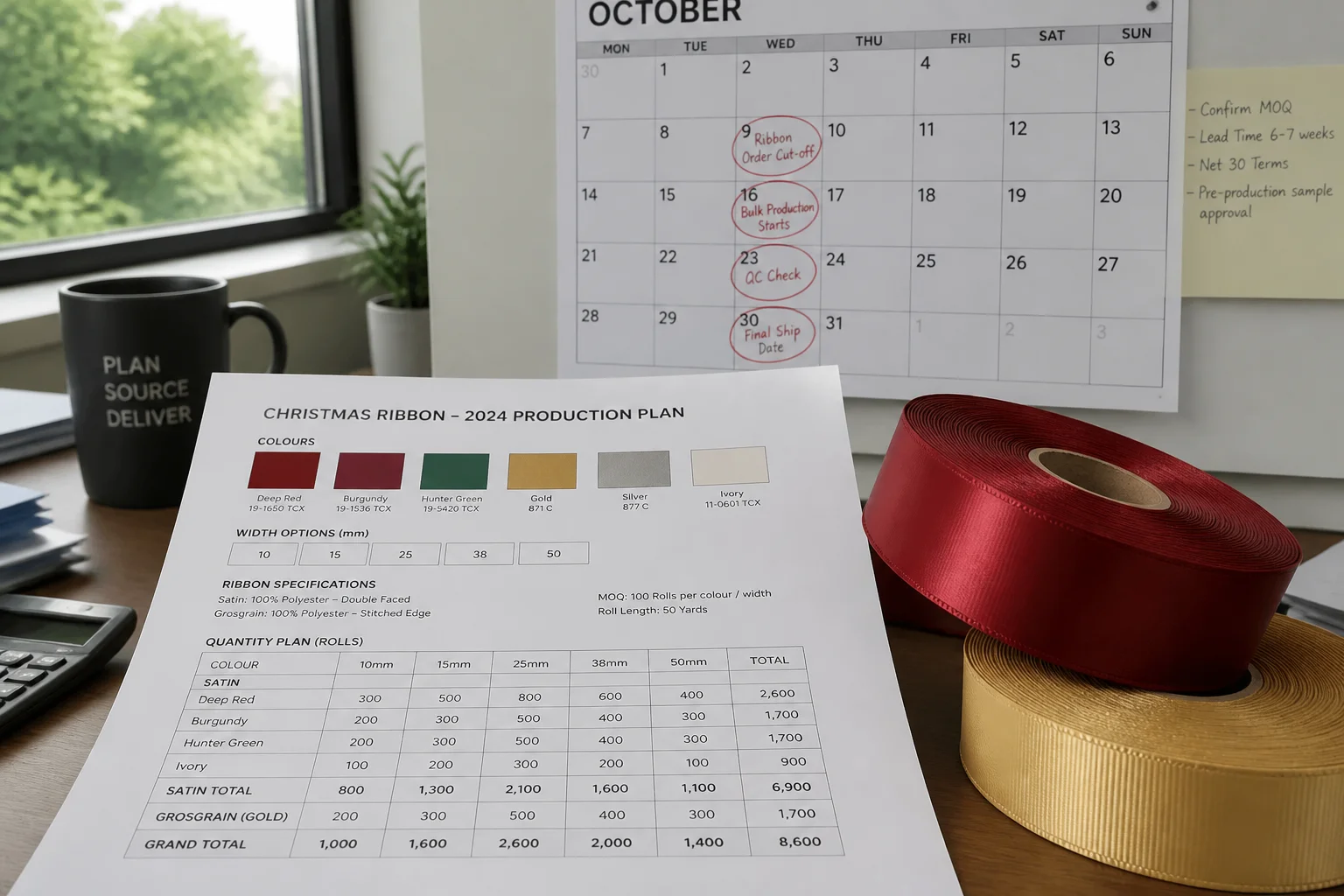
The approach Claire used is available to any buyer with sufficient volume and enough lead time to make the production planning work. The basic requirements are:
Minimum volume: Forward production commitments at Meisida start at approximately 2,000 metres per colour per season. Below this threshold, standard stock orders are usually more economical because the production planning overhead is not recovered by the logistics savings.
Specification clarity: Colour, width, and construction must be confirmed at time of commitment. Specification changes after production has started incur costs. For buyers with a stable annual programme, this is rarely a constraint.
Lead time: Commitments should ideally be placed four to six months before the first required dispatch. For Christmas season requirements, a July commitment is the practical target; August is workable; September reduces the flexibility buffer significantly.
Frequently Asked Questions
What happens if my forecast is wrong and I need significantly more than ordered?
The forward commitment covers the agreed quantity. Supplemental orders placed after October during peak season cannot be guaranteed. Build a realistic buffer into the commitment at the planning stage rather than rely on supplemental availability. Contact mystyleribbon.com in January or February to begin planning for the following Christmas season.
Can the commitment cover multiple ribbon types or just one specification?
A forward commitment can cover multiple specifications — different colours, widths, or construction types — as long as each meets the minimum volume threshold or contributes to a combined order of sufficient size. Many buyers commit to three to five core specifications each season. Contact mystyleribbon.com to discuss structuring a multi-specification commitment.
Is there a price advantage to a forward commitment compared to spot ordering?
Not in unit price terms — forward commitment pricing matches spot pricing at the same volume. The financial advantage comes from logistics: forward planning allows sea freight instead of air freight, typically saving 60–70% per kilogram on shipping. For a mid-size seasonal order this saving often exceeds any unit price negotiation. Contact mystyleribbon.com for a cost comparison on your specific programme.
What if my business is too small for a forward production commitment?
Buyers below the minimum volume threshold can still achieve lead-time security by ordering from Meisida's forward stock programme — core colours and widths produced in advance and available from August. Contact mystyleribbon.com in summer to check availability for the following Christmas season.
Does this approach work for non-Christmas seasonal programmes?
Yes — the model applies to any predictable seasonal demand cycle: Valentine's Day, Mother's Day, Easter, or year-round corporate gifting programmes. Contact mystyleribbon.com to discuss a forward commitment framework for your specific seasonal cycle.