How Ribbon Roll Length and Core Size Affect Your Packaging Line Efficiency — A Buyer's Specification Guide
How Ribbon Roll Length and Core Size Affect Your Packaging Line Efficiency — A Buyer's Specification Guide
Roll length and core size are two ribbon specifications that many buyers treat as secondary — something to accept as supplied rather than actively specify. For buyers running packaging lines at volume, however, these specifications have a direct effect on throughput, waste, and roll changeover frequency.
This guide explains what the available options are, how they affect packaging line efficiency, and what to consider when specifying them for your programme.
Roll Length Options and Their Trade-offs
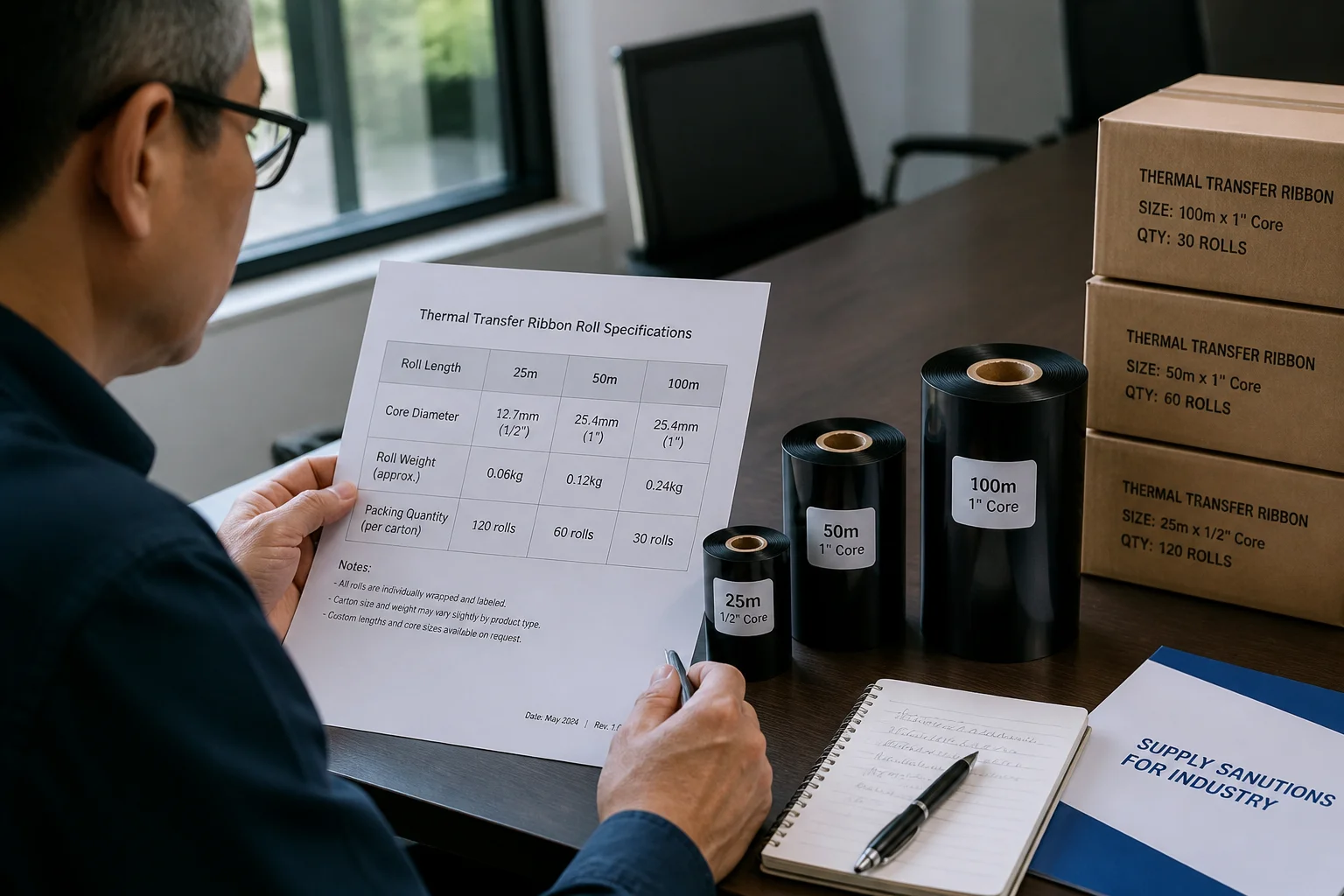
Most woven ribbon is available in roll lengths from 25 metres to 100 metres, with 50 metres being the most common standard for gift packaging programmes. Some factories offer non-standard lengths — 25m, 46m, 91m — typically to match legacy machine specifications or specific retailer requirements.
The practical trade-offs between roll lengths:
25-metre rolls: Lower cost per roll, easy to handle manually, suitable for display stands and retail counter display. Changeover frequency is high if running continuously — one roll produces approximately 50–100 bows depending on bow size. For packaging lines running more than a few hundred bows per shift, the changeover time accumulates.
50-metre rolls: The standard for most commercial gift packaging programmes. Balances roll weight (manageable for manual handling), changeover frequency, and storage footprint. Compatible with most bow-making machines without modification.
100-metre rolls: Lowest changeover frequency, best throughput on high-volume lines. Roll weight at 100m (typically 0.3–0.8kg depending on ribbon width and construction) is still hand-manageable. Core diameter is larger, which may require checking compatibility with bow machine spindles.
Core Size and Machine Compatibility
The plastic core is the tube the ribbon is wound onto. Core diameter matters because bow-making machines, ribbon dispensers, and cutting systems are designed around specific spindle sizes. The two most common core internal diameters are 38mm (1.5 inches) and 76mm (3 inches).
38mm core: Standard for retail and gift packaging applications. Compatible with the majority of handheld and tabletop bow-making machines. A 50m roll of 38mm-wide ribbon on a 38mm core weighs approximately 120–180g.
76mm core: Used for industrial bow-making and automated packaging line equipment. If your equipment requires a 76mm core, specifying the wrong core size means re-winding rolls before use — a significant operational cost.
Flat-wound / pan-cake packs: Some ribbon is supplied as flat-wound packs without a hard core, for equipment with horizontal feed systems. This is a minority specification but worth checking if your equipment manufacturer recommends it.
Before placing an order, confirm the spindle diameter specification for every piece of equipment the ribbon will be used on. If you are ordering for multiple sites or machine types, standardising on one core diameter simplifies stock management significantly.
How to Calculate the Changeover Cost
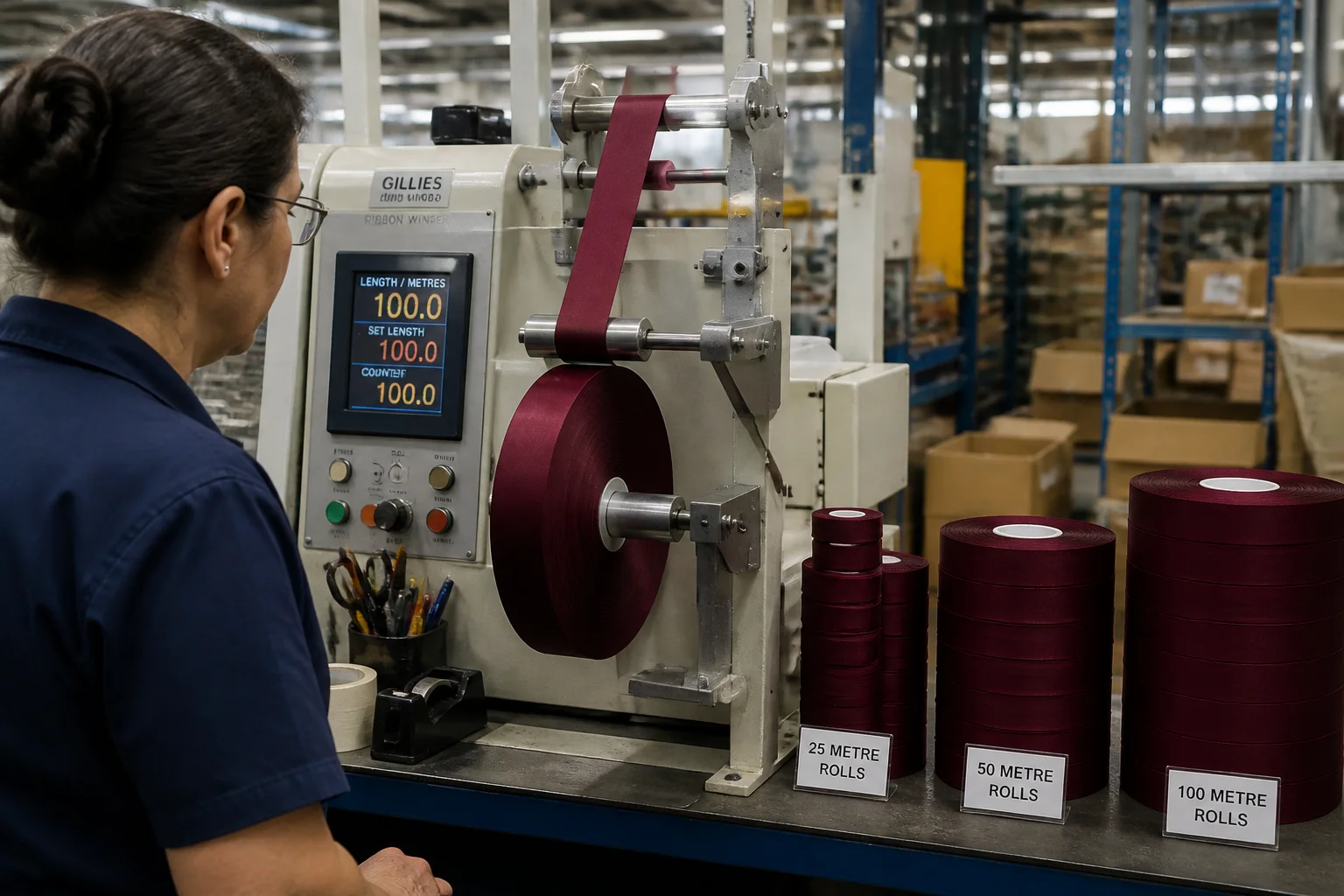
Changeover cost is easy to calculate and frequently underestimated: bows per shift ÷ bows per roll = roll changes per shift; roll changes × time per changeover (1–3 min) × hourly labour cost = changeover cost per shift.
Example: a packing line producing 400 bows per shift using 25m rolls at 60 bows per roll requires about 7 roll changes per shift. At 2 minutes each, that is 14 minutes of labour per shift on changeovers. Moving to 100m rolls (240 bows per roll) reduces changes to 2 per shift — saving roughly 10 minutes per station per shift. Across multiple stations and shifts, the saving is material.
The counter-argument is waste at roll end: longer rolls mean more ribbon left on the roll at end-of-shift if programmes change frequently. For programmes with consistent design runs, 100m rolls are the most efficient. For programmes with frequent design changes, 50m or 25m rolls reduce unused roll-end waste.
Frequently Asked Questions
Can I mix roll lengths within a single order?
Yes. Most factories can supply multiple roll lengths within the same colour and construction in a single order. The minimum quantity per roll specification varies by factory — typically a minimum of one production run per roll specification. Contact mystyleribbon.com to confirm minimum quantities for mixed roll length orders and whether there are price differences between roll lengths for your specification.
What is the standard core wall thickness for gift packaging ribbon?
Standard core wall thickness is typically 2.5–3mm for 38mm internal diameter cores and 3–4mm for 76mm cores. Thinner walls reduce material cost but increase the risk of core crush under shipping compression — relevant for palletised export shipments where stacking weight is significant. Contact mystyleribbon.com to discuss core specification options and whether reinforced cores are appropriate for your shipping conditions.
Does roll length affect the ribbon price per metre?
Roll length has a small effect on unit price because longer rolls require less core material and packing labour per metre of ribbon. In most commercial programmes, the difference is modest — typically 2–5% between 25m and 100m roll pricing for the same ribbon specification. The more significant financial impact is usually the operational efficiency difference on the packaging line, not the unit price. Contact mystyleribbon.com for a comparative quotation across roll length options for your specific programme.
What happens if ribbon is wound too tightly on the core?
Ribbon that is over-wound under excessive tension can develop set — a permanent curve in the ribbon that makes it difficult to tie into a flat bow. Satin ribbon is particularly susceptible to this because the smooth surface slips slightly as tension releases, causing the outer layers to develop a curl. Quality manufacturers use controlled winding tension specifications to prevent this. Contact mystyleribbon.com if you have received ribbon with winding-related curl and to confirm our winding tension standards for your construction.
How should I store ribbon rolls to prevent edge distortion or colour fading?
Store rolls horizontally (on their flat faces, not on the edge) to avoid core oval distortion under the roll's own weight. Keep in a cool, dry environment away from direct sunlight — UV exposure causes gradual colour fading in most polyester ribbons over extended storage periods. Standard gift packaging ribbon stored correctly in a warehouse environment has a practical shelf life of 2–3 years without significant colour or quality degradation. Contact mystyleribbon.com for specific storage guidance for your construction and colour programme.