How to Build a Ribbon Specification for a Private Label Gift Packaging Programme — A Step-by-Step Sourcing Guide
How to Build a Ribbon Specification for a Private Label Gift Packaging Programme — A Step-by-Step Sourcing Guide
Most ribbon procurement problems trace back to an incomplete specification. Buyers who communicate colour by describing it, width by estimating it, and construction by naming a retail category — satin, grosgrain, velvet — without further detail routinely receive samples that are not quite right, place orders that arrive slightly off, and spend time and budget correcting the gap between what they imagined and what they received.
A proper ribbon specification for a private label programme does not require technical expertise to write. It requires being systematic about the information that determines whether the ribbon will behave the way you need it to in the finished packaging. This guide covers the seven elements of a complete ribbon specification and what each one controls.
The Seven Elements of a Complete Ribbon Specification
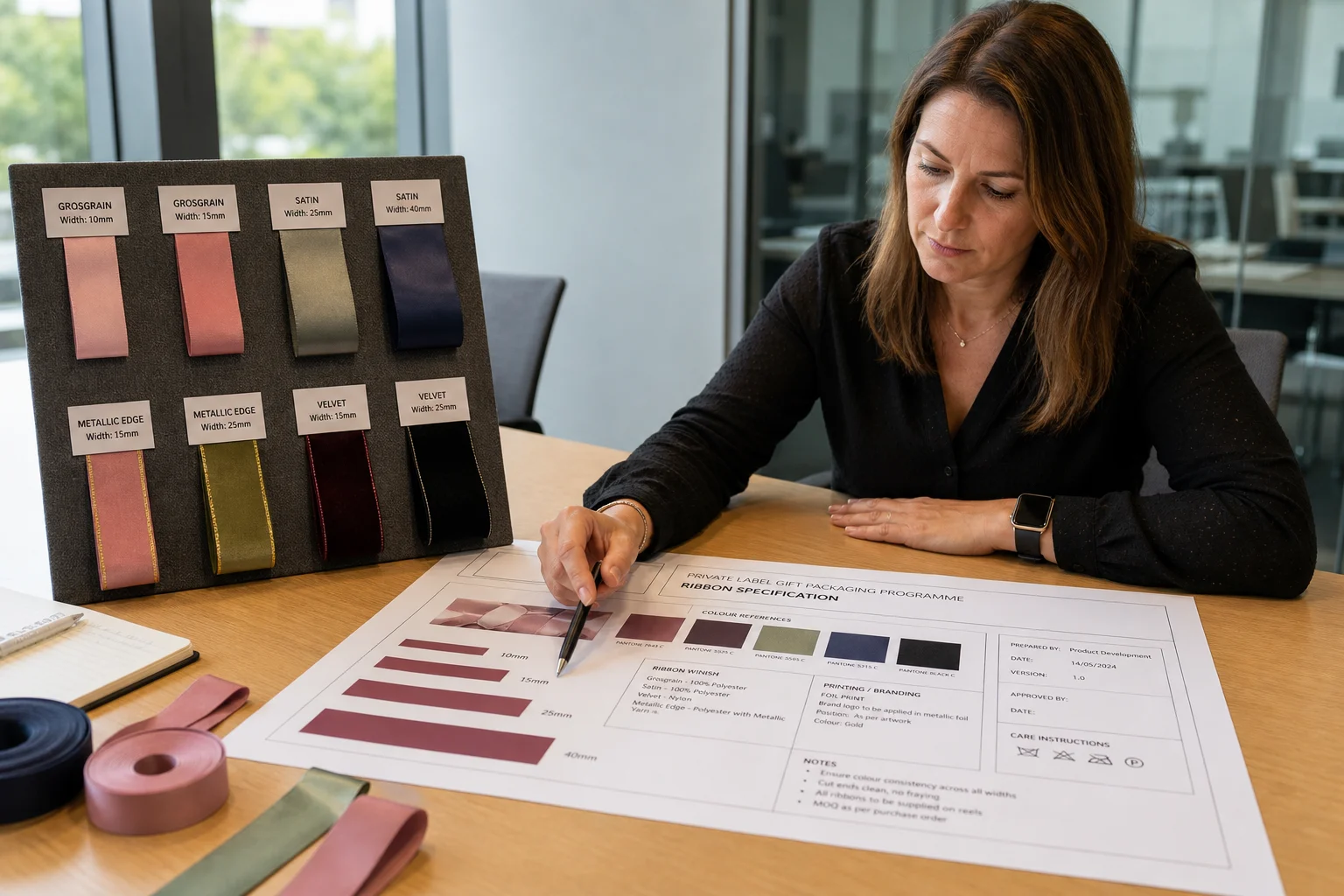
1. Construction type. Name the exact weave: double-face satin, single-face satin, grosgrain, or velvet. For velvet, also specify pile direction and height. If unsure, request physical samples and select from those.
2. Width. State nominal width in millimetres plus tolerance: ±1mm for satin and grosgrain, ±2mm for velvet. Without tolerance, you cannot formally reject a non-conforming delivery.
3. Colour reference. Always provide a physical colour standard — a ribbon swatch, label, or paper swatch — and request a lab dip matched to it before production. Never approve colour from a screen image alone.
4. Yarn composition. Specify fibre type (polyester, nylon, recycled polyester) and blend proportion. For sustainability requirements, add GRS-certified recycled polyester and request the transaction certificate at delivery.
5. Finish and treatment. State any post-weave treatment needed: anti-fray on cut ends, heat-set stiffness, or fire-retardant for display use. Most standard packaging ribbon needs none, but specify explicitly if your application is unusual.
6. Wired or unwired. For bows that must hold their shape, specify wired construction and wire gauge (typically 0.45–0.5mm stainless-coated steel). Without this, you will receive unwired ribbon by default.
7. Packaging and labelling. Specify roll length, core size, bulk or individual polybag, and any brand labelling or barcode requirements. Factory defaults may not suit retail or distribution requirements.

How to Use the Specification in Procurement
A complete specification serves two functions in the procurement process: it gives the supplier enough information to produce accurately, and it gives you a documented standard against which to accept or reject incoming goods. Both functions require the specification to be written down and shared with the supplier before production, not reconstructed from memory or email threads after a problem occurs.
For a new supplier relationship, the process is: share the full specification → request pre-production samples → approve samples with written confirmation → confirm production release. For an established supplier relationship with an approved colour palette, the process is shorter but the written specification still matters for each new season or SKU to catch any change in box size, colour direction, or programme requirements.
Frequently Asked Questions
How detailed does a ribbon specification need to be for a small programme?
Even for a small programme — two or three ribbon SKUs for a single season — a written specification of the seven elements above is worth the hour it takes to produce. The most common small-programme problem is reordering by description rather than by specification and receiving a visually different product. A written spec from the first order becomes the reference standard for all future orders. Contact mystyleribbon.com to request a blank specification template formatted for our production process.
What is the difference between a lab dip and a production sample?
A lab dip is a small dyed yarn or fabric sample produced before production to confirm colour accuracy against your standard. It is produced quickly — typically 1–2 weeks — and allows colour correction before committing to production yarn. A production sample is a length of finished ribbon produced on the actual production equipment after production setup, confirming width, construction, and appearance before the full run proceeds. For new colour and construction combinations, both a lab dip approval and a production sample approval are standard practice. Contact mystyleribbon.com to discuss the approval process for your programme.
How do I specify GRS certification for recycled content ribbon?
Specify in writing: "yarn must be GRS-certified recycled polyester; supplier to provide valid GRS transaction certificate covering this production run at time of delivery." The certificate must name the specific production run or order reference to be valid for your compliance purposes. A factory's general GRS certification does not automatically cover a specific production run — the transaction certificate is the document that links the certification to the goods you received. Contact mystyleribbon.com for our current GRS certification documentation and to confirm coverage for your programme.
Can I get ribbon produced to my brand's Pantone colour without a physical standard?
Pantone references are a starting point, not a guarantee. Ribbon yarn dye formulations are matched to Pantone values, but the visual result depends on yarn type, surface texture, and light source — a Pantone reference on matte polyester satin will not look exactly the same as the same Pantone on a coated paper chip. Physical approval of a lab dip is still required. If you do not have a physical Pantone chip to provide, request lab dips at the Pantone reference and at two adjacent values, then approve the closest to your intention with a physical sign-off. Contact mystyleribbon.com to start a colour matching process with your Pantone reference.
What happens if incoming ribbon does not match the approved specification?
Non-conforming ribbon — colour outside approval, width outside tolerance, wrong construction — should be formally rejected with reference to the written specification. The factory's responsibility to replace or credit the goods depends on whether the non-conformance is against a specification they confirmed in writing. This is why written specification and written approval records matter: without them, the discussion about whose standard is correct becomes subjective. Contact mystyleribbon.com to discuss our quality acceptance criteria and the process for non-conformance management.