How Ribbon Lead Times Actually Work — A Practical Guide for Procurement Planning
A193 | How Ribbon Lead Times Actually Work — A Practical Guide for Procurement Planning
Lead time is the number that most buyers ask about and fewest understand in detail. A ribbon manufacturer says "four to six weeks" and a buyer enters that figure into a project plan. What the figure actually represents — and what variables can extend or compress it — is rarely discussed until a delivery is late.
What Lead Time Actually Measures
Lead time in ribbon manufacturing starts when a production order is confirmed — not when you send an inquiry, not when a sample is approved, and not when a deposit is received. It starts when the factory has a confirmed purchase order with a defined specification. Everything before that is pre-production time, which can vary significantly and is often longer than the production time itself.
The components of total ribbon supply time:
Pre-production time: sample development, approval rounds, specification confirmation. Can be one week (repeat colour on a known construction) or four to six weeks (new custom colour requiring two development iterations).
Material procurement lead time: if the required yarn or dye component is not in stock, it must be ordered. For standard polyester yarns, this is typically one to two weeks. For specialised yarns (rPET with specific certifications, fine counts), it can be three to four weeks.
Production lead time: the time from production start to finished goods ready for QC. Varies by construction complexity, width, and factory scheduling. For a standard satin or grosgrain ribbon in a production colour, typically two to three weeks. For new colour development or complex constructions, allow three to four weeks.
QC and packing time: final inspection, measurement, labelling, packing. Typically three to five days for a standard order.
Shipping time: sea freight from Xiamen to major destination ports ranges from two to four weeks depending on destination. Air freight is available for urgent requirements at higher cost.
What "Four to Six Weeks" Actually Means
When a manufacturer quotes four to six weeks, they typically mean production lead time only — from confirmed order to finished goods ex-factory. Pre-production, material procurement, and shipping are not included. A buyer who builds a project plan on this figure will consistently find ribbon arriving later than expected.
Total programme time for a new colour with a new manufacturer: 10–18 weeks from first inquiry to warehouse delivery. For a repeat order of an approved colour from an established supplier: 7–10 weeks from confirmed order to delivery.
For a seasonal programme with a hard deadline, initiate supplier contact and sample development at least six months before the delivery target. For a December retail floor date, that means starting in June. For February Valentine's delivery, start in August.

How to Get Accurate Lead Time Estimates
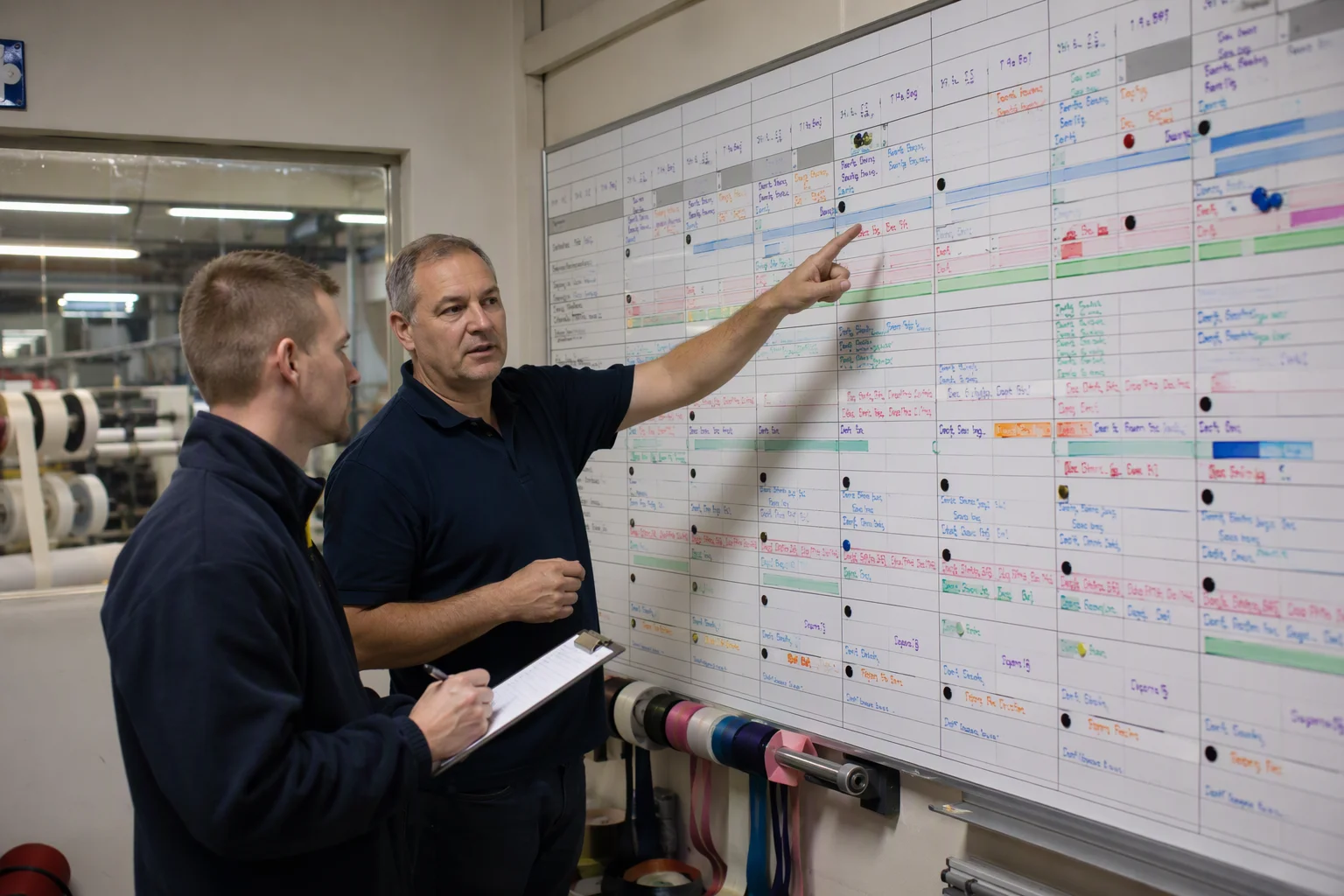
The most useful question to ask a ribbon manufacturer is not "what is your lead time?" but rather "given this specification and quantity, what is your current available production slot, and what would my ex-factory date be if I confirmed an order this week?"
A manufacturer with good production visibility will be able to answer this question with a specific date — not a range. Manufacturers who give only a generic range are either not tracking their production queue in detail or are not willing to be specific. Either is a useful signal.
At Xiamen Meisida Decoration Co., Ltd (Smith Ribbon & Bow, mystyleribbon.com), we provide programme-specific lead time estimates based on current production queue status, the specific construction and colour requirements of your order, and the agreed specification. Contact us at mystyleribbon.com with your programme details for a specific delivery timeline.
Frequently Asked Questions
Can lead time be shortened for urgent orders?
Sometimes, depending on production queue and order parameters. Factors that allow compression: the colour is already in the library (no development required), the yarn is in stock, and a production slot is available. Factors that prevent compression: new colour development, specialised yarn procurement, or full production capacity. Air freight instead of sea can save two to three weeks on shipping. For urgent requirements, contact mystyleribbon.com with your specification and deadline — we will advise on what is realistic.
How does capacity booking work for seasonal programmes?
For buyers with consistent seasonal requirements (Christmas, Valentine's Day, Mother's Day), Meisida offers forward capacity reservation. After a first successful programme, buyers can reserve production capacity for the following season before the current order ships. This eliminates the capacity availability risk for repeat buyers and provides scheduling certainty for both sides. Contact mystyleribbon.com to discuss forward booking for your programme.
What happens to lead time if I change the specification after confirming an order?
Specification changes after order confirmation reset the lead time clock to the point of the change. A width change may require a new yarn order and a new production setup. A colour change may require a new development cycle. Changes should be communicated as early as possible — the earlier in the production process a change is requested, the more likely it can be accommodated without significant delay. Late changes (after yarn is committed or production has started) may not be possible to accommodate at all. Contact mystyleribbon.com to discuss the impact of a specific change on your current order.
How does Meisida handle delivery performance tracking?
We track ex-factory date performance against committed dates and share delivery performance data with buyers on request. For buyers running annual programmes, delivery performance history is available as part of supplier evaluation documentation. For new buyers, we can provide reference contacts from existing clients to verify delivery reliability. Contact mystyleribbon.com for delivery performance documentation.
What documentation comes with a ribbon shipment?
Standard documentation for export ribbon shipments includes a commercial invoice, packing list, bill of lading or airway bill, and country of origin certificate. For buyers requiring compliance documentation, additional certificates can be provided: OEKO-TEX Standard 100 certificate, GRS chain of custody certificate (for recycled content ribbon), REACH declaration, and test reports for specific chemical or physical parameters. Advance documentation is provided before shipment for customs clearance purposes. Contact mystyleribbon.com for documentation requirements specific to your destination country.