A168 | Ribbon for the Bridal and Wedding Accessories Market: Sourcing for Precision, Consistency and a Category That Does Not Forgive Variation
A168 | Ribbon for the Bridal and Wedding Accessories Market: Sourcing for Precision, Consistency and a Category That Does Not Forgive Variation

The bridal and wedding accessories market is one of the most demanding ribbon applications we supply into, and the reason is simple: in this category, there is almost no tolerance for variation. A wedding happens once. The photographs last a lifetime. A ribbon that is the wrong shade of ivory, that frays at the cut edge during a first wear, or that looks slightly different on the flower girl's sash than on the bride's headpiece — these are not minor quality misses. They are visible failures in photographs that the customer will look at for decades.
That is the emotional reality of this market, and it has direct procurement implications. Bridal accessory makers — whether they are small artisan studios producing handmade pieces or mid-size manufacturers supplying bridal boutiques across multiple regions — tend to be the most specification-conscious buyers we work with. They often have more detailed requirements than buyers in higher-volume categories, because the consequences of getting it wrong are disproportionately visible.
The Specific Challenges of This Category
Several features of the bridal market create procurement challenges that do not exist in the same form elsewhere:
Colour naming is unreliable. "Ivory", "champagne", "blush", "nude" — these colour names are used inconsistently across suppliers, and what one factory calls ivory may be noticeably warmer or cooler than another's. For a buyer assembling a coordinated wedding accessory range, shade variation between components is immediately obvious. Physical reference samples and a binding sign-off process are not optional in this category; they are the baseline minimum.
Surface finish variation matters more than in most categories. Double-faced satin ribbon, which is the dominant material in bridal accessories, can have slightly different surface lustre characteristics depending on the loom setup and the finishing process. When two rolls of ribbon are photographed under the same lighting, even small differences in lustre are visible. Buyers who have experienced this problem once become very specific about same-setup production requirements.
Edge quality is non-negotiable. Organza ribbon in particular must have a clean, sealed edge. Any fraying — whether it occurs on the first use or develops after two or three wears — is a product failure in this market. Heat-cut edges are the standard for this application; guillotine-cut edges are not acceptable for exposed uses like headpieces and sashes.
Volumes are often small and irregular. Bridal accessory production does not follow predictable seasonal patterns in the same way as some gift categories. A small studio may place one order of fifty metres, then return three months later for another thirty. Managing these buyers requires a supplier willing to hold standing stock in the relevant specifications and supply in small quantities without excessive minimum order pressure.
What This Means for Sourcing
For a buyer in this category, sourcing ribbon is not primarily a price exercise. Price matters, but it is secondary to confidence that what arrives will match the approved sample and will continue to match it across future orders. The cost of a quality failure in a wedding accessory — in terms of customer relationships, reputational damage in a word-of-mouth-driven market, and the time cost of reworking or replacing finished pieces — far exceeds the cost savings available through aggressive price negotiation.
The practical sourcing approach for this category typically involves:
Requesting and approving physical samples before placing any production order, regardless of how detailed the written specification is.
Establishing a physical reference archive — keeping one metre of each approved ribbon specification as the sign-off standard for all future deliveries.
For ivory and champagne specifically, photographing the approved reference under standardised lighting conditions and including this photograph in the purchase order documentation.
Specifying heat-cut edges on all organza ribbon orders, not guillotine-cut.
For double-faced satin in critical applications, requesting same-setup production and being prepared for a slightly longer lead time as a result.
A Note on Velvet in This Category
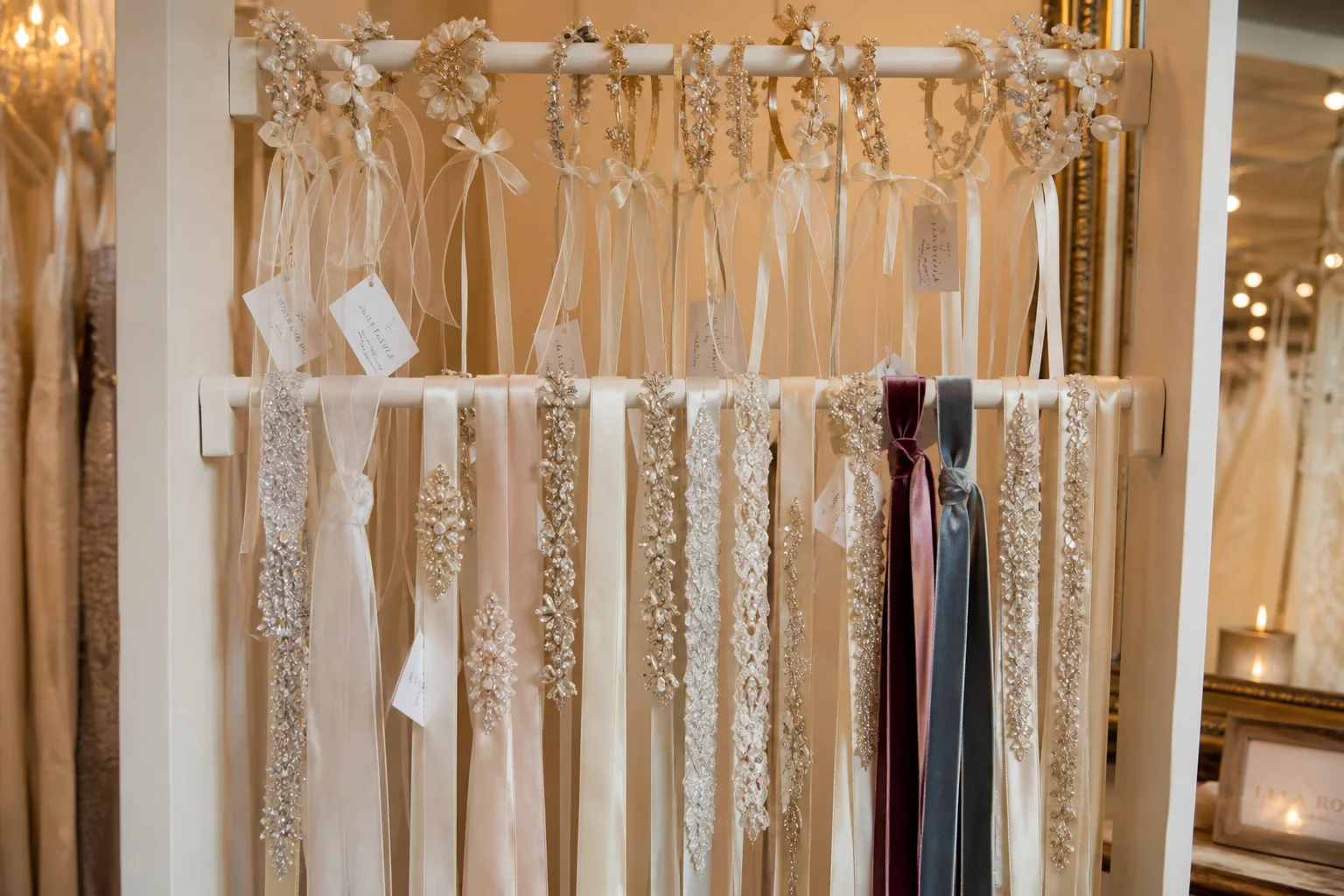
One material worth addressing specifically for the bridal market is velvet ribbon. Narrow velvet ribbon — typically in widths from 6mm to 16mm — has become increasingly common in bridal accessories, used for chokers, hair bands, and as decorative trim on headpieces. The sourcing challenges for velvet are different from satin and organza. Velvet is more susceptible to crush marks during transit, and recovery from crushing varies significantly between products. A roll of velvet ribbon that has been wound too tightly or stored under pressure can arrive with visible permanent compression marks along the outer layers.
For buyers adding velvet to their range, we recommend requesting a transit sample — a roll shipped under standard conditions — before placing a production order, specifically to verify that the material recovers fully and arrives in a usable state. Storage and winding specifications are worth discussing explicitly with the supplier, as standard ribbon-winding practices are not always appropriate for velvet.
The most common sourcing mistake in this category is treating ribbon as a commodity purchase and switching suppliers based on price without re-approving the physical sample. A new supplier's "ivory double-faced satin" at a lower unit cost may look identical in a product photograph sent via WeChat. It will not necessarily match the previous supplier's approved reference under the conditions in which a finished wedding headpiece is photographed — and by the time this is discovered, the production order is already complete.
The second most common mistake is not building adequate lead time into the production calendar for sample approval. In a category where physical sign-off is essential, a buyer who allows two weeks for ribbon procurement is underestimating the process. The sample transit time, the approval process, and the production run together typically require four to six weeks for first-time orders from a new supplier.
For studios and manufacturers who have worked through these issues and established a reliable supply relationship, the ongoing procurement process is straightforward. The real investment is in the setup — in getting the specifications right, approving the samples, establishing the reference standards — and then maintaining those standards consistently across every order.