The Wedding Ribbon Buying Guide: What Every Planner and Stationer Needs to Know Before Ordering
The Wedding Ribbon Buying Guide: What Every Planner and Stationer Needs to Know Before Ordering
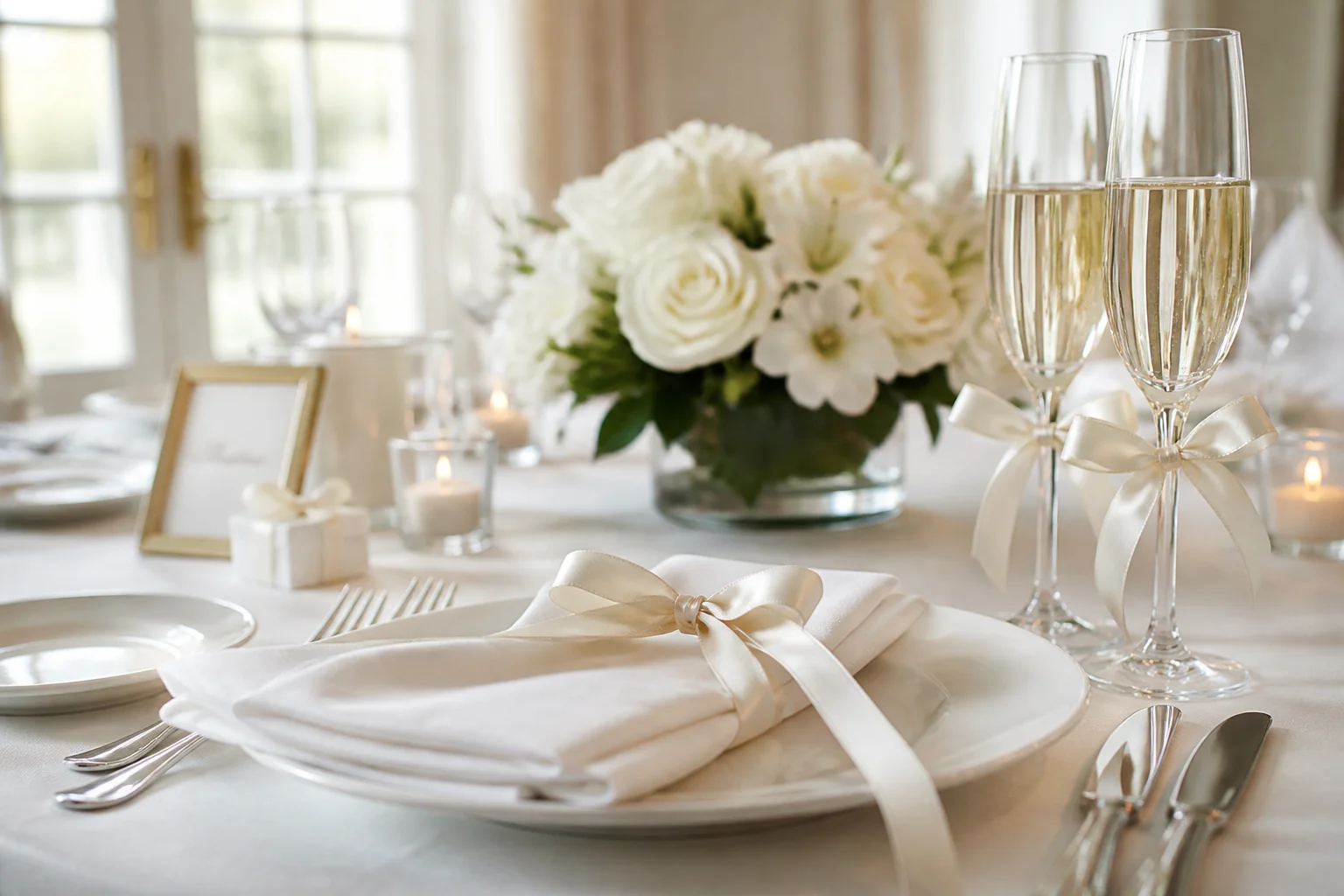
If you plan weddings, design stationery, or run a bridal boutique, you already know that ribbon is everywhere in the wedding world. It's on the bouquets, the invitations, the favors, the cake, the chair backs, the napkin rings, and the card box. It's one of the most versatile decorative elements in any wedding, and it's also one of the most frequently ordered — and frequently misunderstood — products in the wedding supply chain.
I've been supplying ribbon to wedding planners, stationery designers, and event coordinators for over a decade. In that time, I've seen the same questions and the same mistakes come up over and over. So I'm putting everything I know into this guide — not as a sales pitch, but as a practical reference that will help you order the right ribbon, at the right price, with the right expectations about lead time and quality.
Whether you're ordering 50 meters for a single wedding or 5,000 meters for a bridal show, this guide covers the decisions that matter most.
Choosing the Right Material
The first decision is always the material. Different materials create different looks, and the wrong choice can ruin the entire aesthetic. Here's a breakdown of the four most common wedding ribbon materials:
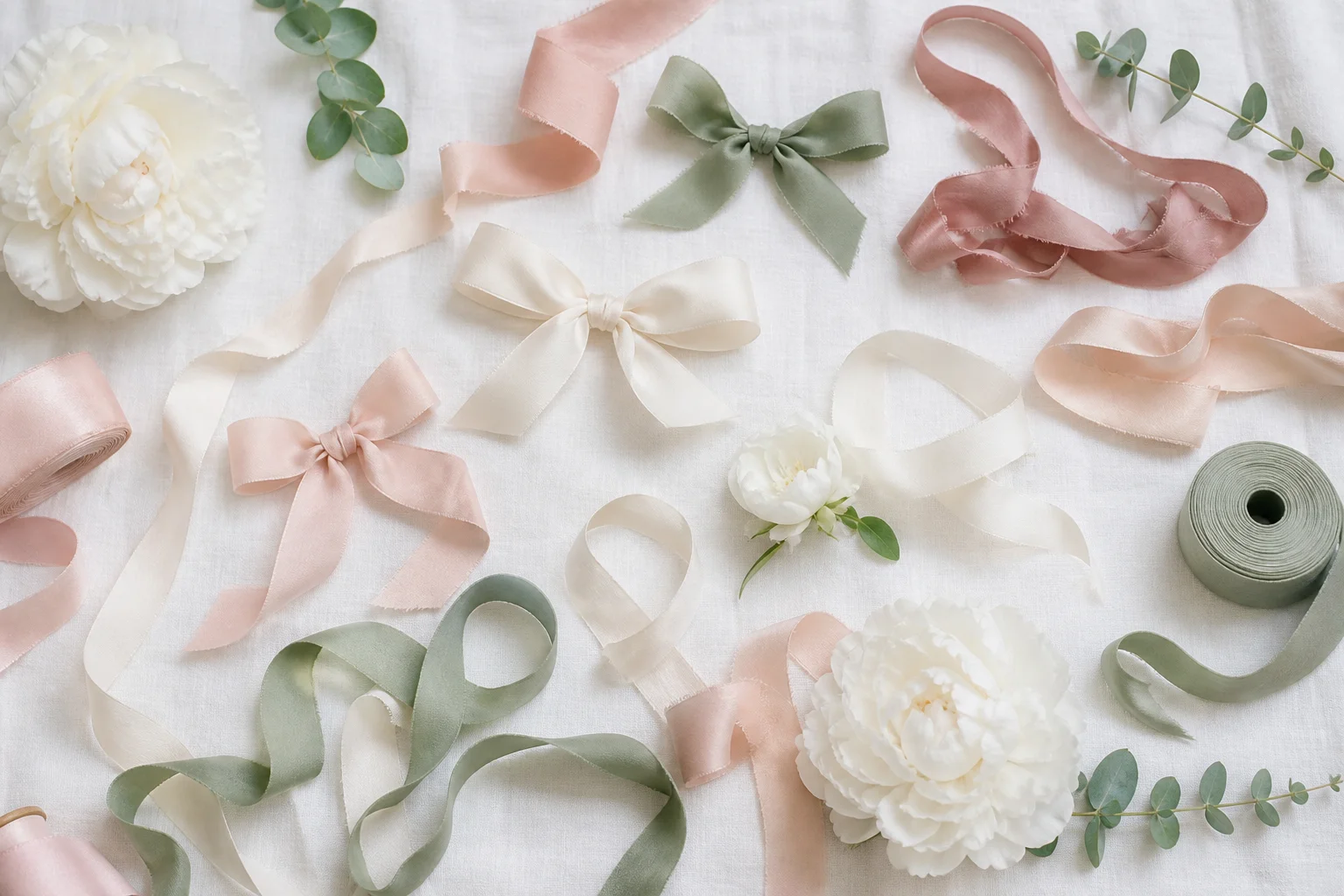
Satin (double-faced and single-faced). Satin is the most popular wedding ribbon material, and for good reason. It has a smooth, lustrous surface that catches the light beautifully. Double-faced satin is shiny on both sides, which makes it ideal for bows and sashes where both sides of the ribbon are visible. Single-faced satin is shiny on one side and matte on the other, which works well for flat applications like wrapping invitation boxes or cake bands.
The main advantage of satin is its elegance. It looks expensive and photographs beautifully. The main disadvantage is that it's slippery — if you're tying bows, they can loosen during transport or during the event. A quick tip: use a small dot of fabric glue or a hidden stitch at the back of the bow to keep it secure.
Grosgrain. Grosgrain has a textured, ribbed surface that gives it a more casual, handmade feel than satin. It's less shiny and more tactile. Grosgrain is the go-to choice for rustic, barn, and garden weddings, and it's also the best choice for any application where the ribbon needs to stay tied — the textured surface grips itself, so bows hold their shape without extra securing.
Grosgrain is also more durable than satin. It resists fraying, holds up well in outdoor settings, and is less likely to show water spots if the event is in a humid environment. For wedding favors that need to survive shipping and handling, grosgrain is usually the safer choice.
Organza. Organza is a sheer, lightweight fabric that creates a soft, ethereal look. It's commonly used for pew bows, chair sashes, and draped ceiling decorations. Organza is beautiful in photos but can be tricky to work with — it frays easily, it's difficult to cut cleanly without a heat sealer, and it doesn't hold a bow shape well on its own.
For organza bows, most planners use a wire-edge organza, which has a thin wire woven into the edges. This allows the bow to hold its shape and be positioned precisely. Plain organza without wire is better for draping and flowing applications.
Velvet. Velvet ribbon has had a major resurgence in wedding styling over the past few years, especially for fall and winter weddings. It's rich, tactile, and luxurious. It works beautifully on bouquets, cake stands, and place settings. The main drawback is price — velvet is more expensive than satin or grosgrain, and it's harder to source in custom colors.
Velvet also has a practical limitation: it's thicker and stiffer than other ribbon materials, which makes it harder to tie into small, intricate bows. For large, loose bows on bouquets or chair backs, it's perfect. For small, tight bows on favor boxes, it can look bulky.
Getting the Width Right
Ribbon width is one of the most important — and most frequently underestimated — decisions in a wedding ribbon order. Here's a practical guide based on the application:
3mm–6mm: Used for tiny details — securing tags to favor bags, wrapping small boutonniere stems, threading through buttonholes. If you're ordering ribbon for a specific small detail, measure the application before ordering. A 3mm ribbon looks very different from a 6mm ribbon, even though the difference is only 3 millimeters.
9mm–15mm: The sweet spot for favor boxes, invitation wrapping, and small bows. 15mm is the most versatile width in this range — it's wide enough to be visible and make a statement, but narrow enough to tie neatly on a small box. For wedding planners who want to order one width for multiple applications, 15mm is usually the best choice.
25mm: The standard width for bouquet wraps, medium-sized bows, and cake bands. 25mm is wide enough to print a custom message or logo on, which makes it popular for personalized wedding ribbons. It's also the most common width for satin sashes on wedding chairs.
38mm–50mm: Used for chair sashes, large bows, and dramatic statement pieces. 38mm is the standard width for chair sashes in the US wedding market. 50mm is used for very large, showy bows on pew ends or cake stands.
75mm–100mm: Used for sash belts on wedding dresses, wide cake bands, and table runners. At these widths, you're no longer in "ribbon" territory — you're in fabric territory, and the product is usually sold by the meter or by the roll rather than by the spool.
Color Matching for Weddings
Wedding color coordination is unforgiving. The ribbon on the bouquet has to match the ribbon on the favors, which has to match the ribbon on the invitations, which has to complement the bridesmaid dresses. If the color is off by even a small amount, it shows — especially in photos.
Here's what I recommend to wedding professionals:
Order everything from one supplier. If you order the bouquet ribbon from one supplier and the favor ribbon from another, the colors will almost certainly be different — even if they're both called "blush" or "dusty rose." Color names are not standardized across suppliers. The only way to guarantee consistency is to order from the same source.
Request a physical sample before ordering. Colors look different on screen than in person. A "blush pink" on your monitor might look peach or salmon when it arrives. We send physical samples to every client who requests one — it costs a few dollars in shipping but saves hundreds of dollars in unusable ribbon.
Consider the lighting. If the wedding is outdoors in natural daylight, the ribbon will look different than it does under indoor reception lighting. If possible, view the sample under the same lighting conditions as the event. We can provide samples measured under D65 (daylight), TL84 (retail/indoor), and A-source (warm tungsten) lighting conditions.
For custom colors, allow extra time. If you need a specific color that doesn't exist in our standard palette of 196+ colors, we can do a custom dye. The process takes about 5 working days for the lab-dip (color sample) plus your approval time. Allow 2 to 3 extra weeks for a custom color order compared to a stock color order.
How Much Ribbon Do You Actually Need?
This is one of the most common questions, and it's easy to underestimate. Here's a practical estimating guide:
Bouquet wraps: 1.5 to 2 meters per bouquet, depending on the style. A simple wrap with a short tail uses about 1.5 meters. A wrap with a long, flowing tail uses 2 meters or more. For a wedding with 5 bridesmaid bouquets plus the bride's bouquet, order at least 12 meters.
Favor boxes: 80cm to 1 meter per box, depending on the box size and bow style. A simple wrap-around with a small bow on a 10cm box uses about 80cm. A full wrap with a large bow on a 15cm box uses about 1.2 meters. For 100 favor boxes, order 80 to 120 meters.
Invitation wrapping: 50cm to 80cm per invitation, depending on the style. A simple belly band uses about 50cm. A full wrap with a bow uses about 80cm. For 150 invitations, order 75 to 120 meters.
Chair sashes: 2 to 3 meters per chair, depending on the chair width and the bow style. For 100 chairs, order 200 to 300 meters. (This is one of the largest ribbon orders in the wedding world — many planners are surprised by how much ribbon a full chair sash setup requires.)
Cake band: 2 to 4 meters depending on the cake size and the number of tiers. A single-tier cake uses about 2 meters. A three-tier cake with bands on each tier uses about 4 meters.
General rule: Always order 10% to 15% more than your estimate. Ribbon is one of the least expensive elements in a wedding, and running out is a crisis that's easy to prevent. The extra cost of 15% overage is negligible compared to the cost of a last-minute rush order or a substitute ribbon that doesn't match.
Custom Printing: What You Need to Know
Custom-printed wedding ribbon — with the couple's names, the wedding date, or a short message — is one of the most popular personalization options for weddings. Here's what you need to know before ordering:
Minimum order quantity (MOQ). Our MOQ for custom-printed ribbon is 300 meters. This is lower than most suppliers, who typically require 500 to 1,000 meters. For a single wedding, 300 meters is usually enough for favors, invitations, and a few bouquets. If you're a planner who uses personalized ribbon across multiple weddings, you can order a larger quantity and use it over time.
Print methods. We offer three print methods for custom wedding ribbon:
Screen printing is the most cost-effective option for simple designs with one or two colors. It works well for text-based designs (names, dates, short messages) and simple logos. The setup cost is lower than hot stamping, and the per-meter cost is lower too.
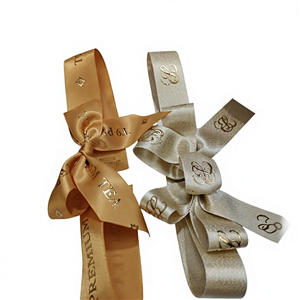
Hot stamping (gold or silver foil) is the most popular choice for wedding ribbon because it creates a premium, elegant look. Gold foil on ivory or blush satin is the single most requested wedding ribbon design we produce. The foil adds a tangible sense of luxury that screen printing cannot match.
Heat transfer printing is used for full-color designs, photographs, or complex artwork. It's more expensive than screen printing but allows for unlimited colors and gradients. It's the right choice for ribbons with a custom illustration or a multi-color design.
Lead time. Custom-printed ribbon takes 7 to 10 working days from artwork approval to shipment. For rush orders, we can do it in 5 working days, but a rush fee applies. Add shipping time on top — 3 to 5 days by air, 28 to 32 days by sea. For a wedding in June, you should order by April at the latest.
Artwork requirements. We need your artwork in vector format (AI, EPS, or PDF) for screen printing and hot stamping. For heat transfer, we can work with a high-resolution PNG or JPG (300 DPI minimum). If you don't have a designer, we can help with basic typesetting — we'll lay out your text in a font that matches your wedding style and send you a proof for approval before printing.
The Cost Breakdown
One of the biggest advantages of ordering from a factory-direct supplier is the price. Here's a rough comparison for 25mm double-faced satin in a standard color:
Craft store (retail): $0.50 to $1.00 per meter. You're paying for the packaging, the retail markup, and the convenience of buying off the shelf. Fine for 10 meters, absurd for 500 meters.
Online marketplace (Amazon, Etsy): $0.30 to $0.60 per meter. Better than retail, but you're still paying a middleman markup. Quality can be inconsistent — you might get a different shade or a different weight than what was shown in the listing.
Factory-direct (us): $0.08 to $0.15 per meter for standard colors, depending on the width and material. Custom printing adds $0.05 to $0.20 per meter depending on the method. This is the price when you buy directly from the factory, with no middleman, no retail markup, and no packaging cost.
For a wedding with 200 meters of ribbon, the difference between retail and factory-direct is roughly $80 to $170. For a wedding planner who uses 2,000 meters of ribbon per month, the savings are $800 to $1,700 per month. That's not a rounding error — it's a significant business cost reduction.
Shipping and Timing
Timing is everything in the wedding industry. Here's what you need to plan for:
Stock colors (no custom print): 3 to 5 working days for production, plus shipping. By air (5-7 days), you can have stock ribbon in your hands within 2 weeks of ordering. By sea (28-32 days), it takes about 5 weeks.
Custom colors (no print): Add 5 working days for the lab-dip process. Total production time: 8 to 10 working days. With air shipping, you're looking at about 3 weeks from order to delivery.
Custom print (stock color): Add 7 to 10 working days for the printing setup and production. With air shipping, about 3 to 4 weeks from order to delivery.
Custom color + custom print: This is the most time-intensive option. Allow 4 to 5 weeks from order to delivery by air. Plan accordingly.
Rush orders: We can expedite production for a rush fee. The fastest we've done is 3 working days from artwork approval to shipment for a custom-printed order. But rush production means priority scheduling, which means other orders get delayed. We do it when we can, but we can't guarantee it for every order.
Common Mistakes to Avoid
After years of supplying ribbon to the wedding industry, here are the most common mistakes I see:
1. Ordering too late. This is the number one mistake. Ribbon is one of the last things planners think about, and it ends up being ordered in a rush. A rush order costs more and leaves no room for error. If the color is wrong or the print is misaligned, there's no time to fix it. Order early — at least 6 weeks before the wedding for custom-printed ribbon.
2. Ordering too little. Running out of ribbon on the day before the wedding is a crisis. Always order 10% to 15% more than your estimate. The extra ribbon costs a few dollars. The crisis of not having enough costs far more.
3. Not requesting a sample. Colors on screen are not reliable. A "dusty rose" on your monitor might be "blush pink" in person. A "sage green" might be "mint green." Request a physical sample before committing to a large order. It takes a few days and costs a few dollars in shipping. It's the cheapest insurance you can buy.
4. Mixing suppliers. If you order the invitation ribbon from one supplier and the favor ribbon from another, the colors will be different. This is almost guaranteed. Order everything from one source to ensure color consistency across all applications.
5. Forgetting about the finish. Not all satin ribbon is the same. Some satin has a soft, matte finish. Some has a high-gloss finish. Some is stiff and some is soft. The finish affects how the ribbon ties, how it photographs, and how it feels. If you're matching an existing ribbon, pay attention to the finish as well as the color.
Our Wedding Ribbon Services
We've been supplying ribbon to the wedding industry for 18 years. Here's what we offer specifically for wedding professionals:
Sample service. We send physical samples of any stock color for the cost of shipping. For custom colors, we provide lab-dip samples within 5 working days. We understand that wedding professionals need to see and feel the ribbon before committing to an order.
Custom color matching. Send us a fabric swatch, a paint chip, or a Pantone code, and we'll match it. Our color lab uses spectrophotometer measurements and multi-light verification to ensure the match is accurate under every lighting condition.
Low MOQ for custom printing. Our 300-meter MOQ for custom-printed ribbon is one of the lowest in the industry. This makes it practical for single-event orders, not just volume production.
Bulk pricing for planners. If you're a wedding planner or event coordinator who orders ribbon regularly, we offer volume pricing that reduces the per-meter cost by 15% to 25% compared to standard pricing. Contact us for a custom quote.
DDP shipping. We handle customs clearance and delivery to your door for orders shipped to the US, UK, EU, and Australia. No surprises at customs, no hidden fees, no paperwork on your end.
Wedding ribbon is one of those products that seems simple until you start ordering it. The material, the width, the color, the print, the quantity, the timing — there are a lot of decisions, and the wrong one can affect the look and feel of the entire event. We're here to help you make the right decisions, and to deliver the ribbon that makes your wedding look exactly the way you envisioned it.
Smith Ribbon & Bow | Xiamen Meisida Decoration Co., Ltd.
GRS-Certified Ribbon Manufacturer | SafeDye™ Color Control Technology
Xiamen, China · 18 Years of Ribbon Manufacturing