The Science of Color: How Meisida Achieves 99% Precision in Custom Ribbon Dyeing and Screen Printing
The Science of Color: How Meisida Achieves 99% Precision in Custom Ribbon Dyeing and Screen Printing
1. Executive Summary: The psychological and branding impact of color in packaging
In the hyper-competitive landscape of global retail, packaging is no longer just a protective shell; it is a silent salesman. At the heart of this sensory experience lies color—the most immediate and influential factor in consumer perception. Studies suggest that up to 90% of snap judgments made about products can be based on color alone. For luxury brands and high-end manufacturers, the ribbon that cinches a gift box or the branded tape that secures a premium garment is a critical touchpoint.
Color evokes emotion. A deep "Hermès Orange" signifies luxury and heritage, while a "Tiffany Blue" whispers of exclusivity and elegance. However, the true challenge for global brands is not just selecting a color, but ensuring that this color remains identical across millions of units, different materials, and various lighting conditions. This is where the science of color precision becomes the differentiator between a generic product and a premium brand. Meisida, a leader in the ribbon industry, has mastered this science, blending 17 years of craftsmanship with cutting-edge chemistry to deliver 99% color precision, ensuring that a brand’s identity is never compromised.
2. 17 Years of Dyeing Heritage: A legacy of consistency
Consistency is the ultimate test of a manufacturer. Founded nearly two decades ago, Meisida has dedicated 17 years to the singular pursuit of ribbon excellence. This heritage is not merely a timeline; it is an accumulation of data, trial, and error, and technical refinement. Over the years, we have cataloged tens of thousands of dye recipes, creating a proprietary database that allows us to replicate complex hues with surgical accuracy.
Our legacy is built on the understanding that dyeing is both an art and a rigorous science. It requires an intimate knowledge of how fibers react to temperature, humidity, and chemical additives. By maintaining a stable workforce of master dyers—many of whom have been with the company since its inception—we combine human intuition with automated precision. This "Dyeing Heritage" ensures that when a client reorders a specific shade five years later, the result is indistinguishable from the original batch. In an industry where "color drift" is a common failure, Meisida’s consistency stands as a benchmark of reliability.
3. Chemistry of Color: Technical difference between Polyester and Nylon dyeing
Achieving 99% precision requires a deep dive into the molecular level of the substrates. The two most common materials in the ribbon industry—Polyester and Nylon—require vastly different chemical approaches.
Polyester (High-Temperature/High-Pressure Dyeing)
Polyester is a hydrophobic fiber, meaning it resists water. To color polyester, Meisida utilizes Disperse Dyes. The process occurs in high-temperature, high-pressure (HTHP) dyeing machines. At temperatures reaching 130°C to 135°C, the polyester fibers "swell," opening up microscopic pores that allow the dye molecules to enter. Once the temperature drops, the pores close, locking the color inside the fiber. This results in exceptional color fastness and resistance to fading, making it ideal for ribbons used in outdoor packaging or long-term displays.
Nylon (Low-Temperature/Acid Dyeing)
In contrast, Nylon is more hydrophilic and requires Acid Dyes. The dyeing process occurs at lower temperatures (around 95°C to 100°C) in a slightly acidic environment. The chemical bond formed between the acid dye molecules and the amino groups in the nylon fiber is extremely strong, providing vibrant, saturated colors that are difficult to achieve on polyester. However, because the process is sensitive to pH levels and temperature fluctuations, it requires constant monitoring to prevent "blotching" or uneven shades.
OEKO-TEX Compliance and Sustainability
In Meisida’s laboratory, chemistry is never divorced from ecology. We strictly adhere to OEKO-TEX Standard 100, ensuring that all dyes and auxiliaries are free from harmful substances such as lead, mercury, and azo dyes. This compliance is not just about safety; it is about the "purity" of the color. High-quality, eco-friendly dyes provide a cleaner spectral reflection, resulting in more "alive" and accurate colors than cheaper, non-compliant alternatives.
4. Pantone Precision: Step-by-step process of matching C, U, TCX, and TPX cards
The universal language of color is Pantone. For Meisida, "matching a color" is a multi-step protocol designed to eliminate subjectivity.
1. Requirement Analysis: We first identify which Pantone system the client is using.
* C (Coated) and U (Uncoated): Primarily for printing on paper, used as a reference for ribbon sheen.
* TCX (Textile Cotton) and TPX/TPG (Textile Paper): Specifically designed for the textile industry. TCX is our gold standard as it accounts for the texture and absorption of fabric.
2. Digital Spectrophotometry: Before a single drop of dye is mixed, the physical sample or Pantone code is scanned using a spectrophotometer. This device breaks down the color into its L*a*b* coordinates—a mathematical representation of the color space.
3. Lab Dip Creation: Our chemists mix a "Lab Dip" based on the digital data. We produce three variations (A, B, C) with slight deviations to account for the specific "metamerism" of the ribbon material.
4. Client Verification: These dips are sent to the client for approval. Only after the client signs off on a physical sample do we proceed to mass production.
5. Inline Monitoring: During the dyeing run, samples are taken every 500 meters and compared against the approved master sample using both digital sensors and expert visual inspection.
5. The Light Box Lab: Strict adherence to TL84, D65, and CWF lighting standards
One of the most common disputes in the ribbon industry is: "The color looks right in my office, but wrong in the store." This is due to metamerism—a phenomenon where two colors match under one light source but differ under another.
To solve this, Meisida operates a specialized Light Box Lab. Every batch of dyed ribbon must be inspected under multiple standardized light sources:
D65 (International Standard Artificial Daylight): Represents noon daylight. It is the primary light source for color matching to ensure the ribbon looks "natural" outdoors.
TL84 (Store Light): Mimics the fluorescent lighting used in European and Asian retail environments (e.g., Marks & Spencer). This ensures the packaging looks correct on a retail shelf.
CWF (Cool White Fluorescent): Represents the standard office and store lighting in the United States.
UV (Ultraviolet): Used to detect optical brighteners or "yellowing" agents that might affect color longevity.
By passing the "Light Box Test," Meisida guarantees that the ribbon’s color remains stable whether it is being viewed in a sunny storefront in New York or a dimly lit boutique in Paris.
6. Printing Evolution: Detailed mechanics of Screen, Puff, Heat Transfer, and Foil Stamping
Dyeing provides the canvas; printing provides the brand story. Meisida has evolved its printing capabilities to offer a range of textures and visual effects.
Silk Screen Printing
The workhorse of the industry. We use high-viscosity inks passed through a fine mesh. This method is ideal for solid colors and achieves a high level of opacity, ensuring the logo "pops" even on dark-colored ribbons.
Puff Printing (3D Effect)
By adding a foaming agent to the screen-printing ink and applying heat, the ink "puffs" up. This creates a tactile, three-dimensional texture that consumers love to touch, adding a premium feel to the packaging.
Heat Transfer (Sublimation)
For complex, multi-colored gradients or photographic images, we use heat transfer. The design is printed onto a carrier paper and then "sublimated" into the ribbon fibers using high heat. This results in a print that is completely flat, incredibly detailed, and won't crack or peel.
Foil Stamping
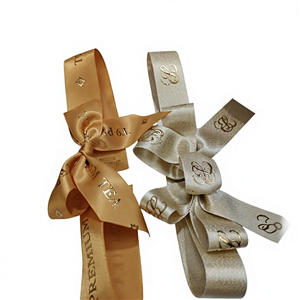
For the ultimate luxury look, we apply metallic foils (Gold, Silver, Rose Gold) using heat and pressure. Meisida’s proprietary foil-bonding process ensures that the metallic layer does not flake off, even when the ribbon is tied and untied multiple times.
7. QR-055 Quality Protocol: Testing for color fastness and stability
Precision is meaningless if the color fades or bleeds. Meisida’s QR-055 Quality Protocol is an internal set of standards that often exceeds international requirements.
Color Fastness to Washing (ISO 105-C06): We test the ribbon in high-temperature soap solutions to ensure no dye migration occurs, which is critical if the ribbon is used on white garments.
Rubbing Fastness (Crocking): We perform both "Dry Rub" and "Wet Rub" tests. Our goal is a Grade 4-5 rating, meaning the color will not transfer to a user's hands or other surfaces.
Water Resistance: The ribbon is submerged in deionized water for 24 hours to check for bleeding.
UV Stability (Light Fastness): Using a Xenon Arc Lamp, we simulate months of sun exposure in a matter of days. This is essential for ribbons used in window displays or outdoor events.
8. Trust & Certifications: BSCI, OEKO-TEX, FSC, GRS
In the modern supply chain, trust must be verified. Meisida’s commitment to quality and ethics is backed by the world's most rigorous certifications:
BSCI (Business Social Compliance Initiative): Ensures that our ribbons are produced in a factory that treats workers fairly and provides a safe environment.
OEKO-TEX Standard 100: Guaranteed chemical safety for human health, making our ribbons safe even for baby products.
FSC (Forest Stewardship Council): For our paper-based packaging and certain cellulose fibers, ensuring responsible forestry.
GRS (Global Recycled Standard): We offer ribbons made from 100% Post-Consumer Recycled (PCR) polyester, allowing brands to achieve their sustainability goals without sacrificing color precision.
9. Conclusion: Partnering with a color authority
Color is the soul of a brand. It is the first thing a customer sees and the last thing they remember. At Meisida, we don't just sell ribbons; we provide Color Assurance. By combining the chemistry of high-temperature dyeing, the precision of Pantone matching, the rigor of Light Box testing, and the innovation of 3D printing, we ensure that your brand’s color is rendered with 99% accuracy, every single time.
When you choose Meisida, you are not just choosing a supplier; you are partnering with a color authority with 17 years of heritage and a future-forward commitment to quality and sustainability. Let us help you wrap your brand in the perfect shade of success.