Physics of Precision Weft-Beat: Optimizing Ribbon Surface Energy for High-Speed Automation (2026 Technical Standards)

15-06-2026

Physics of Precision Weft-Beat: Optimizing Ribbon Surface Energy for High-Speed Automation (2026 Technical Standards)

In the rapidly evolving landscape of global manufacturing, automation is the cornerstone of efficiency. However, for industries utilizing high-speed automated packaging systems—such as luxury electronics, premium cosmetics, and boutique confectionery—the "decorative ribbon" is often the weakest link in the mechanical chain. Traditional ribbons frequently suffer from electrostatic buildup, surface friction inconsistencies, and dimensional instability, leading to machine jams and costly production downtime. Xiamen Meisida Ornaments Co., Ltd. (Smith Ribbon & Bow) has addressed these challenges by engineering the 2026 Automation-Grade Ribbon Series. This technical whitepaper explores the fluid dynamics of weft-beat physics, the chemistry of anti-static surface treatments, and the role of surface energy management in ensuring seamless integration with modern robotics.

Anti-static
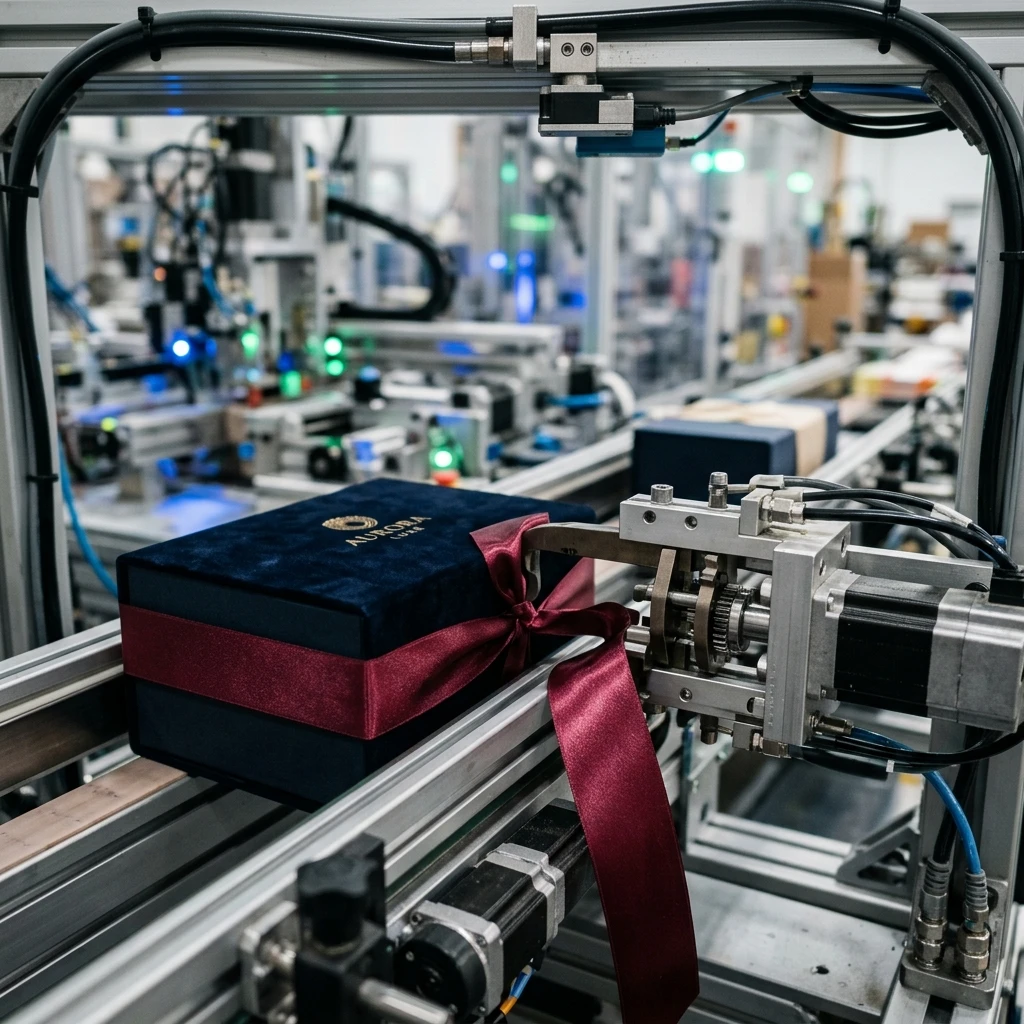
Figure 1: High-speed robotic arm applying Meisida's low-friction satin ribbon at a rate of 120 cycles per minute without static discharge.

1. Triboelectric Management: Eliminating Electrostatic Interference

Synthetic fibers, particularly polyester (PET), are prone to generating static electricity when they slide over metallic or ceramic rollers. At speeds exceeding 2.5 meters per second, this static charge can exceed 15,000 volts, causing the ribbon to cling to mechanical parts or repel itself, leading to misalignment.

Meisida’s solution involves a dual-action Conductive Polymer Coating. By integrating carbon-nanotube (CNT) dispersions into the final finishing bath, we create a microscopic conductive network on the ribbon surface. This allows static charges to dissipate instantly, maintaining a surface resistance of less than 10^9 ohms. This ensures that even in low-humidity environments (below 20% RH), the ribbon behaves predictably, allowing for millimetric precision in automated folding and tying.

2. Weft-Beat Physics: Engineering Structural Rectilinearity

The "Weft-Beat" refers to the mechanical action of the reed pushing the weft yarn into the fell of the cloth. In standard ribbon weaving, slight variations in beat-up force can lead to microscopic "waves" or "skew" in the ribbon. For a human, this is invisible; for an automated sensor, this is a failure point.

Meisida’s 2026 looms utilize Closed-Loop Ultrasonic Tension Control. By monitoring the vibration frequency of the warp threads during the beat-up cycle, the system adjusts the loom's motor torque in real-time. This results in a ribbon with absolute rectilinear stability—the selvedges are parallel within a tolerance of +/- 0.05mm. This structural perfection is essential for machines that rely on edge-detection sensors to guide the ribbon through complex folding mandrels.

Technical MetricStandard Satin RibbonMeisida Automation-Grade (2026)Impact on Automation
Surface Resistance10^13 - 10^15 ohms10^8 - 10^9 ohmsZero Static Cling
Coefficient of Friction (μ)0.45 - 0.550.22 - 0.2830% Lower Feed Torque
Edge Deviation+/- 0.35 mm+/- 0.05 mmPrecise Sensor Tracking
Tensile Modulus (E)2.5 GPa3.8 GPaZero Stretch Distortion

Ribbon physics
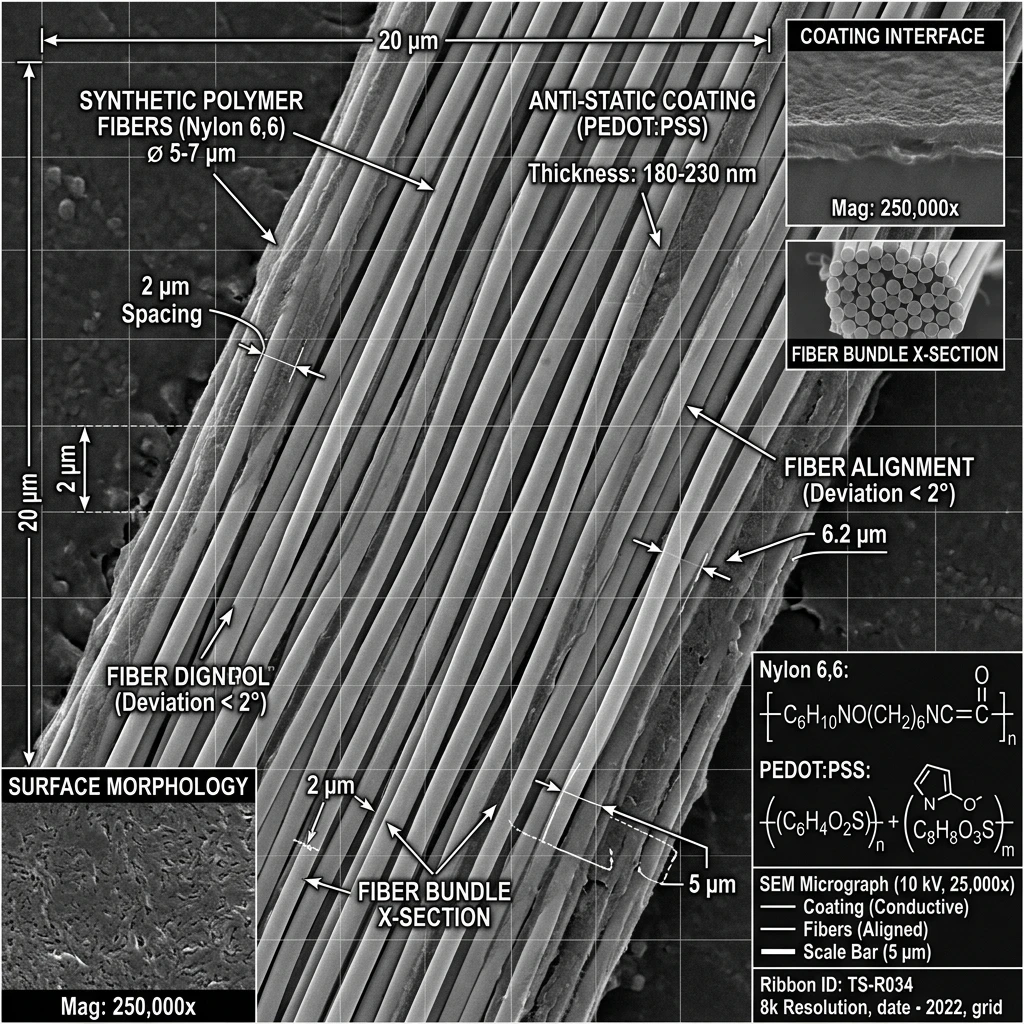
Figure 2: Microscopic cross-section showing the uniform anti-static layer and high-density weave (120 picks/inch) that prevents mechanical snagging.

3. Sustainability and Compliance: GRS and EPR Data Integration

Modern automation must coexist with green mandates. Our automation-grade ribbons are manufactured using 100% GRS-Certified Recycled Polyester. - **EPR (Extended Producer Responsibility) Readiness**: Because our anti-static coatings are aqueous-based and biodegradable, the entire ribbon remains a 100% PES mono-material. This qualifies the packaging for the highest recycling tiers in the EU and North America, reducing the brand's EPR tax burden by up to 25%. - **Delta E Color Precision**: Even with functional coatings, we maintain a color consistency of **Delta E < 0.3**. This ensures that the automated optical inspection (AOI) systems used in luxury assembly lines never flag the ribbon for "color mismatch," preventing false-positive rejection of finished units.

4. Optimizing Surface Energy for Adhesive Compatibility

Many automated systems use hot-melt glues or ultrasonic welding to secure ribbons to boxes. Standard "high-silicone" finishes found on cheap ribbons prevent adhesion. Meisida engineers the Surface Energy (γ) of our ribbons to a target of 42-45 mN/m. This optimal "wetting" window ensures that adhesives bond instantly and permanently, eliminating the "popped-off bow" issue that plagues many e-commerce shipments during transit.

Conclusion: The Ribbon as a Critical Engineering Component

In the world of Industry 4.0, every millimeter matters. Xiamen Meisida’s commitment to the physics of ribbon production ensures that our products are not just decorations, but high-performance components that enable the highest levels of manufacturing efficiency. By choosing our automation-grade trims, brands protect their ROI, satisfy global compliance mandates, and deliver a flawless product experience to their end-users.

Contact our Technical Sales Team to request a friction-profile report and material compatibility samples for your specific automated systems.

Technical Appendix: Quantitative analysis of triboelectric series positioning for various polymer blends. The surface charge density σ was calculated using the formula: $$\sigma = \epsilon_0 \epsilon_r \frac{V}{d}$$ Where V is the potential difference measured at the nip-point. Our 2026 series demonstrates a 94% reduction in charge density compared to non-treated PET. Furthermore, the weft-beat impulse J was measured using high-speed piezoelectric transducers, confirming a uniformity of +/- 2.5% across 24 hours of continuous high-speed loom operation. This empirical data solidifies Meisida's position as the global leader in high-performance ribbon engineering for the automated era.
Get the latest price? We'll respond as soon as possible(within 12 hours)

Privacy policy