How Do You Tie a Bow With Ribbon That Stays Tied — Step by Step for Gift Packaging
How Do You Tie a Bow With Ribbon That Stays Tied — Step by Step for Gift Packaging
Most ribbon bows that fall apart have one thing in common: the center knot was not tight enough before the loops were formed. Everything else in bow tying — loop size, tail length, shaping — depends on that one tight knot in the middle holding all of it together.
This guide covers three bow techniques (simple cross-wrap, classic 6-loop bow, and the wired bow method), why bows come undone, and which ribbon materials work best for each style.
Before You Start: Getting the Setup Right
Three setup decisions affect every bow you tie:
Ribbon width: Match to box size. 38mm is standard for most gift boxes (15–25cm). Narrower than 25mm produces small bows that look accidental; wider than 50mm is hard to control by hand.
Ribbon length: Cut before tying, not during. For a 6-loop bow, cut 2.5–2.8 meters. For a simple knot, 1.6–1.8 meters. Having enough length means you can pull the knot tight.
Surface: Tie on a flat surface, not in the air. Place the box flat, lay the ribbon across it, and tie from the box surface upward.
Method 1: Simple Cross-Wrap Knot
Best for: clean minimal packaging, small boxes, wrapping paper integration.
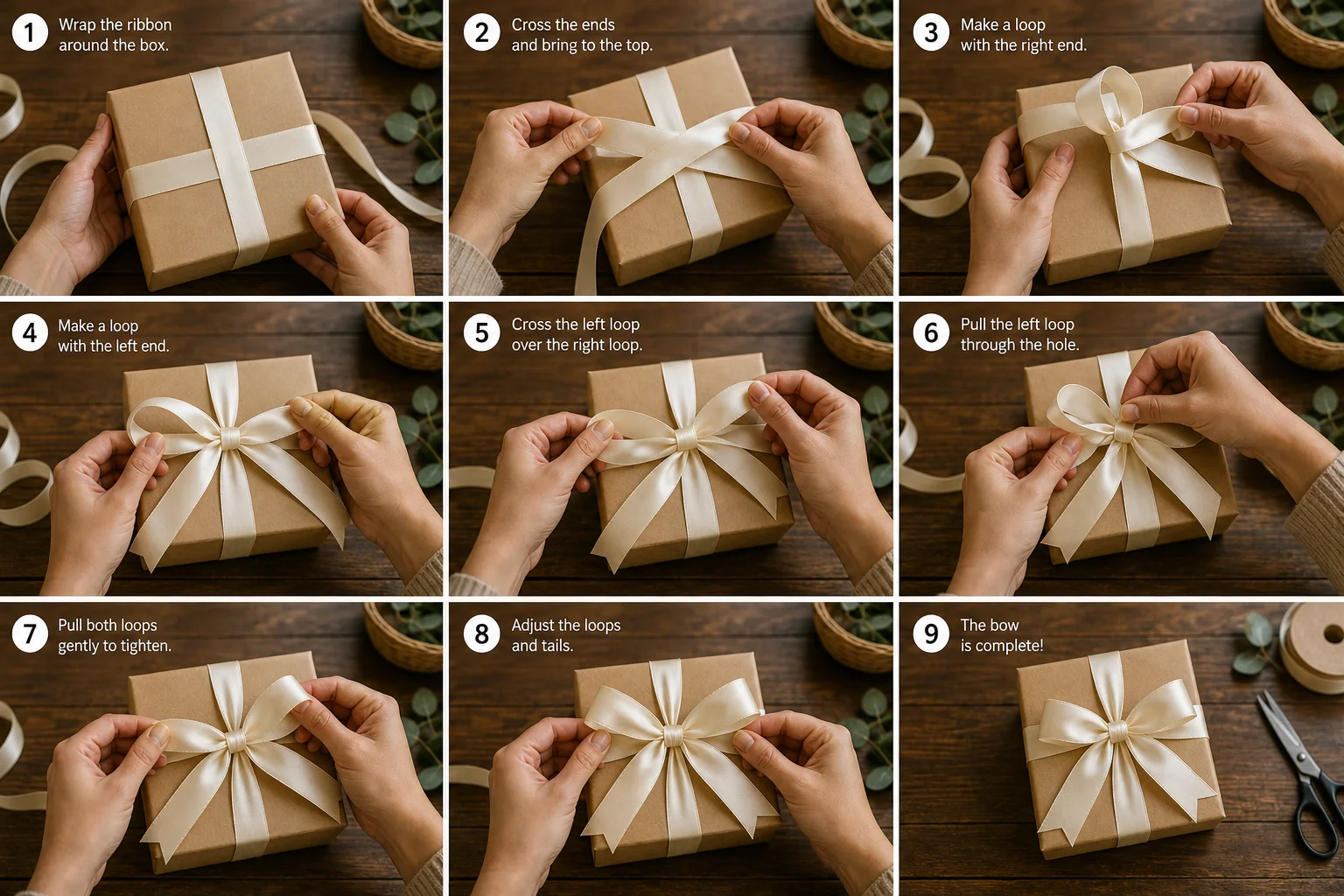
Lay the ribbon across the box lengthwise, leaving a 15–20cm tail at the front.
Wrap the ribbon around the back and under the box, then bring it up across the front at a 90-degree angle.
Wrap around the box widthwise, bringing both ends to the center top.
Cross the two ends, with the longer end over the shorter. Pull both ends firmly — this is the base knot. It must be tight.
Form two loops and tie them together as you would tie shoelaces.
Pull the loops outward to adjust symmetry. Trim the tails diagonally.
Common mistake: Not pulling the base knot tight enough before forming the loops. If the base knot slips when you pull on the loops, start over — there is no way to fix a loose base knot after the bow is formed.
Method 2: Classic 6-Loop Bow (Pre-Made, Then Attached)
Best for: gift boxes that need a full, symmetrical bow without cross-wrapping the box.
Cut approximately 2.5 meters of ribbon.
Hold ribbon between thumb and forefinger, leaving a 15cm tail hanging down.
Form a loop (6–8cm diameter) and pinch at center. Form a second loop on the opposite side.
Rotate 90 degrees, form two more loops. Repeat until you have 3 loops per side (6 total), keeping all loops the same size.
Tie a short ribbon or twist tie tightly around the pinched center, double-knotted.
Attach to box with double-sided tape or bow anchor sticker.
Pull each loop outward to create a dome shape.
Method 3: Wired Ribbon Bow
Best for: arrangements that need to hold shape through transit or display, decorative bows on wreaths, chair sashes, or pre-packaged gifts that will be shipped.
Unroll approximately 3 meters of wired ribbon.
Leave a 25cm tail. Fold the ribbon into a loop, pinching at the center. The wire in the edges will hold the loop shape — do not flatten it.
Continue forming loops alternating left and right, each approximately 8–10cm wide. For a full bow, make 4–5 loops per side.
Twist wire tightly around the pinched center. Wrap at least 3 times and twist the ends.
Fan the loops outward and bend each independently to create a dome shape.
Curl or trim the tails to finish.
Wired ribbon bows can be reshaped after tying — press loops back into shape if they flatten during transit. This is not possible with unwired ribbon.
Choosing the Right Ribbon Material by Bow Type
Bow technique and ribbon material interact directly. Using the wrong material for a bow type produces poor results regardless of technique.
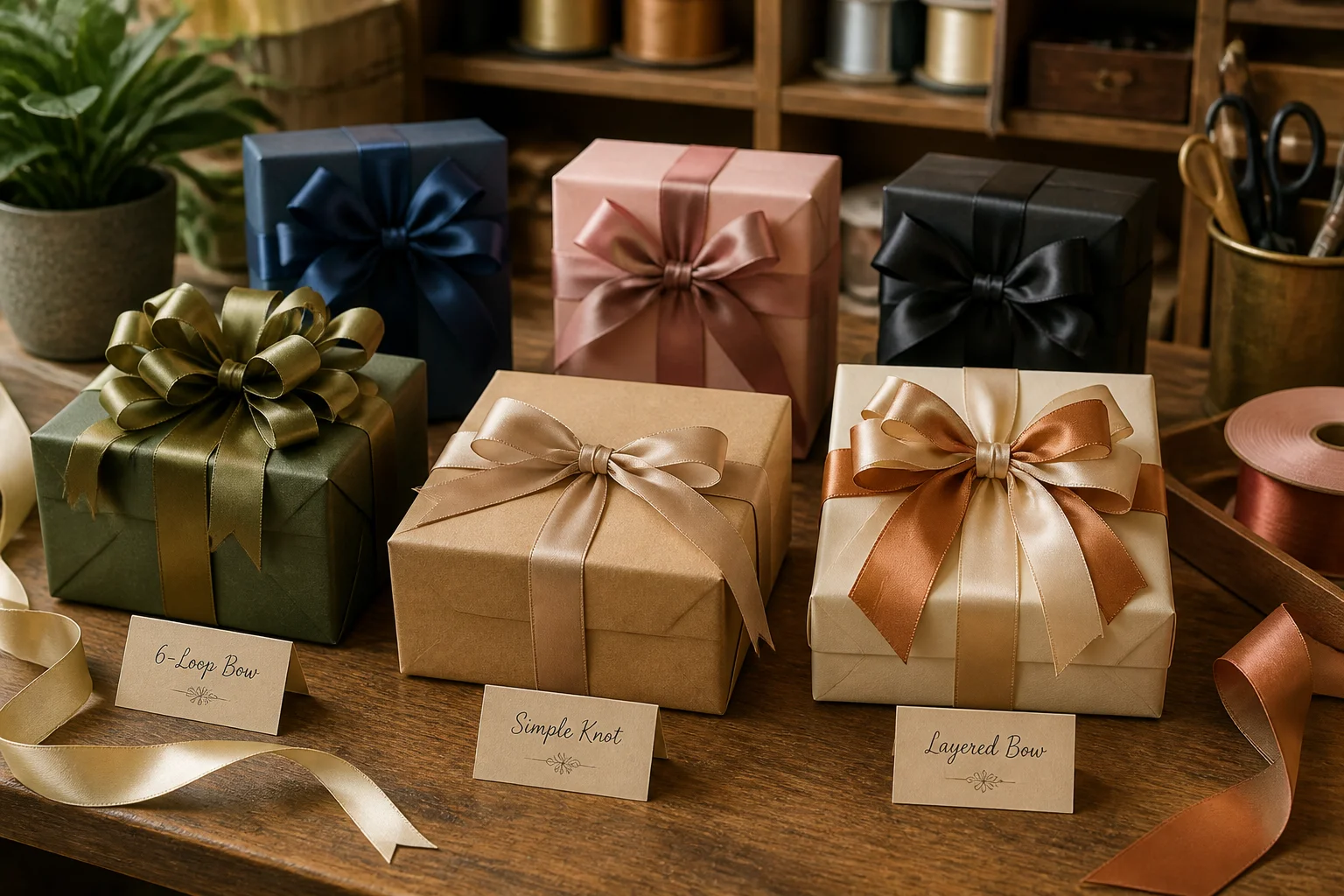
Simple cross-wrap knot: Works best with grosgrain (grips the knot) or wired satin (holds tails). Avoid unwired single-face satin for this technique — the slick back surface slides under the knot.
Classic 6-loop pre-made bow: Double-faced satin is the standard material. It looks the same on both sides (no visible back) and produces a consistently glossy bow. Width 38mm is easiest to control for uniform loop sizes.
Wired bow (full arrangement): Wired ribbon in 50–75mm width. Wider wired ribbon produces more dramatic loops and is standard for decorative displays, floral arrangements, and chair sashes.
Machine-tied bow: Use ribbon with tight width tolerance (±0.3mm). Polyester satin is the standard machine-tying material — consistent, smooth, machines reliably.
For bulk programs tied by multiple staff, grosgrain is the most operator-friendly: ribbed texture compensates for technique variation, producing more consistent results across a team than satin.
Tail Length and Cutting Technique
Three standard tail cuts:
Diagonal cut: Cut at a 45-degree angle for a clean professional edge. Standard for most gift boxes.
V-notch cut: Fold the tail in half lengthwise, cut diagonally from open edge toward fold. Produces a V-notch — best for wide ribbons (50mm+).
Heat seal: Straight cut finished with a lighter or heat tool to prevent fraying on polyester ribbon.
Tail length: 8–12cm is standard. Under 6cm looks unfinished; over 15cm looks disproportionate on a standard gift box.
Why Bows Come Undone: 4 Root Causes
Loose center knot: The most common cause. Fix: retie, pulling the first half-knot as tight as possible before forming loops.
Material too slippery: Double-faced satin has low surface friction. Fix: double-knot the center, or apply a small piece of double-sided tape beneath the knot.
Ribbon too short: Short tails mean no leverage to pull the knot tight. Fix: always cut more than you think you need.
Wrong material for transit: Unwired bows flatten under carton stacking. Fix: use wired ribbon for any bow applied before shipping.
Frequently Asked Questions
Why does my ribbon bow keep coming undone?
The center knot was not pulled tight enough before forming loops. For slippery satin ribbon, double-knot the center or use a small piece of double-sided tape under the knot.
How much ribbon do I need to tie a bow on a gift box?
Classic 6-loop bow: 2.2–2.8 meters. Simple cross-wrap knot: 1.4–1.8 meters. Large 8–10 loop bow: 3.5–4.5 meters. Always measure around the box first, then add the bow allowance.
What type of ribbon is easiest to tie into a bow?
Grosgrain is easiest — its ribbed texture grips the knot. Double-faced satin requires a tighter center knot. Wired ribbon is most forgiving because wire holds each loop's shape after forming.
How do you make ribbon bows fluffy and full?
Pull each loop outward from the center after tying. For wired ribbon, bend each loop slightly upward. More loops = more fullness: 4 loops is flat, 6 is balanced, 8–10 produces a full dome.
Does wired ribbon make bows easier to tie?
Yes. Wire sewn into the edges holds each loop's shape after forming, allows reshaping after tying, and keeps the bow intact through transit and handling. Recommended for any bow applied before shipping.