How to Prevent Ribbon from Fading After Long-Term Storage — Causes and Solutions
How to Prevent Ribbon from Fading After Long-Term Storage — Causes and Solutions
Ribbon fading is one of those problems buyers encounter when they pull inventory from storage for a new season and find that the navy blue they ordered has shifted toward a dusty grey-blue. It happens before the ribbon has even been used. The product is technically intact — the fabric structure is fine, the ribbon hasn't frayed — but the color no longer matches the season's packaging.
This is a storage problem, not a manufacturing defect in most cases. Understanding what causes it and how to prevent it is straightforward once you know what you're dealing with.
The Four Causes of Ribbon Fading in Storage
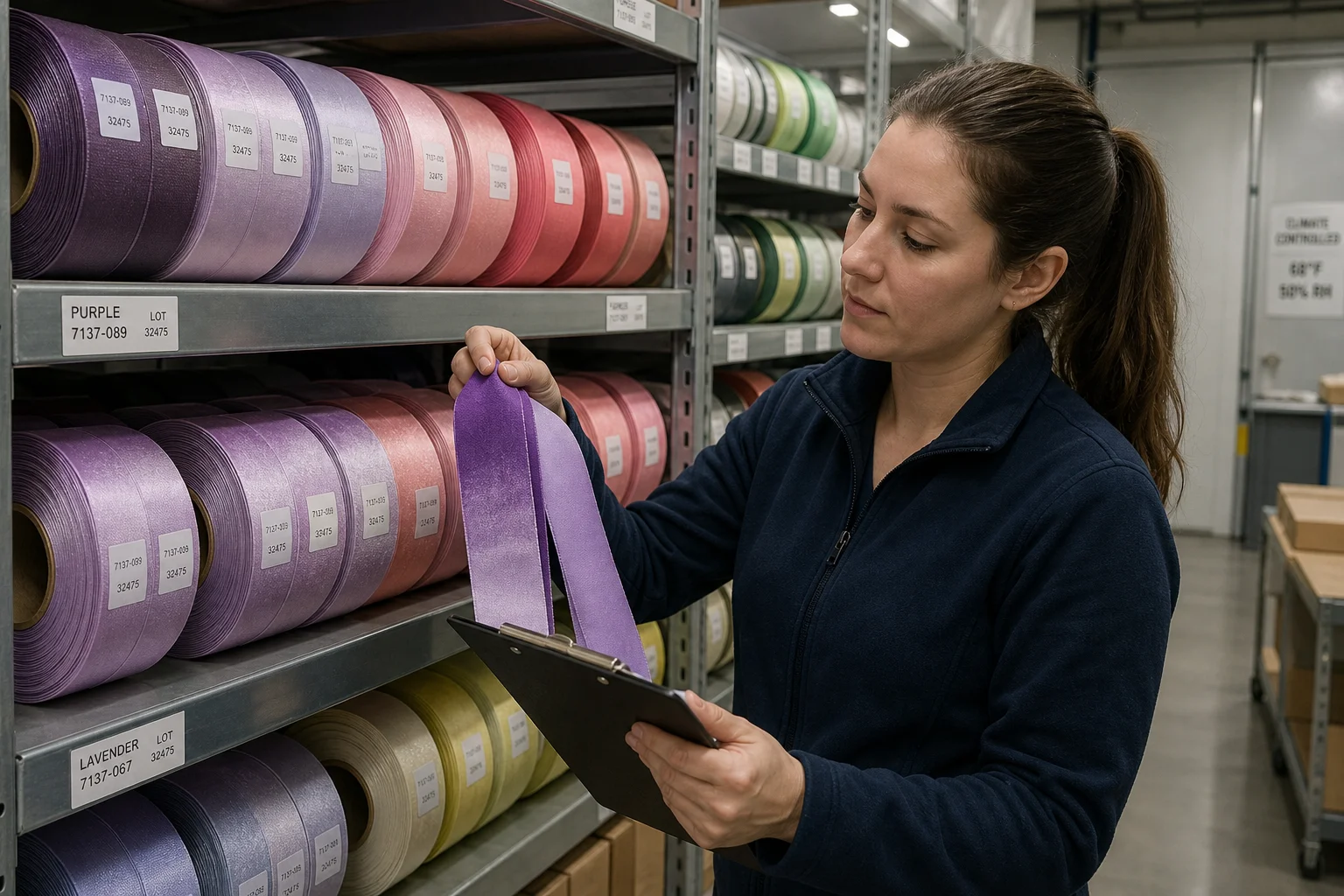
Ribbon dye fading in storage comes from four sources, and most real-world cases involve more than one:
UV and near-UV light exposure: The most common cause. Warehouse fluorescent lighting contains wavelengths that break down the chemical bonds in dye molecules over months of exposure. Deep colors (navy, burgundy, forest green, black) absorb more light and show the effect first. The outer layers of an open spool can fade noticeably while the inner layers stay true to the original color — which only makes the problem visible at the worst possible moment, after the ribbon is already in use.
High humidity: Polyester ribbon is dyed using disperse dyes, which sit on the fiber surface rather than chemically bonding to it (unlike the reactive dyes used for natural fibers). At humidity above 65–70%, moisture activates residual dye migration — excess dye that didn't fully fix during production begins to move within or off the fiber. This causes both fading of the original color and potential bleeding onto adjacent materials.
Temperature cycling: Warehouses that are heated in winter and unconditioned in summer see daily and seasonal temperature swings. Disperse dyes on polyester are thermally activated — repeated heating and cooling cycles gradually cause dye sublimation, where dye molecules convert from solid to gas and escape the fiber. This is the same principle used intentionally in sublimation printing, happening slowly and unintentionally in storage.
Reactive gases: Less commonly recognized but real in industrial environments. Nitrogen oxides from propane or gasoline forklifts, ozone from electrical equipment and UV sterilization systems, and hydrogen sulfide from certain chemical storage can all react with dye molecules. This is most likely to affect ribbon stored in shared warehouses with diverse inventory.
Colorfastness by Fabric Type: What to Expect
Not all ribbon fades at the same rate. Material type affects fade resistance in predictable ways:
Polyester satin and grosgrain: Most UV-resistant of the common ribbon types. Polyester's ester bonds are relatively photostable. Standard polyester ribbon, properly stored, holds color well for 18–24 months.
Nylon ribbon: Noticeably less UV-stable than polyester. Nylon's amide bonds are more photoreactive and degrade faster under both UV and visible light. For long-term storage, nylon ribbon should be prioritized for sealed packaging.
Organza: The open weave structure of organza exposes more fiber surface area per unit of ribbon, accelerating light and humidity effects. Organza is best kept in sealed packaging even for short-term storage.
Velvet: The raised pile means more fiber surface area per unit of ribbon, similar to organza. Additionally, velvet pile can trap humidity and particulates that accelerate degradation. Velvet ribbon requires more careful storage than woven flat ribbon.
Practical Storage Specifications
These are the storage conditions that produce the longest color retention for standard polyester ribbon:
Temperature: 15–25°C (59–77°F). Above 30°C accelerates dye sublimation and moisture effects. Below 10°C can cause condensation when warm air is introduced, leading to moisture damage.
Relative humidity: 45–60%. Above 65% activates dye migration. Below 35% increases static charge, attracting dust to the pile surface (particularly for velvet).
Light: No direct sunlight, and preferably limited fluorescent light exposure. For high-value inventory, UV-filtering sleeves on fluorescent tubes ($2–5 per tube) substantially extend color life at low cost.
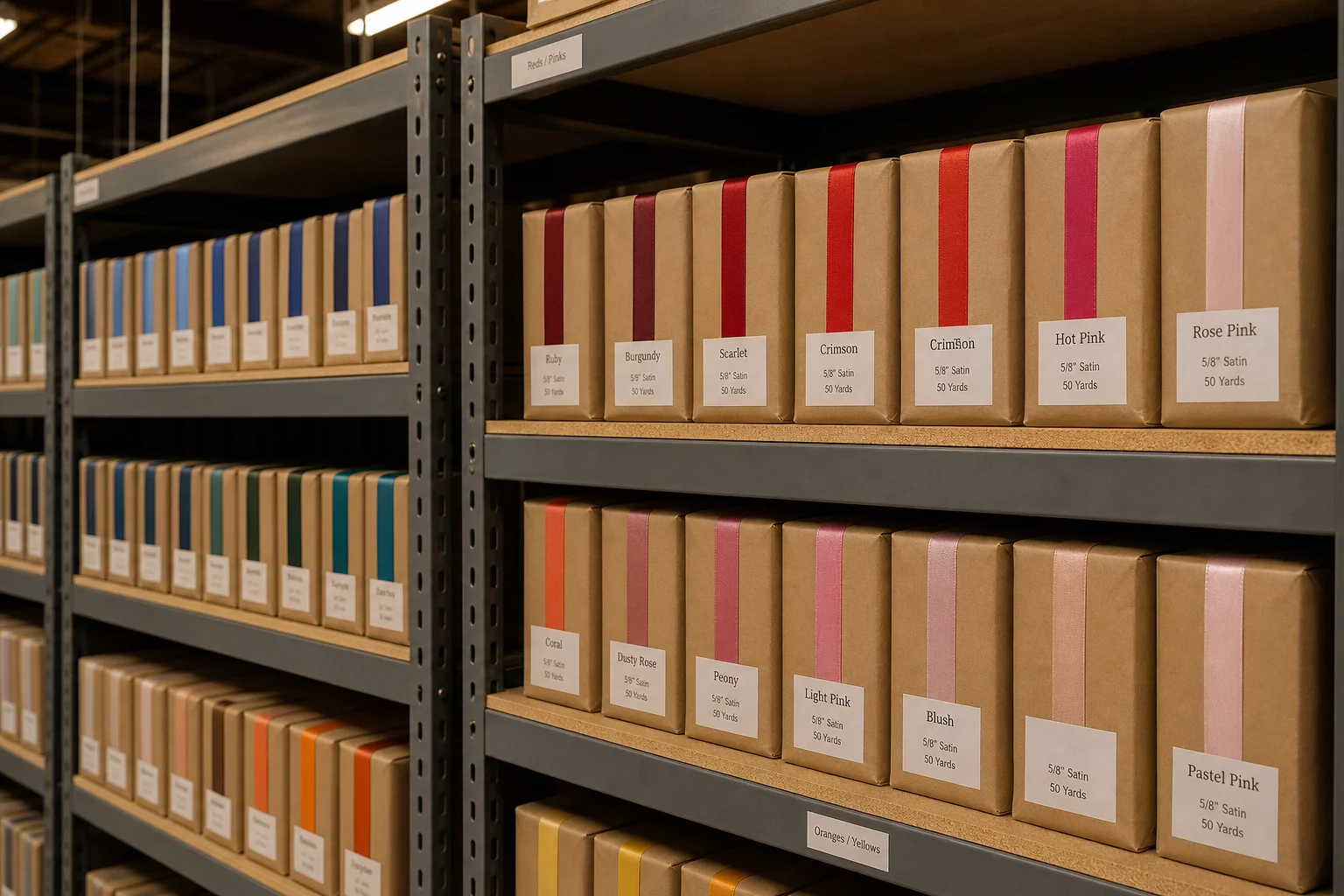
Packaging: Individual polybags sealed with one silica gel desiccant sachet (5–10g per spool) is the most practical protection for standard storage. Reseal after each use. For archival storage over 12 months, sealed kraft paper wrapping inside a closed cardboard box with multiple desiccant packets provides the best protection.
Air circulation: Moderate ventilation is better than stagnant air for preventing gas accumulation, but avoid direct airflow over stored ribbon (which accelerates moisture cycling).
Frequently Asked Questions
Why does ribbon fade during storage even when not exposed to sunlight?
Fluorescent warehouse lighting contains UV wavelengths that degrade dye molecules over months. Other causes: humidity above 70% (activating dye migration), temperature cycling (causing dye sublimation), and reactive gases in industrial storage environments. Deep colors fade fastest.
How long can ribbon be stored before fading becomes noticeable?
Under ideal conditions (15–25°C, 45–60% RH, sealed packaging, no UV), polyester ribbon holds color for 18–24 months. Under poor conditions (open shelving, fluorescent light, high humidity), deep colors can show visible fading in 3–4 months.
What packaging protects ribbon from fading during storage?
Most effective: sealed polybag with silica gel desiccant (blocks light and moisture). Next: kraft paper wrap (blocks visible light). Cardboard box (blocks all light but allows humidity equilibration). Least effective: open shelf storage — not recommended beyond 60 days.
Which ribbon colors are most vulnerable to fading in storage?
Deep saturated colors — navy, burgundy, forest green, black — are most susceptible due to higher dye load and greater light absorption. Organza and nylon ribbon fade faster than polyester satin due to exposed fiber surface area and less photostable polymer chemistry.
How should a buyer specify colorfastness requirements when ordering ribbon?
Specify ISO 105-B02 light fastness grade at order time: Grade 4 is standard commercial; Grade 5 for retail display or storage over 12 months. Request batch-specific test reports rather than generic factory certifications.