How Do I Find a Reliable Custom Ribbon Supplier for My Packaging Business?
How Do I Find a Reliable Custom Ribbon Supplier for My Packaging Business?
Finding a reliable custom ribbon supplier requires more than a quick platform search and price comparison. Wholesale ribbon procurement involves manufacturer verification, minimum order structures, sample evaluation, and certification requirements — all before a single meter ships. Buyers who skip systematic verification typically discover the gaps only after a failed production run or a missed seasonal launch. This guide walks through the full supplier evaluation process from discovery to first-order approval.
Define Your Ribbon Specification Before Searching
The most common sourcing mistake is beginning supplier outreach without a written specification. When buyers approach suppliers with only a vague description — "custom printed ribbon, maybe 25mm, something that looks premium" — they receive quotations that cannot be compared and cannot hold a supplier accountable during production. A usable specification includes ribbon type (satin, grosgrain, velvet, organza, or jacquard woven), width in millimeters, fiber content, Pantone color references, printing method, and the certifications your end customers require.
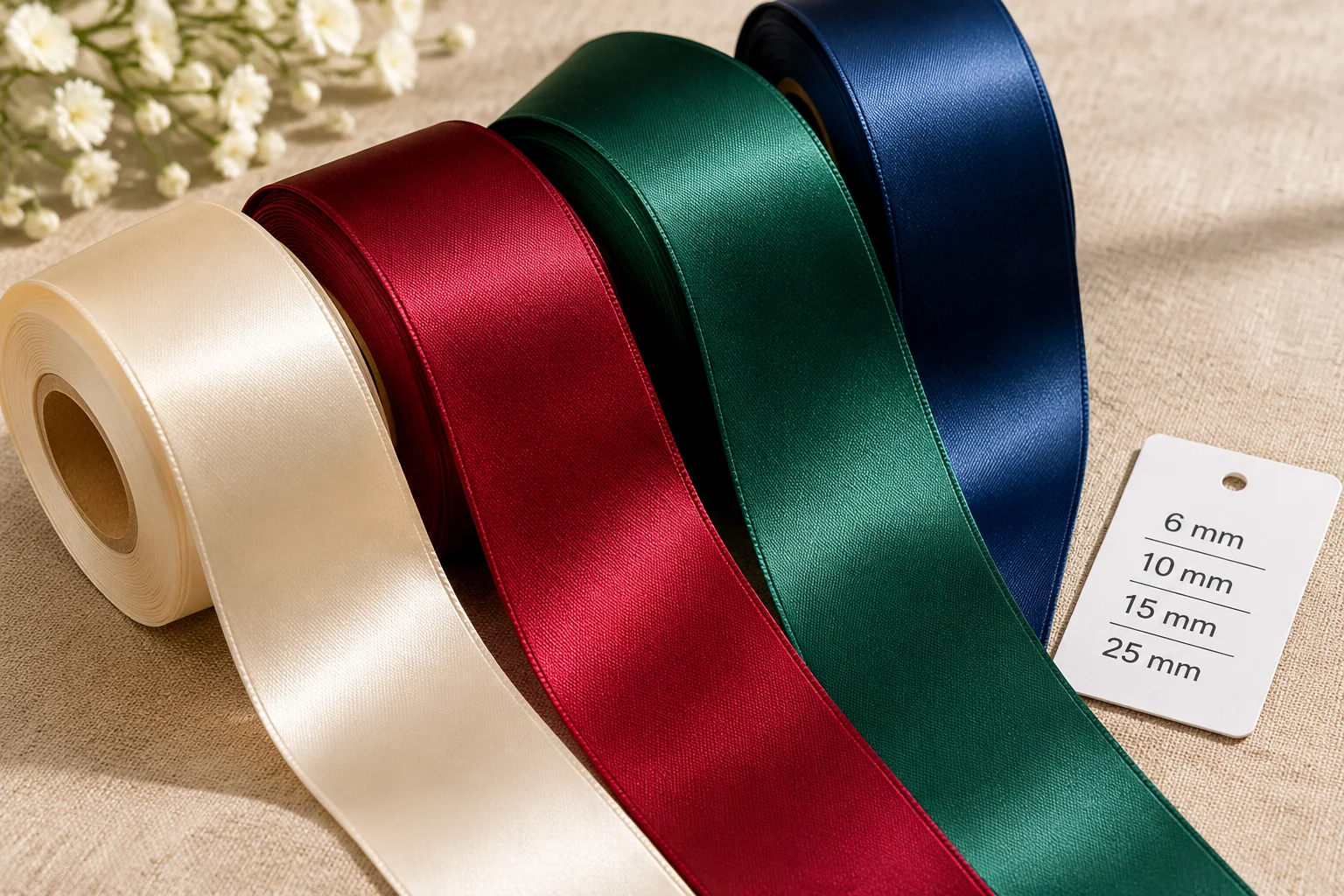
Width deserves attention. Satin ribbon is typically available from 6mm to 100mm: 6, 10, 15, 20, 25, 38, 50, and 75mm are the most commonly stocked sizes. Custom widths outside these increments require a dedicated loom setup and add cost and lead time. Confirm the exact width before committing to a supplier shortlist to prevent design revisions mid-sourcing.
Factory vs. Trading Company: What the Difference Means for Your Program
Ribbon suppliers on B2B platforms include genuine manufacturers, trading companies sourcing from multiple mills, and hybrid operations. Each model has real implications for price, customization capability, and problem resolution.
A ribbon factory owns production equipment — looms, dyeing vats, printing lines — and can make specification changes through its own production management. Lead times are tighter and there is one decision-maker for color, construction, and quality questions. Trading companies aggregate SKUs from multiple manufacturers, offer broader product catalogs, and can consolidate shipments from several factories into one invoice. The trade-off is an additional margin layer and reduced visibility into actual production conditions.
Verification: request the supplier's business license and check whether the registered entity type is manufacturing or trading. Ask for photographs of their production floor showing ribbon looms or printing equipment in active use. A factory will accommodate a video call walk-through; a trading company typically cannot.
Evaluate Sampling Protocols and Lead Times
Standard sampling timelines for satin and grosgrain ribbon run two to four weeks for existing color and construction combinations. Custom Pantone color matching adds two to four weeks for dye trials. Custom jacquard woven ribbon with new artwork requires four to six weeks for a first sample. When samples arrive, test color fastness by washing a length in 30-degree Celsius water, pull the ribbon under tension to check for yarn slippage, and crease printed ribbon sharply to examine the print layer for adhesion failure. Document every evaluation with photographs — this is your only objective reference if production diverges from the approved sample.

MOQ Structures, Pricing, and Certifications
Per-design MOQ for custom heat-transfer printed ribbon typically runs 200 to 500 meters. For custom jacquard woven ribbon, per-design minimums are 500 to 1,000 meters because each design requires its own loom program. For stock ribbon, most factories offer starting quantities of 100 to 300 meters per color and width combination.
At 500 to 1,000 meters for 25mm printed satin ribbon, expect USD 0.10 to 0.18 per meter with a setup fee of USD 80 to 200 per design, usually credited against the first order. For custom jacquard at the same quantity range, prices run USD 0.25 to 0.45 depending on design complexity.
OEKO-TEX Standard 100 certifies the finished ribbon against harmful substances including formaldehyde, azo colorants, and heavy metals — broadly useful for programs targeting European and North American retail markets. GRS (Global Recycled Standard) applies to ribbon made from recycled PET yarn and verifies recycled content percentage through chain-of-custody documentation covering the finished ribbon manufacturer, not only the yarn supplier.
Frequently Asked Questions
How do I verify that a Chinese ribbon supplier is a legitimate factory rather than a reseller? Request the supplier's manufacturing business license and confirm the registered type is manufacturing rather than trading. Ask for a live video call walk-through showing ribbon looms or printing equipment in active use. Legitimate factories accommodate this within two to five business days. Third-party factory audit reports from Bureau Veritas or SGS provide independent verification at roughly USD 300 to 600.
Can I order ribbon samples before committing to a minimum order quantity? Yes. Most established ribbon factories offer pre-production samples at USD 50 to 200, credited against the first production order. For stock ribbon in existing colors, some suppliers provide samples for the cost of shipping only. Never commit to a production order without an approved sample, regardless of time pressure or supplier incentives.
What payment terms should I expect when placing my first order with a new supplier? Standard terms for first-time buyers are 30 to 50 percent deposit before production begins, with the balance payable before shipment. For orders below USD 2,000, some suppliers require 100 percent prepayment. Payment methods offering buyer protection — Alibaba Trade Assurance or letter of credit — are preferable on first orders with unaudited suppliers.
What is a reasonable price range for custom printed satin ribbon at small wholesale quantities? For 25mm-wide heat-transfer printed satin ribbon at 500 to 1,000 meters per design, expect USD 0.10 to 0.18 per meter from Chinese factories. For custom jacquard at the same quantity range, prices run USD 0.25 to 0.45 per meter, with loom setup fees of USD 100 to 300 per design.
How do I protect myself if a production order does not match the approved sample? Photograph the approved sample alongside a measurement reference and your Pantone color chip before confirming production. Issue a written production order referencing the approved sample with stated tolerances: color Delta E less than 1.5, width variation less than 0.5mm, print adhesion pass on a crease test. On arrival, inspect at least 10 percent of units. For defect rates above 2 to 3 percent, requesting replacement of defective units or a proportional credit is commercially standard.