What Is the Minimum Order Quantity for Custom Ribbon — And How to Negotiate MOQ With Suppliers
What Is the Minimum Order Quantity for Custom Ribbon — And How to Negotiate MOQ With Suppliers
MOQ is one of the first numbers buyers encounter when sourcing custom ribbon, and one of the most misunderstood. A supplier quotes 500 meters minimum, but the buyer only needs 200. What happens next usually determines whether the buyer finds a good supplier or gets stuck in a cycle of samples that never lead anywhere.
This guide explains where ribbon MOQs come from, what ranges to expect by supplier type and customization level, and which negotiation approaches actually work — versus the ones that waste everyone's time.
Why MOQs Exist: The Production Economics Behind the Number
Ribbon MOQs are not arbitrary. They reflect specific production cost thresholds:
Loom setup time: Changing a loom from one color or specification to another takes 2–4 hours of technician time. On a machine producing 200 meters per hour, a 2-hour setup needs at least 200 meters of production just to break even on the setup cost at a standard labor rate. The MOQ is the run length where setup cost becomes an acceptable fraction of total production cost.
Dye batch minimums: Custom color dyeing requires a minimum dye bath volume to achieve consistent, reproducible results. Below this volume, color consistency between different dye batches of the same order cannot be guaranteed. Typical minimum dye batch: 150–300 meters depending on fiber type and color depth.
Quality control sampling: Width measurement, color comparison, and edge inspection require a minimum run to catch drift before it affects the whole batch. Short runs have a higher per-meter QC cost.
Understanding this helps buyers frame MOQ negotiations productively: rather than "can you lower the minimum?", the question becomes "how can we make a smaller run economically viable for the factory?"
Typical MOQ Ranges by Supplier Type and Customization Level
MOQ varies significantly by what you are customizing and who you are buying from:
Custom-color ribbon (dye-match to Pantone or physical sample):
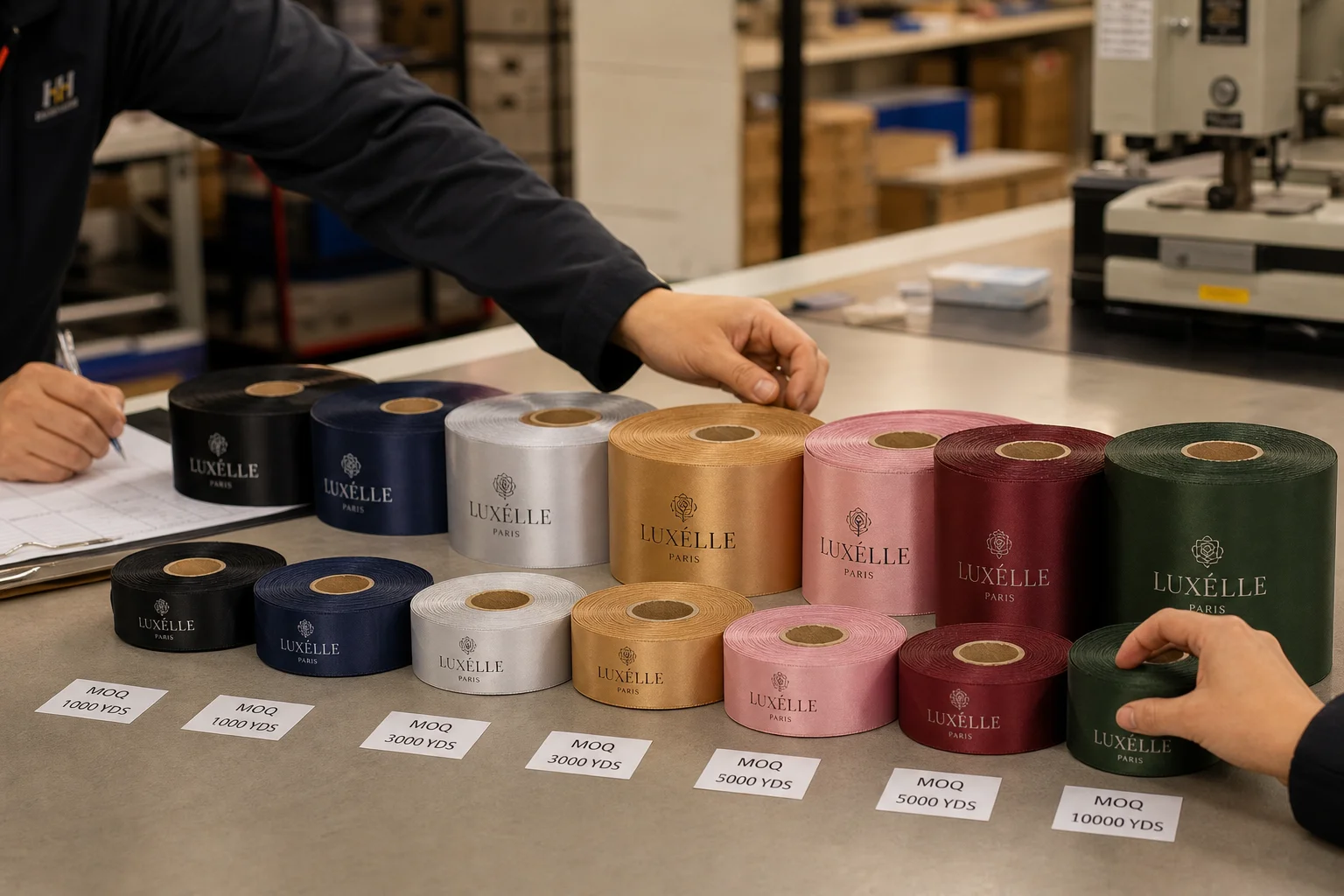
Direct factory, standard widths (25–50mm): 300–500 meters per color
Direct factory, wide widths (75–150mm): 500–1,000 meters per color
Trading company: 100–300 meters per color (often sourced from factory at higher minimums, with margin added)
Custom-print ribbon (logo or pattern printed on ribbon):
Screen printing: 500–2,000 meters per design, with setup fee ($80–200 per screen)
Digital/heat-transfer printing: 200–500 meters per design, higher per-meter cost
Woven jacquard (pattern woven into ribbon): 1,000–3,000 meters per design, high setup cost
Standard stock colors (no custom dye):
Direct factory: often no stated MOQ, practical minimum of 50–100 meters per color
Distributor/trading company: no MOQ, available by the roll
How to Negotiate Lower MOQ: What Actually Works
Three approaches consistently succeed; two common approaches consistently fail.
What works:
Pay the setup fee separately: Most factories bury color development cost in the per-meter price, which forces a higher MOQ to amortize it. Offering to pay the setup fee (typically $50–150 for standard color development) as a separate line item often reduces the MOQ by 30–50% because the factory's per-meter cost is now viable at lower volumes.
Combine SKUs: If you need four colors of 38mm ribbon, order them as a single specification run of 1,200 meters (300 per color) rather than four separate 300-meter orders. The factory treats this as one production run, and the combined volume meets or exceeds their minimum for the setup cost to work.
Commit to a reorder within 12 months: Factories amortize setup cost across expected lifetime volume. A written (or email) commitment to reorder within a specified period reduces the first-order MOQ because the factory can spread setup cost across the anticipated total run.
What doesn't work:
"We're a small company, can you make an exception?" Factories hear this constantly. It doesn't change the production economics.
Asking for samples to test "before committing to a larger order." Factories provide samples because they expect an order to follow. If your actual need is 200 meters, say so — it reframes the conversation around what MOQ enables a viable order, rather than suggesting a larger order is coming when it isn't.
Comparing MOQ Across Suppliers: Total Cost at Your Volume
When comparing suppliers, the MOQ number alone is misleading. Evaluate total cost at your actual required quantity:
Supplier A: MOQ 500m at $0.18/m = $90 per 500m. If you need 300m, you must buy 500m = $90 total.
Supplier B: MOQ 300m at $0.23/m = $69 per 300m. For 300m, cost is $69.
Supplier A has a lower per-meter price but costs more if your volume falls below their MOQ. Always ask suppliers for the per-meter price at your exact quantity, not just at or above their stated MOQ.
Also clarify whether setup fees are included in the per-meter price or charged separately. A quoted per-meter price of $0.18 that includes a $100 setup fee amortized over 500 meters is actually $0.38/m for a 300-meter run — a significant difference from a supplier quoting $0.25/m with no setup fee.
Frequently Asked Questions
What is the typical minimum order quantity for custom ribbon?
Custom-color ribbon from a direct factory: 300–500 meters per color for standard widths. Custom-print ribbon: 500–2,000 meters depending on print method. Trading companies often show lower MOQs but source from factories with higher minimums.
Can I negotiate a lower MOQ for custom ribbon?
Yes. Pay setup fees separately to reduce per-meter cost at lower volumes. Combine multiple colors of the same specification into one run. Commit to a reorder within 12 months to spread setup cost across expected total volume.
Why do custom ribbon MOQs exist at all?
MOQs reflect loom setup time, dye batch minimums, and per-meter QC cost. They are the minimum run length at which production economics work for the factory. Below this threshold, the factory's cost per meter exceeds what the market will bear.
What is the difference between custom-color MOQ and custom-print MOQ?
Custom-color MOQ is typically lower (300–500m) because it uses existing weaving infrastructure. Custom-print MOQ is higher (500–2,000m) because it requires screen setup or digital print preparation on top of standard production.
How do I compare MOQ fairly across different ribbon suppliers?
Compare total cost at your actual required quantity, not MOQ alone. Ask for the per-meter price at your volume. Confirm whether setup fees are included or separate. A supplier with lower MOQ and higher per-meter price may cost less than one with higher MOQ and lower per-meter price, depending on your volume.