Custom Ribbon Guide - Nov 20
How to Plan a Bulk Custom Ribbon Order for Holiday Gift Packaging: A Buyer's Cost and ROI Guide
Every Q4, procurement teams across retail, food gifting, and corporate gifting face the same crunch: custom packaging materials need to be ordered months ahead, the holiday deadline is non-negotiable, and the cost per unit has to justify the premium over plain stock ribbon. Custom ribbon is one of the highest-ROI packaging details you can invest in — but only when you plan the order correctly from the start.
This guide walks through the full procurement cycle for bulk custom ribbon orders: how to calculate your volume needs, what drives unit cost, how to manage supplier lead times, and how to build a business case for branded packaging that holds up to finance team scrutiny.
Step 1: Calculating Your Total Ribbon Volume
Before approaching any supplier, you need a defensible volume number. A poorly estimated order either leaves you short in December or ties up cash in leftover inventory in January.
Start with your packaging forecast: how many units will you pack during the holiday season? For each SKU or box size, measure the ribbon requirement per package — most gift boxes require 60 to 120 cm of ribbon for a standard bow tie (accounting for wrap-around length plus bow loops). Add 10 to 15 percent waste factor for cutting, rejection, and machine feed.
Example calculation: 20,000 units to pack, 90 cm of ribbon per unit, base requirement of 18,000 meters, plus 12 percent waste factor (2,160 meters), equals a total order of 20,160 meters. Rounding to the nearest 500-meter production unit gives you a 20,500-meter order. This prevents the two most common procurement errors: running short mid-season or over-ordering and sitting on slow-moving inventory in January.
Step 2: Understanding What Drives Your Unit Cost
Custom ribbon pricing is straightforward once you understand the four main cost drivers: material base, print method, volume tier, and lead time urgency.
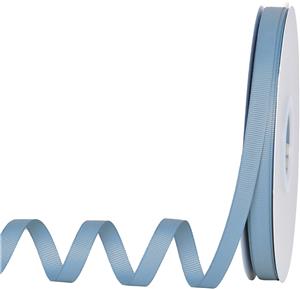
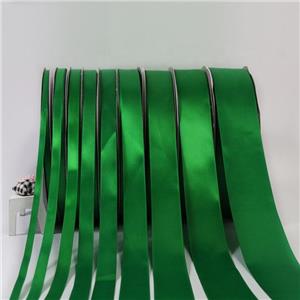
Material base cost: satin polyester ribbon is the most cost-effective starting point at $0.04 to $0.08 per meter for the plain substrate. Grosgrain runs $0.06 to $0.10 per meter. Velvet and organza substrates cost $0.12 to $0.25 per meter before any printing cost is added.
Print method premium: digital printing adds $0.04 to $0.08 per meter above the base substrate cost and handles gradients and photo-quality artwork. Screen printing adds $0.06 to $0.12 per meter but has a one-time setup charge of $30 to $60 per color. Woven jacquard adds a loom programming charge of $80 to $150 per design, then $0.10 to $0.20 per meter in weaving premium.
Volume tier discounts: most factories use tiered pricing with meaningful breaks at 500m, 1,000m, 3,000m, and 5,000m per SKU. Moving from a 500m order to 1,000m typically saves 8 to 15 percent per meter. If your volume puts you close to a tier threshold, model whether increasing the order slightly to reach the next break delivers net savings after accounting for carrying cost of additional inventory.
Lead time urgency: rush production under 10 business days adds 15 to 30 percent to the unit price. Air freight versus ocean freight can add $0.03 to $0.08 per meter equivalent in logistics cost. Building 12 to 14 weeks of lead time into your procurement calendar eliminates both premiums entirely.
Step 3: Supplier Selection for Bulk Holiday Orders
Not every ribbon supplier can handle a 20,000-meter holiday order on a fixed delivery timeline. When evaluating suppliers for large seasonal orders, focus on three operational capabilities: production capacity, QC process, and financial stability.
Production capacity: ask directly — what is the factory's daily output for custom printed satin ribbon in your required width? A supplier with 2,000 meters per day capacity needs 10 production days for your order. A supplier with 5,000 meters per day completes it in 4 days, giving you a larger buffer before your shipping window opens.
QC process: for a bulk order, expect the supplier to offer a pre-production sample, a mid-production inspection at approximately 30 to 40 percent completion, and a final inspection with a shipping report. Suppliers who cannot describe this process in specific terms are likely to deliver inconsistent quality across a large run.
Financial stability: standard payment terms for a well-established factory are 30 percent deposit at order confirmation and 70 percent balance against shipping documents. If a supplier insists on 100 percent upfront payment before production, that is a signal worth investigating — it may indicate working capital limitations that could affect production reliability.
Step 4: Managing the Production and Shipping Timeline
Holiday ribbon procurement follows a consistent timeline that experienced buyers protect fiercely.
Weeks 1 to 2: finalize artwork; send specs to shortlisted suppliers for quotes.
Week 3: compare landed cost; confirm order with 30 percent deposit.
Weeks 4 to 5: review pre-production sample against Pantone reference and specification.
Weeks 6 to 8: full production run; request mid-production inspection at 40 percent completion.
Week 9: final inspection; release 70 percent balance against shipping documents.
Weeks 10 to 14: ocean freight transit (25 to 35 days to North America; 20 to 28 days to Europe).
The critical path is sample approval in weeks 4 to 5. A rejected sample requiring redesign adds 1 to 2 weeks immediately. Buyers who invest in a thorough creative brief at week one — precise Pantone references, clean artwork files, explicit quality expectations — recover that time many times over.
What Smith Ribbon and Bow Offers for Holiday Bulk Orders
Our factory operates 48 Jacquard looms and 12 digital printing lines with a combined daily output exceeding 15,000 meters of finished ribbon. We service over 300 gift packaging and retail brands across North America, Europe, and Australia with seasonal orders running from 500 meters to 200,000 meters per season.
Standard lead times: 10 to 12 business days for digital printed orders, 15 to 18 business days for woven jacquard. Pre-production samples within 5 business days of artwork approval. Pricing confirmed within 24 to 48 hours for orders above 1,000 meters when a complete specification is provided. Payment terms: 30 percent deposit, 70 percent balance against bill of lading.
Contact our export team at smith@ribbon-bow.cn with your volume, width, material, design concept, and delivery requirement to receive a full quote package.